No Mugging Up, No Outdated Labs: Inside the Practical Learning System at Scaler School of Technology
- 2 days ago
- 8 min read
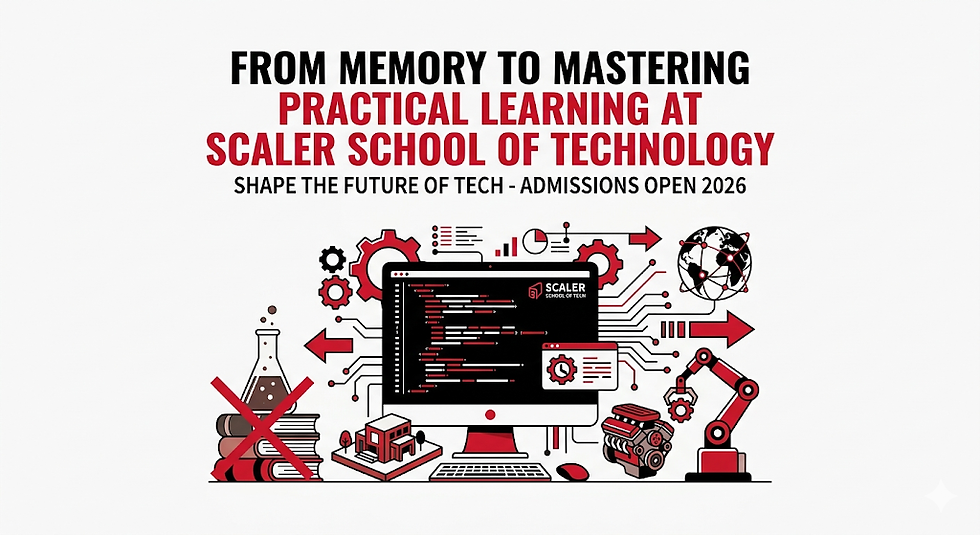
The traditional Indian tech education model is broken. Millions of engineers graduate each year with degrees from prestigious-looking brick-and-mortar universities, yet over 80% of them are deemed unemployable by the modern tech industry. Why? Because while tech changes at supersonic speeds, legacy college curriculums remain frozen in time, forcing students to rely on rote memorization to clear written semester exams.
If you are a student or an aspiring engineer entering the college admissions race in 2026, you face a distinct set of modern challenges: generative AI has redefined how code is written, cloud infrastructure has evolved past ancient setups, and companies no longer look at just a degree on a sheet of paper. They demand proof of practical skills from day one.
Enter a revolutionary paradigm shift located in India's Silicon Valley, Bengaluru: the practical learning system at Scaler School of Technology. This ecosystem completely strips away obsolete textbook teaching, unhelpful laboratory manuals, and high-stress viva exams that measure your memory rather than your logic. Instead, it places you directly into an intense, project-focused environment that simulates the operations of top-tier product tech engineering divisions.
Let's dive deep into how this program works, check the audited outcome metrics, and discover how you can fast-track your computer science career without getting trapped in the "mugging up" loop.
Before we explore the exact methodology, remember that early-stage admissions and scholarship evaluations are active for the current academic session. You can use the exclusive referral link https://scalerschooloftech.com/4ruflJ5 and enter the custom coupon code CS500 during your application checkout to secure a waiver on your registration processing fees.
1. The Anatomy of Failure: Why Traditional Computer Science Degrees Keep You Jobless
To understand why the practical learning system at Scaler School of Technology is causing a massive stir across the tech ecosystem, we must first look at the legacy architecture it is designed to replace.
Most undergraduate engineering departments operate on a system that dates back to the early 2000s. Students spend months copying handwritten code into physical journals, executing basic Turbo C++ or Java applets that have no market relevance today. The assessment model heavily rewards memorizing complex algorithms verbatim rather than understanding how to adapt them to real-world edge cases.
When these graduates enter companies like Amazon, Google, or high-growth tech startups, a common problem occurs: they have to spend their first 6 to 12 months completely unlearning obsolete concepts, trying to comprehend modern concepts like distributed system design, automated testing pipelines, and agentic workflows.
2. Real-World Engineering: The Practical Learning System at Scaler School of Technology Explained
At its core, the pedagogy at Scaler School of Technology (SST) functions like a living, breathing software team rather than a standard classroom. The curriculum is updated continuously by an advisory council of over 100 industry leaders who are actively building modern infrastructure.
The Learning-by-Building Philosophy
At SST, the distance between learning a concept and building a product with it is exactly zero. You do not wait until your final semester to work on a major project. You build real applications every single month. Instead of writing abstract code lines that exist only inside a command-line terminal, your assignments involve engineering micro-services, configuring databases, and optimizing frontend components.
[Learn Core Concept] ---> [Collaborative AI-Pair Programming] ---> [Deploy Real Product] ---> [ quarterly Peer Review]
An AI-Native Curriculum Built for 2026
You cannot learn modern software development using methods from a decade ago. Every lab and assignment at SST integrates an in-house, 24/7 AI pair-programming companion. Instead of banning generative tools, the faculty teaches you how to act as an architect: using AI to write structural boilerplate, while focusing your human cognitive load on systemic logic, edge-case optimization, and code validation.
You learn how to construct complex agentic systems using frameworks like LangChain, LangGraph, and CrewAI, preparing you for modern tech roles that did not exist three years ago.
3. The 4-Year Academic Lifecycle: From Baseline Coding to Global Scale
The curriculum is structured into four highly focused phases that move sequentially from absolute fundamentals to deep market specialization.
Year 1: Building Foundational Muscle
The journey starts with mastering pure algorithmic logic and structured data problem-solving using Java and Python. Rather than doing basic calculator programs, first-year students build functional apps like a mini version of Canva, automated weather advisers, or interactive AI-assisted games.
Year 2: Scalable Systems & Full-Stack Mastery
Students transition into system architecture, working across the MERN stack (MongoDB, Express.js, React, Node.js), writing deep relational schemas, and analyzing systemic trade-offs. This is also where initial industry-validated skill checks occur to clear you for real corporate projects.
Year 3: Deep Specialization Tracks
In the third year, you customize your engineering pathway based on your long-term career goals. You can pick between two cutting-edge domains:
Computer Science & Advanced AI: Focusing on fine-tuning large language models, building RAG (Retrieval-Augmented Generation) pipelines, and handling intense distributed system scaling.
AI & Business Engineering: Tailored for product managers and technical founders, combining advanced coding with product management strategy, growth hacking, and business design.
Year 4: 12-Month Industry Immersion
The entire final year is spent working full-time at a tech company as an elite apprentice intern. You get 12 continuous months of documented work history before you even collect your graduation certificate, removing the "no prior experience" barrier that stops millions of university graduates.
4. Scaler School of Technology vs. Traditional B.Tech Engineering Colleges
When you compare a standard engineering program with what is being done at SST, the differences in structure, execution, and outcomes become clear:
Evaluated Parameter | Traditional B.Tech Colleges | Practical Learning System at Scaler School of Technology |
Curriculum Updates | Usually updated once in 5-10 years; heavily bound by rigid academic university approval processes. | Updated dynamically every 6 months to match the actual hiring requirements of the tech sector. |
Faculty Profile | Academics who have spent decades inside universities, often with minimal hands-on industry experience. | Active software developers, technical architects, and tech leaders from companies like Meta, Google, and Amazon. |
Primary Assessment | Memory-heavy written exams, descriptive theory papers, and copying manual entries into journals. | Real-time evaluations on deployed products, robust code optimization checks, and monthly hackathons. |
Industry Exposure | A token 2-month summer project or winter project in the final year, often requiring zero real code deployment. | A mandatory 12-month full-time paid corporate internship embedded within the 4-year curriculum. |
AI Integration | Often restricted or banned in classrooms, leading to outdated, disconnected problem-solving. | Fully embedded through specialized AI labs, LLM fine-tuning tracks, and everyday AI-assisted workflows. |
If you want to bypass the legacy system entirely and get started with this modern engineering model, you can access the registration form directly via https://scalerschooloftech.com/4ruflJ5. Don't forget to apply the exclusive code CS500 to get an instant fee waiver on your profile assessment.
5. Scaler Innovation Labs: Where Undergraduates Build Global Tech Startups
The physical infrastructure at the Bengaluru campus features modern workspace clusters known as Scaler Innovation Labs (SIL). This isn't a dark computer lab where half the monitors don't turn on; it's a high-performance incubator environment open 24/7.
Students leverage these spaces to build real tech companies that pull in recurring market revenue while still in school. Let's look at a few examples of student-led projects currently scaling inside the ecosystem:
Xspecies AI: A highly ambitious deep-tech startup incubated right inside the SST campus lab, currently working on building a custom humanoid robot under the technical guidance of seasoned engineers from Stanford and Ola Electric.
Trackaroo: A comprehensive auto-dealership management system built entirely by an undergraduate student, Pratyush. The platform currently tracks over ₹25 Lakhs in software revenue, servicing major automotive dealership ecosystems like Tata and Ather Energy.
NeoSapiens: An AI-native hardware-wearable venture that successfully cleared highly competitive entry pools and secured institutional investment interest on national platforms like Shark Tank India.
Percevia: An assistive technology project that beat out over 20,000 national entries to win the prestigious Samsung Solve for Tomorrow award, bringing home a ₹25 Lakh developmental grant to build smart AI eyewear for visually impaired individuals.
6. The Audited Outcome Metrics: Unprecedented Internships and Placements
In the tech industry, intent means nothing if the placement data doesn’t support it. Because Scaler School of Technology was built from the ground up by the founders of Scaler Academy—an upskilling platform with a network of over 1,200 global hiring partners—the institutional connections run exceptionally deep.
The maiden internship placement report for the founding undergraduate batch tells a remarkable story, especially considering these are second-year students competing against final-year applicants nationwide. The performance numbers have been independently audited by B2K Analytics, applying the same rigorous verification standards used by top-tier Indian business schools.
Key Internship Data at a Glance
96.3% Verified Placement Rate: Nearly the entire eligible class locked down corporate internship offers before finishing their second year.
₹2 Lakhs per Month Highest Stipend: An incredible 6-figure monthly paycheck for an undergraduate sophomore intern position.
Top Tier Financial Performance: The top 10% of the batch pulled an average monthly stipend of ₹92,000, while the top 25% maintained an average above ₹50,000.
Global Structural Reach: 12 international internship offers were successfully converted, sending students to work in tech hubs across Singapore, Germany, and Indonesia.
Pre-Placement Offers (PPOs): Early performance evaluations from corporate partners have already resulted in full-time pre-placement job offers ranging from 30 LPA to 46 LPA.
Students are interning at premium consumer tech and corporate platforms including Apple Developer Academy, Zomato, Swiggy, Tata 1mg, and high-frequency trading firms. The school's practical training platform has effectively allowed undergraduate students to out-compete candidates from top-tier national engineering institutes.
7. The Degree Pathway: Solving the Credentials Dilemma
One question that naturally arises for parents and students tracking the Indian tech space is: What about an official degree?
Scaler understands that while tech companies focus entirely on code capability, an official academic credential is still necessary to pass basic administrative screeners, clear civil service entry tests like the UPSC, or secure student visas for postgraduate studies (MS/MBA) abroad.
To solve this completely, Scaler has decoupled the skill acquisition tracker from the academic credential. While you spend your days fully immersed in the practical coding framework on campus, you register for and complete a fully recognized, UGC-approved undergraduate degree in parallel.
Students can independently choose from top-tier academic pathways:
B.Sc (Hons) in Data Science and Applications directly from IIT Madras.
B.Sc (Hons) in Computer Science directly from BITS Pilani.
This combination gives you the ultimate competitive edge: a highly prestigious, recognized degree from India's elite educational tier, combined with the comprehensive, market-tested software development skills gained at Scaler.
8. Frequently Asked Questions (FAQs)
Q1: Is the practical learning system at Scaler School of Technology valid for students without an initial coding background?
Yes, absolutely. The first phase of the curriculum is intentionally designed assuming zero prior background in computer science. Nearly 50% of the founding batch that achieved the recent 96.3% internship conversion rate came from diverse high school backgrounds without prior coding knowledge. The program builds your logical muscle from scratch before scaling into advanced systems.
Q2: What degree do I get if I enroll at Scaler School of Technology?
SST grants an intensive institutional Certification in Computer Science and AI. To ensure you have a fully recognized university credential, you can pursue an official, UGC-approved online Bachelor of Science (BS/B.Sc Hons) degree from prestigious partner institutions like IIT Madras or BITS Pilani in parallel. This setup gives you both elite academic credentials and real-world industrial skills.
Q3: What is the age limit and eligibility criteria to apply for the undergraduate programs?
To apply for the current 2026 intake, your age must be less than or equal to 20 years as of July 1, 2026. You must have scored a minimum of 60% in your Grade 12 board examinations with Mathematics as a core subject. The admission stream is fully inclusive and open to students coming from Science, Commerce, or Arts pathways, provided the core math criteria is met.
Q4: How can I apply for the entrance exam, and are there fee waivers?
Admissions are processed through the Scaler NSET (National Scholarship and Entrance Test). To kickstart your application, visit the portal via https://scalerschooloftech.com/4ruflJ5. Make sure to use the specific code CS500 at the payment window to bypass the default registration fees and lock in priority processing.
Step Into the Future of Tech Education
Getting stuck in an outdated system that forces you to memorize dry definitions off a whiteboard won't make you a software engineer. The modern tech landscape requires actual builders, problem solvers, and forward-thinking architects who know how to ship high-quality products.
The practical learning system at Scaler School of Technology offers a direct, fast-tracked route into the industry, combining intensive daily building with a 12-month deep immersion program and recognized degrees from India’s top institutions.
If you're ready to move past rote memorization and build something meaningful, start your application journey today.
Official Admissions & Registration Directory:
Official Application Portal: Click Here to Start Your SST Application
Exclusive Registration Fee Waiver Code: CS500 (Apply during application submission)
SST Official Brochure Access: Download Program Guide & Detailed Curriculum Matrix
Schedule a 1:1 Advisory Session: Connect with an Admissions Counselor in Bengaluru


Comments