US vs Iran Conflict: Is the World Heading Towards a Bigger Open War?
- May 4
- 4 min read
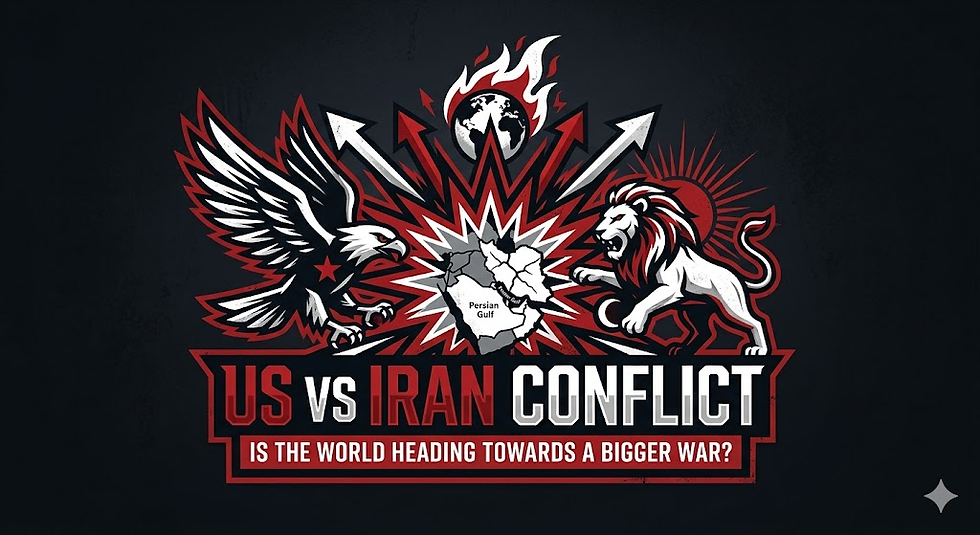
The headlines in May 2026 are dominated by a single, terrifying question: Is the current conflict between the United States and Iran the spark that ignites a third World War?
For decades, the tension between Washington and Tehran has been a slow-burning fuse. However, the events of early 2026—marked by "Operation Epic Fury," the assassination of high-ranking leaders, and a crippling global energy crisis—have transformed a regional rivalry into a high-stakes standoff that threatens the stability of the entire planet.
The Boiling Point: From Brinkmanship to Open War
The "shadow war" that defined much of the early 2020s ended abruptly on February 28, 2026. Following the collapse of nuclear negotiations in late 2025 and a massive internal crackdown by Iranian security forces, the United States and Israel launched a massive wave of airstrikes.
This was not just another "surgical strike." Code-named Operation Epic Fury, the campaign targeted over 900 sites, including Iran's nuclear infrastructure, air defenses, and leadership hubs. The most significant blow was the death of Supreme Leader Ali Khamenei.
The Retaliation: A Region Under Fire
Tehran’s response was immediate and multi-pronged. Within hours, thousands of drones and ballistic missiles were launched not just at Israel, but at U.S. military installations and allied Arab nations.
Targeting the Gulf: Up to 80% of Iran's projectiles were directed at the UAE, Kuwait, and Bahrain, hitting desalination plants and power grids.
The Chokepoint: Iran effectively closed the Strait of Hormuz, the world’s most vital oil artery, through which 20% of global oil flows.
The Global Fallout: Why This Matters to You
The conflict is no longer confined to the Middle East. If you’ve noticed a spike in your grocery bill or the price of a gallon of gas, you are feeling the ripples of this Open War.
1. The Energy Crisis of 2026
We are currently witnessing the largest oil supply disruption in history, surpassing even the 1970s energy crisis. Brent Crude surged past $120 per barrel in March, and while a temporary ceasefire has brought slight relief, the Strait of Hormuz remains a "trickle." For the average consumer, this means:
Gas Prices: U.S. national averages are pushing toward $5.00 per gallon.
Inflation: Higher fuel costs mean higher transport costs for everything from bread to electronics.
2. The Risk of Great Power Involvement
The most dangerous aspect of the US-Iran war is the potential for "Mission Creep." While the U.S. and Israel are the primary combatants, the involvement of other superpowers remains a looming threat:
China’s Role: As a major buyer of Iranian oil, China has been forced into the role of a mediator, but its deployment of advanced radar systems to Iran suggests a deeper strategic interest.
Russia’s Shadow: Distracted but opportunistic, Moscow has consistently used Middle Eastern instability to divert Western resources away from Eastern Europe.
The Current Status: A Fragile Truce
As of May 4, 2026, the world is holding its breath. A two-week ceasefire, brokered by Pakistan and nudged by China, began in April and has been extended indefinitely by President Trump. However, the situation is a "dual blockade." The U.S. Navy is blockading Iranian ports, while Iran continues to harass shipping in the Persian Gulf.
The "Nuclear" Deadlock:
Recent talks in Islamabad failed to reach a permanent deal. The U.S. demands "zero enrichment" and the removal of all nuclear material. Iran, now under a fractured but defiant leadership, insists on its right to civilian nuclear power.
FAQ: Frequently Asked Questions
Q: Has a "World War" officially started?
A: No. While the conflict involves multiple nations and has global economic impacts, it has not yet escalated into a direct conflict between the world’s major superpowers (the U.S., China, and Russia).
Q: Why did the U.S. strike Iran in February 2026?
A: The administration cited several reasons: preventing a nuclear breakout, stopping imminent threats to U.S. bases, and responding to human rights violations during internal Iranian protests.
Q: Is the Strait of Hormuz open?
A: It is partially open but highly restricted. Commercial shipping is moving at a fraction of its normal volume due to the threat of mines and naval blockades.
Q: Will gas prices go back down?
A: Not in the immediate future. Analysts suggest that until a permanent peace treaty is signed and the "dual blockade" is lifted, energy markets will remain volatile.
Others:
The geopolitical landscape is shifting faster than ever. Understanding these conflicts is the first step toward preparing for their economic and social impacts.
Conclusion:
The world is not yet in a "Total War," but we are closer than we have been in decades. The 2026 Iran War has proven that conventional military superiority cannot easily solve ideological and regional power struggles.
If diplomacy fails to turn this ceasefire into a lasting treaty, the risk of a "Round 4" could draw in global powers, turning a regional disaster into a global catastrophe. The path forward requires more than just military might; it requires a structural shift in how the West and the Middle East interact.


Comments