OpenDoor Fires Entire Indian Workforce: Why the Layoffs Are Sparking Global Debate About Remote Work and Outsourcing
- 11 hours ago
- 3 min read

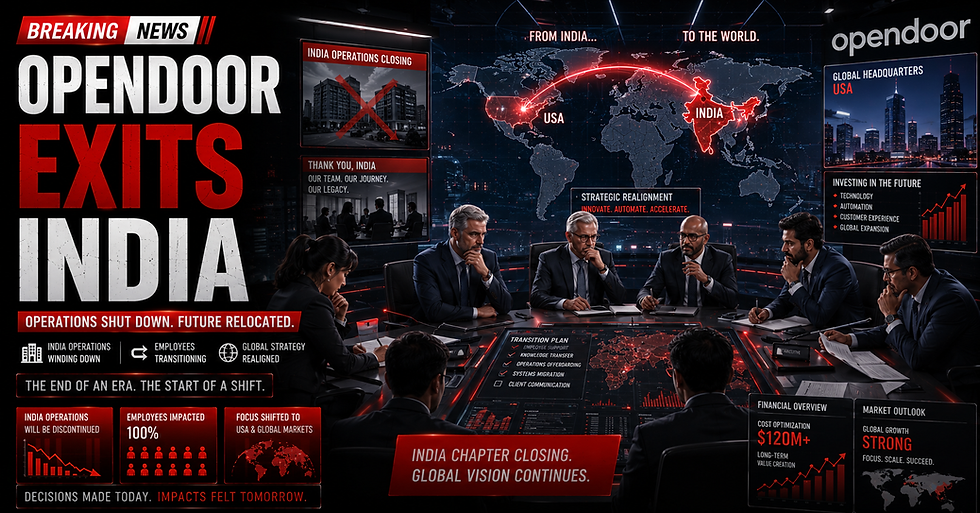
The phrase "OpenDoor Fires Entire Indian Workforce" quickly became a trending topic across social media, business publications, and professional networking platforms after reports emerged that the company had reportedly terminated its India-based workforce.
The move has triggered discussions about outsourcing, remote work, global hiring strategies, corporate restructuring, and the future of international employment.
While layoffs have become a recurring theme across the technology and business sectors in recent years, this particular development attracted attention because of the scale of the decision and the reasoning reportedly associated with it.
As professionals worldwide debate the implications, the incident raises important questions about how global companies are restructuring their operations in 2026.
OpenDoor Fires Entire Indian Workforce: What Happened?
According to reports, OpenDoor reportedly eliminated its India-based workforce as part of a broader organizational restructuring initiative.
The decision generated immediate reactions because India has long served as one of the world's most important talent hubs for technology, operations, customer support, and business services.
The reports indicated that company leadership believed a greater concentration of teams closer to customers could improve operational efficiency and customer experience.
This explanation quickly became the center of discussion across professional communities.
Why the Story Went Viral
Several factors contributed to the widespread attention:
1. India's Global Workforce Reputation
India remains one of the largest providers of skilled professionals for multinational companies.
Many global businesses rely heavily on Indian talent across technology, engineering, operations, finance, and customer service.
2. Remote Work Expectations
The growth of remote work led many professionals to believe geographic location was becoming less important.
This decision appeared to challenge that assumption.
3. Questions About Outsourcing
The incident reignited debates about:
Offshore teams
Outsourcing strategies
Cost optimization
Global workforce distribution
Hybrid work models
The Changing Landscape of Global Hiring
The story highlights a broader trend affecting companies worldwide.
Businesses increasingly evaluate:
Customer proximity
Operational efficiency
Collaboration requirements
Cost structures
Regulatory environments
Market-specific expertise
As a result, organizations are continuously adjusting workforce strategies.
The OpenDoor situation illustrates how these decisions can generate significant public attention.
How Professionals Reacted
Reactions have varied significantly.
Some Professionals Argued
Talent quality matters more than location.
Remote work enables global collaboration.
Companies should prioritize skills over geography.
Others Believed
Customer-facing operations benefit from proximity.
Regional teams may improve communication.
Local market understanding can be valuable.
The debate demonstrates how workforce strategies remain one of the most complex issues facing modern businesses.
What This Means for Indian Professionals
India continues to be one of the world's largest technology and business talent markets.
Despite isolated workforce reductions at individual companies, demand remains strong across:
Software engineering
Artificial intelligence
Data science
Cloud computing
Cybersecurity
Product management
Digital transformation
Many analysts argue that India's role in the global technology ecosystem remains extremely significant.
The Future of Remote Work
One of the biggest questions emerging from the story concerns the future of remote work.
Several trends continue to shape employer decisions:
Hybrid Models
Many companies now prefer hybrid arrangements combining remote and in-office collaboration.
Regional Hubs
Organizations increasingly build teams around major customer markets.
Global Talent Networks
Despite occasional restructuring efforts, companies continue hiring internationally for specialized skills.
The future is likely to involve a mix of all three approaches rather than a single universal model.
Why Workforce Strategy Is Becoming More Complex
Modern organizations face competing priorities:
Cost efficiency
Talent acquisition
Customer satisfaction
Productivity
Innovation
Team collaboration
Balancing these factors often leads to difficult decisions.
The OpenDoor case illustrates how workforce restructuring can become both a business decision and a public relations challenge.
What Business Leaders Can Learn
The story provides several lessons for organizations:
Communication Matters
Workforce decisions can significantly impact public perception.
Transparency Is Important
Clear explanations often help stakeholders understand difficult decisions.
Talent Remains Critical
Regardless of location, attracting and retaining skilled professionals remains essential.
Workforce Flexibility Is Valuable
Companies increasingly need adaptable workforce models.
Broader Implications for Global Companies
The discussion extends beyond a single company.
Many organizations are reassessing:
Remote work policies
International hiring strategies
Customer support structures
Operational footprints
Workforce allocation
These conversations are likely to continue throughout 2026 and beyond.
The Human Side of Corporate Restructuring
Behind every workforce announcement are individuals, families, and careers.
The human impact of organizational decisions often becomes the most significant aspect of these stories.
For professionals affected by layoffs, career transitions can be challenging.
However, the continued demand for technology and business talent offers opportunities for many skilled workers to find new roles.
Final Thoughts
The OpenDoor Fires Entire Indian Workforce story has become far more than a corporate restructuring headline.
It reflects larger questions about:
Remote work
Outsourcing
Global hiring
Workforce strategy
International talent markets
As businesses continue adapting to changing economic and operational realities, workforce decisions will remain a key topic for leaders, employees, and policymakers alike.
While opinions differ regarding the decision, the broader conversation highlights the evolving nature of work in an increasingly interconnected global economy.


Comments