Passing the Torch: Who Steps Into the Portugal Post-Ronaldo Leadership Void?
- Jul 7
- 5 min read
The date was July 6, 2026. Under the bright lights of Dallas Stadium in Texas, the final whistle blew on a grueling, tactical Iberian derby. A 91st-minute strike from Spain's substitute Mikel Merino broke Portuguese hearts, sealing a 1-0 win for La Roja in the Round of 16 of the 2026 FIFA World Cup. While Spain celebrated reaching the quarterfinals, the world's cameras collectively turned to a single figure standing in the center circle.
At 41 years old, Cristiano Ronaldo stood motionless, staring blankly into the crowded rafters before breaking down in tears. It was the definitive closing of a legendary chapter. The five-time Ballon d'Or winner had already confirmed that this tournament would be his sixth and final World Cup campaign. Over a career spanning more than two decades, 27 World Cup matches, and 11 goals in the tournament, Ronaldo reshaped the global football landscape. Yet, as he walked down the tunnel with his head bowed, a monumental question began to echo across Lisbon, Porto, and the wider footballing world: Who steps into the Portugal post-Ronaldo leadership void?
Replacing a global icon who has defined a nation’s sporting identity for a generation is a task as psychological as it is tactical. Portugal possesses one of the most star-studded squads in world football, but the departure of a figure who commanded absolute gravity leaves a vacuum that cannot be filled by one man alone.
The Weight of the Seven: Ronaldo’s Final Act
Cristiano Ronaldo's final World Cup campaign in 2026 was a testament to his unmatched longevity. Even at 41, playing his domestic football in Saudi Arabia for Al-Nassr, he remained the focal point of the Seleção das Quinas. Throughout the group stage, Ronaldo showed flashes of his clinical best, scoring a magnificent brace to down Uzbekistan 5-0 and netting a crucial goal in a 2-1 win over Croatia in the Round of 32.
However, the final match against Spain illuminated the challenges that lay ahead. Despite playing the full 90 minutes and unleashing three shots, Ronaldo was kept quiet by a disciplined Spanish backline. Statistically, his final campaign left an unusual tactical footprint: he recorded 17 shots over the tournament—the most by a player without creating a single chance for a teammate at a single World Cup edition since records began in 1966.
When Roberto Martínez opted to keep younger options like Gonçalo Ramos on the bench during the dying embers of the Spain clash, it proved that the system was still structurally tied to its veteran talisman. With Martínez stepping down following the exit, the new technical era must navigate a tactical landscape completely decoupled from CR7.
Filling the Portugal Post-Ronaldo Leadership Void
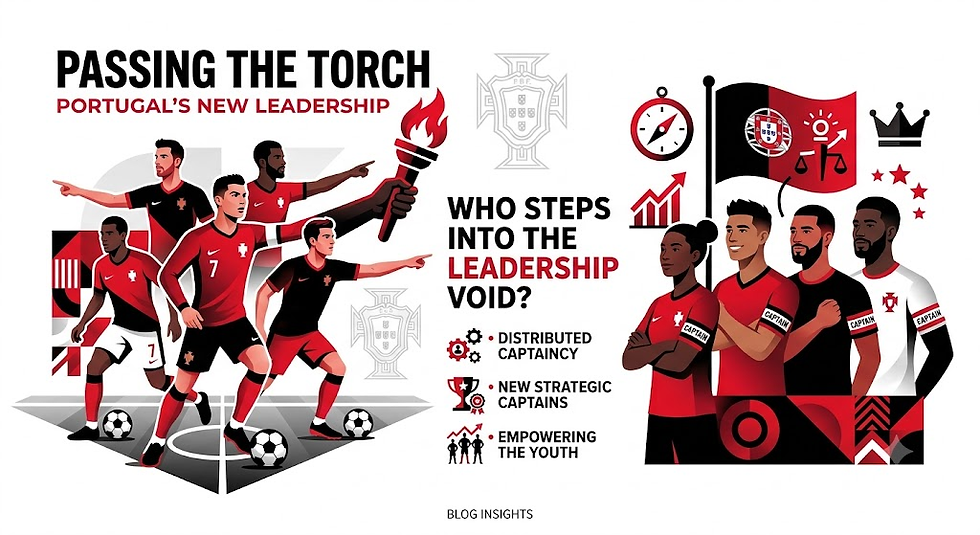
Stepping into the Portugal post-Ronaldo leadership void requires a blend of competitive arrogance, tactical intelligence, and international pedigree. Fortunately, the current generation features several mature figures who wear the captain's armbands for some of Europe’s elite clubs. The responsibility of leading Portugal into the 2028 UEFA European Championship and the 2030 World Cup will likely be distributed across a core leadership committee.
1. Bruno Fernandes: The Technical General
If there is one player who has consistently demonstrated the vocal, demanding leadership style reminiscent of Ronaldo, it is Manchester United captain Bruno Fernandes. Bruno has long been the creative engine of the national team. While the 2026 exit left him deeply frustrated—admitting post-match that the squad failed to perform at their absolute best despite a strong first-half display—his structural importance is undeniable.
Fernandes is a player who leads by example through his relentless work rate and tactical communication. He is not afraid to hold his teammates accountable on the pitch. In a post-Ronaldo era, Fernandes will likely assume structural control of the attacking transition, free from the obligation of constantly looking to feed a single focal point.
2. Rúben Dias: The Defensive Rock
True leadership often starts from the back, and Manchester City’s Rúben Dias is the natural heir to the emotional throne of the locker room. Dias has been an "untouchable" fixture in the starting XI, acting as the vocal organizer of the defensive unit.
With veteran defensive pillars phasing out, Dias’s role expands from a premier center-back into the psychological anchor of the entire team. His composure, communication skills, and elite mentality make him a prime candidate to wear the captain's armband permanently. Alongside rising stars like Sporting CP’s Gonçalo Inácio—who entered the 2026 tournament with a significantly bolstered status—Dias will be tasked with maintaining defensive stability during high-stakes international fixtures.
3. Bernardo Silva: The Calming Influence
Where Bruno Fernandes brings fire, Bernardo Silva brings ice. The Manchester City midfielder offers a different dimension of leadership—one defined by technical security, tempo control, and vast tournament experience. Bernardo’s ability to manipulate tight spaces and retain possession under intense pressure provides the team with a tactical safety valve.
During the frantic final minutes against Spain, it was Bernardo’s header that crashed against the crossbar in the 97th minute, agonizingly close to forcing extra time. As a senior figure who commands immense respect within the squad, Bernardo will be vital in mentoring the influx of young midfield talents.
The Next Generation: The Tactical Evolution
The departure of Ronaldo forces an inevitable tactical shift. Under previous regimes, Portugal’s attacking identity was highly centralized. The modern iteration of the squad, however, thrives on positional fluidity and tactical versatility.
This structural depth allows Portugal to pivot away from a rigid focal point. Midfielders like João Neves and Vitinha possess the dynamism to dictate play from deep, while wingers like Rafael Leão provide isolated 1v1 threat out wide. Up front, Gonçalo Ramos will finally have the opportunity to establish himself as the undisputed central striker, offering a more modern pressing profile that can disrupt opposing build-ups from the front.
Frequently Asked Questions
Did Cristiano Ronaldo play his last international match in 2026?
Cristiano Ronaldo confirmed that the 2026 FIFA World Cup in the United States, Mexico, and Canada was his final appearance at a World Cup tournament. Following Portugal's 1-0 Round of 16 elimination against Spain on July 6, 2026, Ronaldo stated he would take time to reflect with his family before making any definitive announcements regarding his immediate international retirement or future with the UEFA Nations League.
Who is expected to fill the Portugal post-Ronaldo leadership void?
The Portugal post-Ronaldo leadership void will most likely be shared by a leadership group consisting of Bruno Fernandes, Rúben Dias, and Bernardo Silva. Bruno Fernandes provides the vocal and creative spark, Rúben Dias organizes the squad from a central defensive standpoint, and Bernardo Silva offers veteran composure and tactical versatility.
How does Portugal’s tactical system change without Cristiano Ronaldo?
Without Ronaldo, Portugal is expected to transition into a highly fluid, high-pressing attacking system. Instead of funneling crosses and final-third passes toward a singular target man, the team will leverage the movement of Gonçalo Ramos alongside the creative rotations of Bruno Fernandes, Vitinha, and Bernardo Silva to create a more unpredictable and balanced offensive approach.
Join the Football Conversation
The post-CR7 era is officially here, and the future of Portuguese football hangs in a fascinating balance. Can this golden generation convert their immense individual talent into major silverware without the greatest player in their history?
We want to hear from you! Who do you believe should be named the permanent captain of the national team? Should it be the defensive stability of Rúben Dias or the fiery passion of Bruno Fernandes? Drop your tactical breakdowns and predictions in the comments section below.
To keep up with the latest international fixtures, team selections, and tactical deep dives, bookmark the Official FIFA World Cup Portal.
For detailed squad metrics, upcoming player statistics, and domestic coverage, check out the comprehensive database on ESPN Football.


Comments