Petrol and Diesel Price Today in India: City-Wise Rates (March 2026)
- Mar 10
- 5 min read
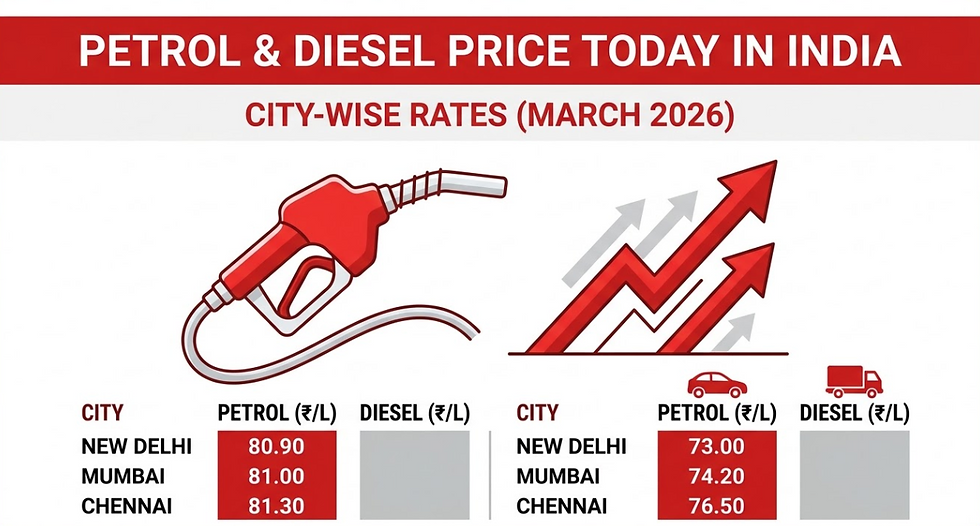
Fuel prices play a crucial role in the Indian economy as they directly affect transportation costs, inflation, and daily household expenses. Petrol and diesel prices in India are revised daily by oil marketing companies such as Indian Oil Corporation (IOC), Bharat Petroleum (BPCL), and Hindustan Petroleum (HPCL) based on international crude oil prices and exchange rates.
As of 10 March 2026, petrol and diesel prices in India remain largely unchanged across major cities despite a sharp rise in global crude oil prices. Brent crude briefly surged above $100 per barrel, but domestic fuel prices have not been revised yet.
This article provides the latest petrol and diesel prices in India today, including city-wise rates, reasons behind price stability, and factors that influence fuel prices in the country.
Petrol and Diesel Price Today in Major Indian Cities
Fuel prices vary across cities due to differences in state taxes, transportation costs, and local VAT.
City-Wise Petrol and Diesel Prices (10 March 2026)
City | Petrol Price (per litre) | Diesel Price (per litre) |
Delhi | ₹94.77 | ₹87.67 |
Mumbai | ₹103.49 | ₹90.03 |
Chennai | ₹101.23 | ₹92.82 |
Kolkata | ₹104.95 | ₹91.76 |
Bengaluru | ₹102.86 | ₹88.94 |
Hyderabad | ₹107.41 | ₹95.65 |
Lucknow | ₹95.48 | ₹88.27 |
Pune | ₹94.77 | ₹87.67 |
Fuel prices across major cities have remained unchanged recently, even though global crude oil markets have experienced volatility.
Why Petrol and Diesel Prices Differ Across Cities
Many people notice that fuel prices are higher in some cities than others. This difference is mainly due to taxes and transportation costs.
State Taxes (VAT)
Each Indian state charges its own Value Added Tax (VAT) on petrol and diesel. States with higher VAT rates usually have higher fuel prices.
For example, cities like Hyderabad and Kolkata often see higher petrol prices compared to Delhi due to higher local taxes.
Transportation and Logistics Costs
Fuel transported over longer distances from refineries incurs additional logistics costs. These expenses are included in the final retail price.
Cities located far from major refineries may therefore have slightly higher fuel prices.
Dealer Commission
Petrol pumps receive a commission for selling fuel. This commission also forms part of the final price paid by consumers.
Why Fuel Prices Have Not Increased Despite Oil Price Surge
Global crude oil prices recently surged due to geopolitical tensions in the Middle East. However, retail fuel prices in India have not been increased yet.
Oil Refiners Absorbing Costs
Reports suggest that state-owned refiners are currently absorbing the increase in crude oil costs instead of passing them on to consumers.
This strategy is possible because these companies made strong profits when crude prices were lower earlier.
Government Monitoring Fuel Prices
The Indian government closely monitors fuel price movements to control inflation. Sudden increases in petrol and diesel prices can affect transportation, food costs, and overall economic stability.
Factors That Influence Petrol and Diesel Prices in India
Fuel prices in India are influenced by several domestic and global factors.
Global Crude Oil Prices
Crude oil is the main raw material used to produce petrol and diesel. When crude oil prices rise in international markets, fuel prices usually increase as well.
Global oil prices can change due to geopolitical conflicts, supply disruptions, or production cuts by major oil-producing countries.
Exchange Rate (Rupee vs Dollar)
India imports most of its crude oil and pays for it in US dollars.
If the Indian rupee weakens against the dollar, importing crude oil becomes more expensive, which can push fuel prices higher.
Central and State Taxes
Taxes form a significant portion of petrol and diesel prices in India.
The two main types of taxes include:
Central Excise Duty
State Value Added Tax (VAT)
Together, these taxes can make up nearly 40–50% of the retail fuel price in some states.
Demand and Supply
Fuel demand also affects pricing.
For example:
Increased travel during festivals or holidays can increase demand.
Industrial activity and transportation demand also influence fuel consumption.
Fuel Price Trend in India (Recent Years)
Fuel prices have seen several fluctuations in recent years due to changes in global oil markets.
Petrol Price Trend in India
Year | Average Petrol Price |
2022 | ₹96 – ₹110 |
2023 | ₹95 – ₹108 |
2024 | ₹94 – ₹105 |
2025 | ₹94 – ₹104 |
2026 | ₹94 – ₹107 |
Despite global oil price volatility, retail petrol prices in many Indian cities have remained relatively stable over the past year.
How Fuel Prices Are Revised in India
India follows a dynamic fuel pricing system.
Since 2017, petrol and diesel prices have been revised daily at 6 AM based on international crude oil prices and currency exchange rates.
Consumers can check daily fuel prices through:
Oil company websites
Mobile apps
SMS services provided by fuel retailers
Impact of Fuel Prices on the Economy
Petrol and diesel prices influence multiple sectors of the economy.
Transportation Costs
Higher fuel prices increase transportation costs for goods and passengers.
This can affect:
Public transport fares
Delivery services
Logistics companies
Food Prices
Many agricultural products rely on diesel for transportation and farm equipment. Rising diesel prices can increase food costs.
Inflation
Fuel prices are closely linked to inflation in India. A sharp rise in petrol or diesel prices can increase the cost of goods and services across the economy.
Tips to Reduce Fuel Expenses
Consumers can take several steps to reduce fuel consumption and save money.
Fuel Saving Tips
Maintain proper tyre pressure
Avoid unnecessary idling
Drive at steady speeds
Use public transport when possible
Consider carpooling
These simple habits can improve fuel efficiency and lower overall expenses.
Frequently Asked Questions (FAQs)
What is the petrol price in Delhi today?
As of 10 March 2026, petrol in Delhi costs ₹94.77 per litre, while diesel costs ₹87.67 per litre.
Which city has the highest petrol price in India?
Cities like Hyderabad and Kolkata usually have higher petrol prices due to higher state taxes and transportation costs.
Why are petrol prices higher in Mumbai?
Mumbai has higher fuel prices mainly because of higher state taxes and local VAT imposed by the Maharashtra government.
How often are petrol and diesel prices updated?
Fuel prices in India are revised daily at 6 AM under the dynamic pricing system.
Will petrol and diesel prices increase soon?
Although global crude oil prices have recently increased, domestic fuel prices have not yet been revised. Oil companies may absorb costs temporarily before making any price changes.
Final Takeaway
Petrol and diesel prices in India as of March 2026 remain stable across major cities despite rising global crude oil prices. Delhi continues to have relatively lower fuel prices, while cities like Mumbai, Hyderabad, and Kolkata see higher rates due to state taxes.
Fuel prices are influenced by a combination of global oil markets, exchange rates, taxes, and supply-demand dynamics. As international crude oil prices remain volatile, consumers should continue monitoring daily price updates from oil marketing companies.
For now, Indian motorists are experiencing stable fuel prices, but future revisions will largely depend on global energy market developments.


Comments