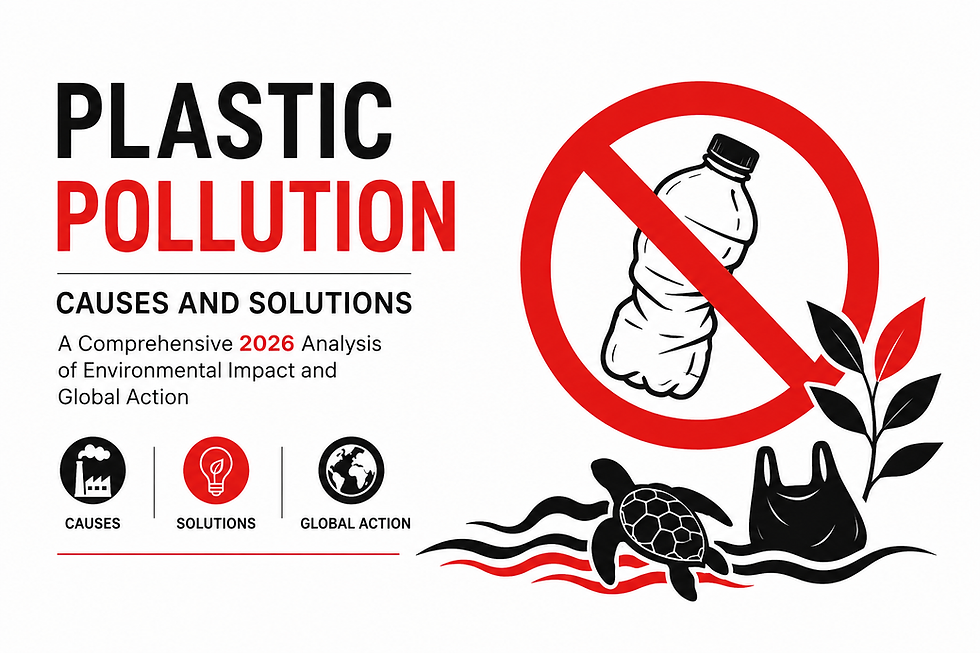
Plastic Pollution Causes and Solutions: A Comprehensive 2026 Analysis of Environmental Impact and Global Action
- Aug 5
- 7 min read
Plastic pollution represents one of the most pervasive environmental crises of the 21st century. As of 2026, global plastic production exceeds 460 million metric tons annually, with over 20 million metric tons leaking directly into terrestrial, freshwater, and marine ecosystems each year. From the depths of the Mariana Trench to the summit of Mount Everest, synthetic polymer residues have infiltrated every biome on Earth.
                 GLOBAL PLASTIC MATERIAL LIFECYCLE FLOW

[PETROCHEMICAL EXTRACTION]──► [ POLYMER MANUFACTURING ] ──► [ SINGLE-USE PRODUCTS ]
                                                                       │
[ MICROPLASTIC FRAGMENTATION ] ◄── [ MARINE & SOIL LEAKAGE ] ◄── [ WASTE MISMANAGEMENT ]
               │                                                       │
               ▼                                                       ▼
  [ BIOACCUMULATION IN FOOD WEBS ]            [ LANDFILLS & INCINERATION ]
Despite growing global awareness and international legislative efforts, less than 10% of all plastic ever manufactured has been recycled. The remaining 90% accumulates in landfills, open dumps, and natural habitats, where it breaks down into toxic microparticles that persist for centuries. Understanding plastic pollution causes and solutions requires examining the entire lifecycle of synthetic polymers—from fossil fuel extraction and industrial design to consumer habits and global waste management infrastructure.
The Global Lifecycle and Environmental Persistence of Synthetic Polymers
The longevity of plastic products contrasts sharply with their actual operational lifespan. While packaging materials are used for an average of just six months before disposal, the chemical bonds of synthetic polymers like polyethylene, polypropylene, and polyethylene terephthalate (PET) resist natural biological degradation.
Key Environmental Takeaway: Over 36% of all plastics produced globally are dedicated to single-use packaging. Under ambient environmental conditions, standard commercial plastics do not biodegrade; instead, photo-oxidation and mechanical weathering fragment them into microplastics (particles smaller than 5 millimeters) and nanoplastics, which permanently alter soil and water chemistry.
Key Drivers and Plastic Pollution Causes and Solutions Overview
To implement targeted interventions, we must first isolate the structural drivers behind the exponential growth of synthetic waste. The crisis is not merely a consequence of littering, but the result of systemic economic and industrial practices.
                    PRIMARY DRIVERS OF PLASTIC WASTE

   ┌──────────────────────────────────────────────────────────────┐
   │ 1. PETROCHEMICAL OVERPRODUCTION & LOW VIRGIN POLYMER COSTS   │
   ├──────────────────────────────────────────────────────────────┤
   │ 2. LINEAR "TAKE-MAKE-WASTE" PRODUCT DESIGN MODELS            │
   ├──────────────────────────────────────────────────────────────┤
   │ 3. INSUFFICIENT MUNICIPAL RECYCLING & PROCESSING CAPACITY    │
   ├──────────────────────────────────────────────────────────────┤
   │ 4. WEAK EXTENDED PRODUCER RESPONSIBILITY (EPR) REGULATION    │
   └──────────────────────────────────────────────────────────────┘
1. Petrochemical Overproduction and Cheap Virgin Resin
Virgin plastic resins derived from petroleum and natural gas remain cheaper to synthesize than recycled polymers (rPET, rHDPE). Petrochemical subsidies and expanded refining capacity keep raw plastic prices low, disincentivizing manufacturers from transitioning to circular material alternatives.
2. Pervasiveness of Single-Use Packaging
Modern commerce relies heavily on single-use formats—polybags, multilayer sachets, expanded polystyrene, and plastic beverage bottles—designed for linear disposal. Multilayer materials combining plastic with aluminum foil are virtually impossible to recycle mechanically, forcing municipal systems to route them directly to landfills or incinerators.
3. Inadequate Waste Management Infrastructure
Global waste processing capabilities have failed to keep pace with production growth. Millions of metric tons of municipal solid waste are generated daily in regions lacking formal collection services, leading to uncontrolled burning or direct dumping into river systems that transport plastic waste to ocean basins.
4. Fragmented Policy Frameworks and Externalized Costs
Historically, manufacturers have not borne the financial or environmental costs associated with the post-consumer fate of their products. Without mandated Extended Producer Responsibility (EPR) frameworks, the economic burden of waste management falls on local governments and taxpayers.
Environmental, Ecological, and Human Health Impacts
The ecological and public health consequences of plastic accumulation in 2026 are widespread, affecting aquatic environments, terrestrial ecosystems, climate systems, and human bio-systems.
                     CASCADE OF PLASTIC POLLUTION EFFECTS

 [ OCEAN LEAKAGE ] ──► [ MARINE ENTANGLEMENT ] ──► [ HABITAT DESTRUCTION ]
          │
          ▼
[ MICROPLASTIC FORMATION ] ──► [ TROPHIC TRANSFER ]──► [ HUMAN INGESTION ]
          │
          ▼
 [ CHEMICAL LEACHING ] ──► [ ENDOCRINE DISRUPTION ] ──► [ TOXICITY RISKS ]
Aquatic and Marine Ecosystem Degradation
An estimated 20 million metric tons of plastic waste enter aquatic environments annually. Over 1,500 species of marine animals and birds are known to ingest plastic debris or become entangled in discarded fishing gear ("ghost nets"). Ingestion of plastic causes physical blockages, internal punctures, and chronic starvation in marine mammals, sea turtles, and seabirds.
Human Exposure to Microplastics and Toxic Additives
Recent toxicological studies confirm that microplastics contaminate ambient air, drinking water supplies, agricultural soil, and commercial food networks. Recent research indicates that over 36% of commercial fish harvested for human consumption contain synthetic polymer microparticles. Microplastics have been detected in human blood samples, lung tissue, placenta tissue, and arterial plaques, where chemical additives such as phthalates and bisphenols (BPA) pose risks of endocrine disruption and systemic inflammation.
Climate Change and Carbon Emissions
The plastic lifecycle contributes directly to global greenhouse gas emissions. From fossil fuel extraction and refining to high-temperature incineration and environmental degradation, plastic accounts for roughly 4% of total global greenhouse gas emissions. The open burning of plastic waste in informal waste sectors releases black carbon, dioxins, and furans into the atmosphere.
Comparative Analysis: Material Lifespans, Waste Share, and Mitigation Priorities
Evaluating the environmental impact of various plastic categories helps prioritize policy interventions and technological solutions.
Plastic Product Category | Average Operational Lifespan | Share of Global Waste Output | Environmental Degradation Time | Primary Mitigation Strategy |
Packaging & Single-Use Containers | 0.5 Years (6 Months) | ~36.5% | 450 - 1,000 Years | Mandatory EPR, Deposit Return Schemes (DRS), Reuse Systems |
Consumer Products & Toys | 3.0 Years | ~20.0% | 100 - 500 Years | Eco-design mandates, Repairability standards, Non-toxic polymers |
Textiles & Synthetic Fibers | 5.0 Years | ~14.0% | 200 - 800 Years | Microfiber washing filters, Circular textile-to-textile recycling |
Electrical & Electronic Goods (E-Waste) | 8.0 Years | ~9.5% | 300 - 700 Years | Modular design, Mandatory e-waste take-back systems |
Transportation Components | 13.0 Years | ~8.0% | 400 - 900 Years | Advanced lightweight composite recycling, closed-loop automotive recovery |
Construction & Building Materials | 20.0 to 35.0 Years | ~12.0% | 500+ Years | Standardized polymer sorting, high-grade structural re-processing |
Multi-Tiered Practical Solutions: From Policy to Personal Action
Combating plastic pollution requires a systemic approach that combines global governance, corporate accountability, technological innovation, and individual practice.
                 SYSTEMIC SOLUTIONS FOR A CIRCULAR PLASTICS ECONOMY

[ UPSTREAM INTERVENTIONS ] ──► Production Caps, Cap-and-Trade, Bio-based Materials
[ MIDSTREAM DESIGN ]──► Eco-Design Mandates, Standardization, Refill Systems
[ DOWNSTREAM RECOVERY ]──► Advanced Mechanical Recycling, Mandatory EPR Frameworks
1. Global Policy Frameworks: The UN Plastics Treaty
A key development in global environmental policy is the United Nations International Legally Binding Instrument on Plastic Pollution (the UN Global Plastics Treaty). Negotiated through the Intergovernmental Negotiating Committee (INC) sessions—including INC-5.1 in Busan, INC-5.2 in Geneva, and INC-5.3 in 2026—this treaty establishes legally binding global standards addressing the full lifecycle of plastics.
Key international policy goals include:
Mandating global reduction targets for virgin plastic production.
Phasing out hazardous chemical additives and non-recyclable single-use polymers.
Establishing legally binding Extended Producer Responsibility (EPR) regulations.
Mobilizing international climate finance to upgrade waste processing infrastructure in developing nations.
2. Corporate Redesign and Circular Business Models
Businesses are shifting from linear consumption models to circular frameworks that eliminate waste at the design phase.
Reuse and Refill Infrastructure: Transitioning from single-use beverage containers and household cleaning products to standardized, returnable vessel networks.
Advanced Material Substitutions: Scaling home-compostable bio-materials synthesized from marine algae, agricultural waste residues, and PHA (polyhydroxyalkanoates).
Closed-Loop Recycling Technology: Investing in mechanical sorting infrastructure (NIR optical sorters) and chemical recycling technologies that break polymers down into high-purity monomers without degrading material quality.
3. Individual and Community Action Checklist
While systemic reform is necessary, individual behavior and community advocacy play a major role in driving market demand and municipal policy changes.
                     INDIVIDUAL ZERO-WASTE ACTION PLAN

  ┌───────────────────────────────────────────────────────────────┐
  │ 1. REFUSE: Eliminate single-use bags, cutlery, and straws     │
  ├───────────────────────────────────────────────────────────────┤
  │ 2. REDUCE: Choose bulk goods and minimal packaging options    │
  ├───────────────────────────────────────────────────────────────┤
  │ 3. REUSE: Adopt stainless steel, glass, and durable totes     │
  ├───────────────────────────────────────────────────────────────┤
  │ 4. RECYCLE: Separate clean waste to avoid bin contamination   │
  ├───────────────────────────────────────────────────────────────┤
  │ 5. ADVOCATE: Support local municipal bans on expanded foam    │
  └───────────────────────────────────────────────────────────────┘
Frequently Asked Questions
What are the primary plastic pollution causes and solutions being addressed globally in 2026?
The primary causes include the overproduction of cheap virgin plastics derived from petrochemicals, high reliance on single-use packaging, inadequate waste management systems, and a lack of producer accountability. The most impactful solutions involve binding global reduction treaties, mandatory Extended Producer Responsibility (EPR) laws, corporate transition to refillable/reusable systems, scaling non-toxic bio-materials, and expanding advanced recycling infrastructure.
How do microplastics enter the human body and impact health?
Microplastics enter the human body primarily through the consumption of contaminated drinking water and seafood, as well as the inhalation of airborne synthetic fibers. Medical studies have detected microplastics in human blood, pulmonary tissue, and organs. These particles can leach toxic chemical additives (like bisphenols and phthalates) into tissues, potentially causing cellular stress, inflammation, and metabolic disruption.
Why is recycling alone insufficient as a plastic pollution causes and solutions strategy?
Recycling addresses only a fraction of end-of-life material, making it clear that comprehensive plastic pollution causes and solutions must prioritize source reduction. Globally, less than 10% of plastic waste is recycled due to economic barriers, polymer degradation during re-processing, and multi-layer material complexity. Without capping virgin plastic production and phasing out unrecyclable product designs, recycling infrastructure alone cannot keep up with growing waste volumes.
What is the status of the United Nations Global Plastics Treaty in 2026?
The United Nations Global Plastics Treaty has progressed through key Intergovernmental Negotiating Committee (INC) sessions—including INC-5.1 in Busan, INC-5.2 in Geneva, and INC-5.3 in early 2026. Member states are finalizing legally binding provisions on virgin production limits, chemical transparency, financial support for waste infrastructure, and formal inclusion of waste pickers in the circular transition.
Official Environmental Resources & Action Portals
To learn more about plastic pollution research, policy updates, and global conservation campaigns, visit these verified international resources:
UN Environment Programme (UNEP): Beat Plastic Pollution Global Campaign
Global Plastics Policy Centre: University of Portsmouth Plastics Research & Evidence
World Wildlife Fund (WWF): WWF Plastic Free Oceans & Circular Economy Initiative
OECD Environment Directorate: Global Plastics Outlook Data & Projections


Comments