Scaler School of Technology: A Popular Choice After MHT-CET (Use Code CS500)
- Jun 26
- 7 min read
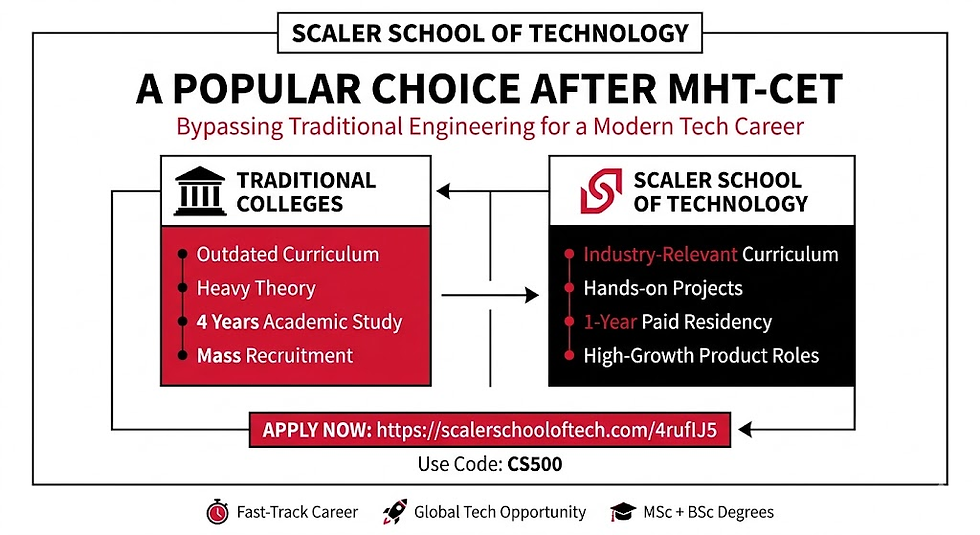
The MHT-CET (Maharashtra Common Entrance Test) results are out, and thousands of engineering aspirants across Maharashtra find themselves at a crucial crossroads. Traditionally, the conventional trajectory involved navigating the stressful rounds of the Centralized Admission Process (CAP) to secure a seat in top-tier state colleges like COEP Pune, VJTI Mumbai, or ICT Mumbai. However, as we move through 2026, the global tech landscape has evolved dramatically. The rise of generative AI, advanced cloud systems, and algorithmic automation means that traditional four-year engineering degrees are facing an existential crisis. Standard university curriculums are often outdated, failing to bridge the widening gap between classroom theory and real-world software engineering demands.
For ambitious students who want to build high-growth careers in software development, product management, or data science, relying solely on traditional degree colleges might no longer be the safest bet. This shifting dynamic explains why the Scaler School of Technology (SST) in Bengaluru has emerged as an immensely popular Choice After MHT-CET. Designed by tech industry veterans specifically for the modern digital era, Scaler offers a direct product-focused alternative to conventional engineering paths. It completely bypasses rote-learning paradigms to deliver a rigorous, industry-immersive education.
If you want to fast-track your tech career and learn directly from industry leaders, you can take the first step today: Apply now using CS500 Code: https://scalerschooloftech.com/4ruflJ5 to unlock exclusive benefits and start your tech journey.
The MHT-CET Dilemma in 2026: Why Traditional Engineering is Falling Short
For decades, getting a high percentile in MHT-CET was the ultimate goal for science students in Maharashtra. Landing a seat in an IT or Computer Science engineering branch at a reputable state university felt like a guaranteed ticket to a stable corporate job. However, in 2026, the structural flaws of traditional engineering institutions have become more transparent than ever.
1. Outdated Curriculum vs. Dynamic Tech Ecosystems
Most traditional state universities operate on rigid academic frameworks. Modifying a curriculum to include cutting-edge technologies like Large Language Models (LLMs), DevOps pipelines, Kubernetes, or advanced Next.js architectures requires multiple rounds of bureaucratic approvals. Consequently, students spend their critical formative years studying obsolete hardware concepts, drawing manual engineering graphics, or writing basic code in outdated compiler versions.
2. Lack of Practical Industry Exposure
The typical university structure prioritizes internal semester exams, viva-voce evaluations, and massive theoretical write-ups over actual code deployment. Students often graduate with high Cumulative Grade Point Averages (CGPA) but lack the practical ability to construct a scalable production-ready web application, build a CI/CD pipeline, or work collaboratively via Git and GitHub.
3. The Shrinking Value of Local Placements
While premier institutions like VJTI or COEP maintain strong legacy placement networks, many tier-2 and tier-3 colleges in Maharashtra rely heavily on mass recruiters. In 2026, mass tech recruitment has transformed significantly; companies now demand day-one productivity and deep specialized skill sets rather than generalist engineering backgrounds.
This is precisely where choosing an alternative educational path becomes vital. Scaler School of Technology stands out as the ultimate Choice After MHT-CET because it flips the traditional model entirely, replacing ancient academic text with hands-on development.
What is Scaler School of Technology (SST)?
Located in India’s Silicon Valley—Bengaluru—Scaler School of Technology is a residential undergraduate program created by the founders of InterviewBit and Scaler. It offers a 4-year integrated program in Computer Science, awarding a Bachelor of Science (B.Sc.) in Computer Science from a top UGC-recognized university, alongside a Master of Science (M.Sc.) in Computer Science.
Unlike traditional universities where professors have spent their entire lives in academia, the faculty at SST consists of active software engineers, tech leads, and product architects from tech giants like Google, Microsoft, Amazon, Meta, and Netflix. The entire program is structured like a four-year boot camp combined with an incubator, ensuring that every concept taught directly maps to a skill currently in high demand within the global market.
If you are looking to outpace your peers and build real-world software skills, don't miss out on this opportunity. Apply now using CS500 Code: https://scalerschooloftech.com/4ruflJ5 to secure your spot.
Why Scaler School of Technology is the Superior Choice After MHT-CET
When comparing traditional engineering colleges in Maharashtra to Scaler School of Technology, the differences are distinct. SST is built intentionally to address the structural deficiencies of traditional Indian higher education.
Comprehensive Comparison: SST vs. Traditional Engineering Colleges
Evaluation Parameter | Traditional Engineering Colleges (MHT-CET Path) | Scaler School of Technology (SST) |
Location & Ecosystem | Spread across various cities; limited direct exposure to premier startup hubs. | Centered in Bengaluru, giving students direct physical access to India's tech hub. |
Faculty Profile | Academic professors, often lacking recent experience in commercial software development. | Active or former tech leaders, engineers, and architects from MAANG companies. |
Curriculum Focus | Heavily theoretical; includes mandatory non-CS subjects (Physics, Chemistry, Mechanics). | 100% pure Computer Science, Data Structures, Algorithms, System Design, and AI. |
Mandatory Internship | Usually 1 to 2 months during summer breaks, often unsupervised or purely observational. | 1 full year of paid, evaluated industry residency at top-tier product tech companies. |
Placement Network | Vulnerable to regional economic shifts and changes in mass service-sector hiring. | Direct access to Scaler’s global network of 900+ premium partner tech companies. |
Real-World Curriculum Built for 2026
Traditional engineering tracks force Computer Science students to spend their entire first year studying foundational sciences like Mechanics, Basic Civil Engineering, and Engineering Chemistry. This setup takes away valuable time that could be spent masterfully learning syntax, algorithmic thinking, and database management.
At SST, you dive straight into core computer science principles from day one. You master Data Structures and Algorithms (DSA), System Design (both Low-Level and High-Level), Cloud Architecture, and Artificial Intelligence engineering. You don’t just write code on paper for a university sheet; you build projects, push code to production, and learn to debug complex systems under the guidance of industry veterans.
The Power of the 1-Year Paid Industry Residency
One of the most innovative features making SST a premier Choice After MHT-CET is its integrated third-year industry residency. Instead of spending your third year sitting in a classroom listening to lectures, you are placed directly inside a product-driven company for a full 12 months.
During this residency, you work as a full-time software engineering intern, earning a real stipend, building production features, attending standups, and learning company engineering cultures. This structural advantage means that by the time you enter your final year, you already possess a full year of corporate experience on your resume, instantly putting you ahead of traditional engineering graduates.
Bengaluru vs. Maharashtra Tech Hubs: The Location Advantage
While Pune and Mumbai have thriving IT clusters, Bengaluru remains the undisputed tech capital of India. It houses the headquarters of premier domestic startups, multinational tech offices, and global development centers.
By relocating to Bengaluru for your undergraduate education, you immerse yourself in a unique networking environment. At SST, your classmates are top-performing students from across the country, and your neighbors are tech founders, venture capitalists, and senior developers. The opportunities to attend regional hackathons, open-source meetups, and technical tech conferences are unmatched, providing a profound career accelerant that traditional state colleges find difficult to match.
If you want to position yourself at the center of India’s tech revolution, now is the time to act. Apply now using CS500 Code: https://scalerschooloftech.com/4ruflJ5 and use the referral code to fast-track your enrollment.
Placement Excellence and Industry Partnerships
The primary goal of studying engineering is to build a successful, high-paying career doing meaningful work. Traditional engineering institutions often highlight their overall placement percentages, but these figures frequently mask a reliance on low-paying mass recruiter roles.
Scaler’s ecosystem has a proven track record of career transformation. With an expansive network of over 900 hiring partners, Scaler has successfully placed thousands of learners into top-tier tech roles. The average CTC of Scaler alumni matches or exceeds the average packages of premier IITs and NITs, significantly outperforming the placement averages of standard state-level colleges. Because tech companies trust Scaler’s strict vetting and thorough training processes, SST students gain access to high-growth product engineering roles that rarely visit campus placement drives in traditional regional colleges.
How to Apply to Scaler School of Technology
The admission process for Scaler School of Technology is independent of the standard MHT-CET CAP rounds. This allows you to apply, clear the assessment, and secure your seat well before or alongside the state counseling deadlines.
Online Registration: Visit the official portal using the specialized application link.
SST Online Entrance Test (NSET): Take the online test designed to evaluate your aptitude, logical reasoning, and fundamental problem-solving capabilities.
Personal Interview Rounds: Interact with industry experts and faculty members who evaluate your passion for technology, drive, and long-term career aspirations.
Admission Offer: Successful candidates receive an official admission offer to join the elite cohort in Bengaluru.
Make sure to utilize the exclusive code to ensure your application stands out during the processing cycle. Apply now using CS500 Code: https://scalerschooloftech.com/4ruflJ5 to get started immediately.
Frequently Asked Questions (FAQs)
Q1: Is Scaler School of Technology a better choice after MHT-CET than top-tier state colleges like VJTI or COEP?
Ans: Yes, for students focused on software engineering and product development, SST offers significant advantages over traditional options. While legacy colleges like VJTI and COEP have long histories, their curriculums remain bound to standard university regulations. Scaler School of Technology provides an industry-focused alternative featuring a real-world curriculum, direct instruction from MAANG engineering leads, a full one-year paid industry residency, and a campus location in Bengaluru. This makes it an ideal Choice After MHT-CET for students seeking modern, project-based learning.
Q2: What degree do I receive upon completing the program at SST?
Ans: Students at Scaler School of Technology complete a comprehensive 4-year residential program. You earn a Bachelor of Science (B.Sc.) in Computer Science alongside a Master of Science (M.Sc.) in Computer Science from a recognized, top-tier UGC-approved university. The degree is fully accredited, opening doors for higher education abroad or public sector roles if desired.
Q3: Do I need a high MHT-CET score to get admission into Scaler School of Technology?
Ans: No, SST does not look at your MHT-CET score for admissions. They evaluate applicants through their independent national-level exam called the NSET (National Scaler Entrance Test), followed by personal interview rounds. This process focuses on your logical aptitude, problem-solving skills, and passion for coding rather than rote memorization.
Q4: How does the 1-year industry residency work at SST?
Ans: During the third year of the program, students do not attend standard classroom lectures. Instead, they work full-time within a partner tech company as a paid software engineering intern. This gives students hands-on experience with production systems, team dynamics, and real-world project deadlines, resulting in a stronger professional profile prior to formal graduation.
Secure Your Future in Tech Today!
Relying on traditional engineering paradigms could leave you playing catch-up in a fast-evolving market. Choosing Scaler School of Technology means stepping into an educational ecosystem built explicitly to turn you into a world-class software engineer. From day one, you will code, build, and network alongside the brightest minds in the capital of Indian technology.
Don't let rigid university systems limit your career potential. Click the official link below to submit your application, use the exclusive industry discount code, and launch your journey toward global tech success today.
Final Call to Action:
🚀 Official Application Link: Apply to Scaler School of Technology
🎟️ Exclusive Access Code: CS500
🔗 Direct Registration Portal: Click Here to Apply Now using Code CS500


Comments