Scaler School of Technology vs. Polaris: Comprehensive Curriculum and Course Comparison 2026
- Apr 23
- 5 min read
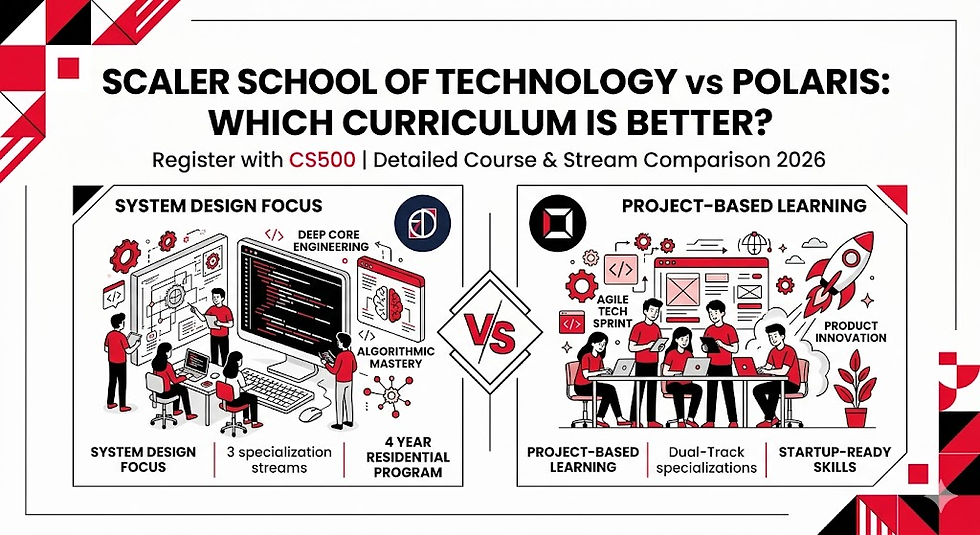
Are you looking to kickstart your tech education in 2026? Choosing between the Scaler School of Technology and Polaris School of Technology is a pivotal decision for any aspiring engineer. While both institutions have redefined the landscape of computer science education in India, their curricula offer distinct approaches to pedagogy, stream specialization, and technical depth.
In this guide, we dive deep into the course structures, credit systems, and stream details of both institutions to help you decide which academic path aligns with your learning goals.
The Evolution of Tech Education in 2026
By 2026, the traditional four-year degree has faced significant competition from "Industry-First" residential programs. Students are no longer just looking for a degree; they are looking for a curriculum that evolves as fast as AI and quantum computing. When comparing the Scaler School of Technology vs Polaris curriculum 2026, the focus shifts from theoretical rote learning to credit-based practical mastery.
If you are ready to begin your journey, you can Register with CS500 to access the latest 2026 enrollment benefits.
Scaler School of Technology: Course Structure & Stream Details
The Scaler School of Technology (SST) curriculum is built on a "layered" learning approach. Unlike traditional universities, SST divides its 4-year residential program into phases that move from foundational computer science to deep-tech specialization.
1. Foundational Years (Year 1 & 2)
The first two years focus on the "Core" of Computer Science. This includes:
Advanced Data Structures & Algorithms (DSA): Moving beyond basics into competitive programming levels.
System Design (Low-Level & High-Level): A rare inclusion in undergraduate programs, focusing on how scalable apps like Uber or Netflix are built.
Mathematics for CS: Discrete Math, Linear Algebra, and Probability tailored for AI/ML.
2. Specialization Streams (Year 3 & 4)
In 2026, Scaler offers three primary streams:
Full-Stack Development: Focuses on modern frameworks (Next.js, GoLang, and Microservices).
Data Science & Machine Learning: Deep dives into LLMs (Large Language Models), Neural Networks, and Data Engineering.
Algorithmic Programming: For those aiming for high-frequency trading firms or core R&D roles.
Polaris School of Technology: Course Structure & Stream Details
Polaris takes a "Modular & Disruptive" approach. Their curriculum is designed for students who want to experience the "startup" side of tech alongside rigorous engineering.
1. The "Sprint" Based Learning
Polaris utilizes a sprint-based curriculum where students complete modules in 4-6 week intensive bursts. This mimics the Agile environment of top tech companies.
2. Stream Specializations in 2026
Polaris offers unique "Dual-Track" specializations:
Software Product Engineering: Combining coding with product management principles.
AI & Cloud Native Architecture: Heavy focus on AWS/Azure/GCP integrations and deploying AI at scale.
Cybersecurity & Blockchain: A dedicated stream for secure systems and decentralized ledger technology.
Which one is right for you? If you prefer a structured, deep-dive into core engineering, Scaler is the leader. If you want a fast-paced, product-centric environment, Polaris is a strong contender. For a detailed look at Scaler’s specific modules, Register with CS500 today.
Side-by-Side Comparison: Scaler School of Technology vs Polaris Curriculum 2026
Feature | Scaler School of Technology | Polaris School of Technology |
Primary Focus | Engineering Excellence & Problem Solving | Product Innovation & Agile Tech |
AI Integration | Generative AI integrated into every module | Specialized AI stream and AI-assisted coding |
Specialization Starts | Late 2nd Year / Early 3rd Year | Beginning of 2nd Year |
Internship Duration | 1 Full Year (Industry Immersion) | 6-9 Months (Startup/Product focused) |
Credit System | Skill-acquisition based | Project-milestone based |
Key Curriculum Highlights for 2026
The Rise of "Applied AI" in the Syllabus
Both institutions have overhauled their 2026 syllabi to include Generative AI. In the Scaler School of Technology vs Polaris curriculum 2026 battle, Scaler emphasizes building AI tools (the "Builders" track), whereas Polaris emphasizes utilizing AI to create products (the "Architects" track).
Industry-Integrated Projects
A key differentiator for 2026 is the "Live Lab" credit. Students at Scaler work on production-level codebases from partner companies like Google, Microsoft, and Amazon. Polaris students often build their own MVPs (Minimum Viable Products) as part of their final year credits.
For more insights on choosing the right college for your tech career, visit collegesimplified.in for expert guidance.
Why Scaler's Curriculum Stands Out in 2026
When we analyze the Scaler School of Technology vs Polaris curriculum 2026, Scaler’s depth in "Core CS" remains its biggest strength. The curriculum is vetted by the top 1% of software engineers globally. By the time an SST student reaches their third year, they have often covered the equivalent of a Master’s degree in Computer Science from a top-tier US university.
Ready to explore the syllabus? Register with CS500 to download the full 2026 course brochure.
Frequently Asked Questions (FAQ)
Q1: What are the main differences in the Scaler School of Technology vs Polaris curriculum 2026?
A1: The main difference in the Scaler School of Technology vs Polaris curriculum 2026 lies in the pedagogical approach. Scaler focuses on deep-core engineering, DSA, and large-scale system design, while Polaris focuses on agile product development and cloud-native architectures.
Q2: Which specialization streams are available in the Scaler School of Technology vs Polaris curriculum 2026?
A2: In the Scaler School of Technology vs Polaris curriculum 2026, Scaler offers Full-Stack, Data Science, and Algorithmic Programming. Polaris offers Software Product Engineering, AI & Cloud, and Cybersecurity/Blockchain.
Q3: Is Generative AI part of the Scaler School of Technology vs Polaris curriculum 2026?
A3: Yes, both programs have integrated AI. The Scaler School of Technology vs Polaris curriculum 2026 ensures that students learn to build and deploy LLMs and use AI-assisted development tools throughout their four-year tenure.
Q4: How do the credit systems work in the Scaler School of Technology vs Polaris curriculum 2026?
A4: The Scaler School of Technology vs Polaris curriculum 2026 uses a mastery-based credit system. In Scaler, you earn credits by passing rigorous coding evaluations and industry projects. In Polaris, credits are heavily weighted toward project completion and "sprint" outcomes.
Q5: Can I switch streams midway through the Scaler School of Technology vs Polaris curriculum 2026?
A5: Both institutions allow for some flexibility. In the Scaler School of Technology vs Polaris curriculum 2026, students usually pick their final specialization by the end of the second year, allowing for a foundational base before narrowing their focus.
Conclusion
The choice between Scaler School of Technology vs Polaris curriculum 2026 ultimately depends on your learning style. If you want to be a master of the "under-the-hood" mechanics of software and build systems that serve millions, Scaler’s curriculum is unmatched. If you are driven by the idea of rapid prototyping and the "founder-engineer" mindset, Polaris offers a compelling modern alternative.
CTA
Regardless of your choice, ensure you are staying updated with the latest trends in 2026 tech education. For more detailed reviews, stream breakdowns, and student experiences, check out collegesimplified.in.
Take the first step toward a world-class tech education today—Register with CS500 and secure your spot in the future of engineering.


Comments