Scaler School of Technology vs Traditional Engineering Colleges: 2026 Course & Stream Comparison
- 6 hours ago
- 4 min read
INTRODUCTION
Choosing the right academic path in 2026 requires a deep dive into what you will actually be learning every day. With the rapid evolution of Computer Science, the gap between industry-aligned institutes and conventional universities has widened. If you are weighing your options, this guide focuses strictly on the course architecture, stream specializations, and academic delivery of the Scaler School of Technology (SST) versus traditional B.Tech programs.
The Evolution of Engineering Academics in 2026
For decades, the Indian engineering landscape was dominated by a fixed four-year structure. However, 2026 marks a turning point where students prioritize modern stream depth over general theory. When looking at Scaler School of Technology vs traditional engineering colleges, the primary differentiator is how the syllabus is constructed.
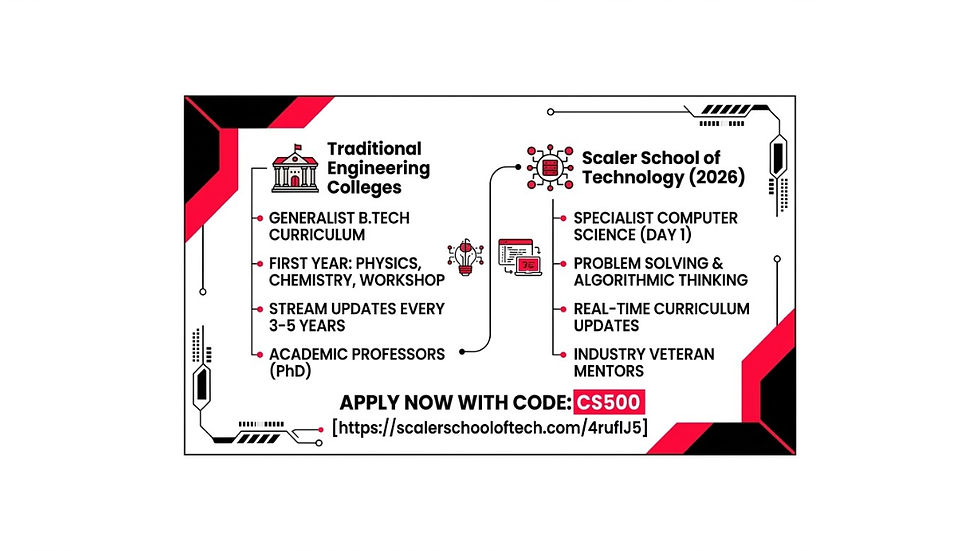
Traditional colleges often follow a university-mandated curriculum that includes "First Year Foundation" subjects like Chemistry, Workshop Practice, and Professional Ethics. While these offer a broad base, SST bypasses non-computing subjects to focus entirely on Computer Science from Day 1.
Apply Now: Ready to dive into a tech-first curriculum? Use the link https://scalerschooloftech.com/4ruflJ5 and enter Coupon Code CS500 for exclusive benefits.
Curriculum Structure: Theory vs. Applied Science
1. Traditional Engineering Colleges: The Generalist Approach
In a standard B.Tech program, the curriculum is divided into eight semesters.
Years 1 & 2: Focus on Engineering Physics, Mathematics, and basic Electrical Engineering.
Years 3 & 4: Introduction to core CS subjects like Operating Systems, DBMS, and elective streams.
The Challenge: The syllabus is updated in 4-to-5-year cycles, meaning students in 2026 might still be studying technologies that were relevant in 2020.
2. Scaler School of Technology: The Specialist Approach
The academic framework at SST is built on a "Learning by Doing" philosophy.
Algorithmic Thinking: Instead of just learning syntax, the course emphasizes Problem Solving and Data Structures as the core academic pillar.
Integrated Specializations: In 2026, SST offers deep-dives into Machine Learning, Full-Stack Development, and Mobile Engineering integrated directly into the credits.
Real-time Updates: The curriculum is reviewed quarterly by industry veterans to ensure the "streams" reflect the current state of software architecture.
Stream Specializations and Course Depth
When comparing Scaler School of Technology vs traditional engineering colleges, one must look at the elective freedom.
In traditional setups, "Specializations" (like AI or Cyber Security) are often just 2-3 additional subjects added to the standard CS degree. At SST, the stream is the degree. Students engage in intensive labs where they build compilers, design scalable distributed systems, and contribute to open-source—all within their academic credit hours.
Key Course Comparison Table (2026 Data)
Feature | Traditional B.Tech | Scaler School of Technology |
First Year Focus | Physics, Chemistry, Mechanics | DSA, Java/Python, Logic |
Stream Depth | Academic/Theoretical | Production-level Engineering |
Faculty | Academic Professors (PhD) | Tech Leaders & CTOs |
Curriculum Cycle | 3-5 Years | 6-12 Months |
Faculty and Academic Mentorship
The "Course" isn't just the textbook; it's who teaches it. In traditional engineering colleges, faculty members are primarily researchers. While this is great for academic theory, it can create a gap in practical software design.
At Scaler School of Technology, the "instructors" are the same individuals who have built systems at Google, Amazon, and Meta. This means the course delivery includes insights into how code is written in a professional environment, focusing on code quality, documentation, and scalability.
Don't Miss Out: Start your journey with a modern CS curriculum. Visit https://scalerschooloftech.com/4ruflJ5 and use Coupon Code CS500 to apply today.
Scaler School of Technology vs Traditional Engineering Colleges: The 2026 Learning Environment
Academic rigor in 2026 is no longer about sitting in a 9-to-5 lecture hall.
Traditional Colleges: Rely on pen-and-paper exams and internal assessments based on theory.
SST: Utilizes a "Gamified" learning platform where your progress is tracked through code submissions and peer reviews. The "coursework" is 80% hands-on coding.
For more insights on choosing the right stream, check out our guide on Stream Selection after 12th Grade to see how Computer Science stacks up against other branches in 2026.
FAQ: Understanding the Academic Differences
Q1: How does the curriculum of Scaler School of Technology vs traditional engineering colleges differ for a first-year student?
A1: In traditional engineering colleges, a first-year student studies general engineering subjects like Chemistry and Graphics. At Scaler School of Technology, the first year is dedicated entirely to core Computer Science fundamentals and Data Structures.
Q2: Is the degree from Scaler School of Technology vs traditional engineering colleges recognized for higher studies?
A2: Traditional engineering colleges provide a standard UGC/AICTE B.Tech degree. Scaler School of Technology provides a degree in partnership with recognized universities, ensuring the course credits are valid for global higher education. Use code CS500 for admission details.
Q3: Which has a more updated syllabus: Scaler School of Technology vs traditional engineering colleges?
A3: Scaler School of Technology has a significantly more updated syllabus because it is not bound by rigid university board cycles, unlike most traditional engineering colleges which update their course content every few years.
Q4: What are the stream options in Scaler School of Technology vs traditional engineering colleges?
A4: Traditional engineering colleges offer broad streams like CS, IT, and ECE. Scaler School of Technology focuses on specialized CS streams like AI, Cloud Computing, and Backend Engineering with much higher granularity.
Q5: Are lab sessions more frequent in Scaler School of Technology vs traditional engineering colleges?
A5: Yes, the "lab" is the classroom at SST. While traditional engineering colleges have scheduled lab hours, the entire Scaler School of Technology course is built around continuous coding and building projects. Apply with code CS500.
Conclusion
In 2026, the choice between Scaler School of Technology vs traditional engineering colleges boils down to your academic goals. If you want a broad, multi-disciplinary engineering foundation, a traditional B.Tech is the standard path. However, if your goal is to master Computer Science through a rigorous, updated, and specialized stream, Scaler School of Technology offers a curriculum designed for the modern era.
By focusing on the "how" and "what" of learning, you ensure that your four years of education are spent mastering the tools of the future rather than the theories of the past.
Ready to take the next step in your academic journey?
Visit College Simplified for more detailed reviews on modern tech schools and traditional universities.
Apply to Scaler School of Technology:
Coupon Code: CS500


Comments