School Infrastructure Safety Measures: The Unsafe School Dilemma
- 3 days ago
- 6 min read
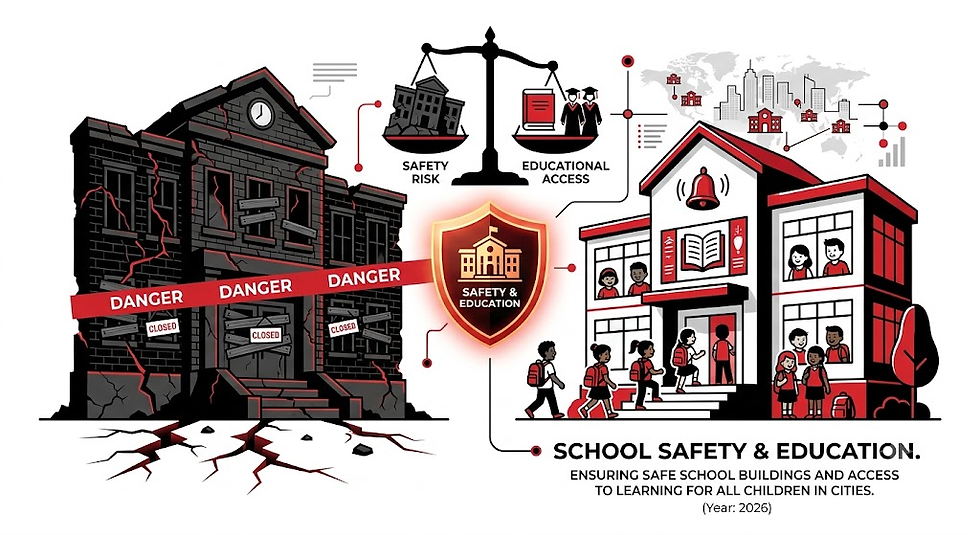
Imagine a cold winter morning in a bustling metropolitan area. Hundreds of students gather outside their primary school’s padlocked iron gates. A bright yellow notice pasted to the brick wall delivers a devastating blow: “Closed indefinitely due to structural integrity failures.”
For these children, their daily routine—and their path to a brighter future—abruptly grinds to a halt.
This scenario is playing out with increasing frequency across the globe. As our cities expand at unprecedented rates, they face a silent, ticking time bomb: decaying, outdated, or poorly constructed educational facilities. Urban planners, school boards, and policymakers are caught in a complex double-bind. Do they allow children to continue learning in structurally compromised buildings to preserve their immediate access to learning? Or do they shut these facilities down for repairs, inadvertently violating the fundamental right to education?
This delicate balance forms the unsafe school dilemma.
The Scale of the Crisis: Urban School Decay in 2026
As we navigate 2026, the physical state of urban public education has reached a critical bottleneck. Millions of children in both developing and developed nations attend classes in buildings that pose direct threats to their physical well-being.
According to global infrastructure assessments, over 50% of public school buildings in major European cities were constructed prior to 1990—long before modern seismic, thermal, or ecological safety standards were established (Serrano-Jiménez et al., 2025). In rapidly expanding urban centers across low- and middle-income countries, the situation is even more dire. Severe structural deficits, a lack of perimeter fencing, compromised electrical grids, and a lack of clean, running water plague thousands of public schools (Fobosi, 2026).
These issues go far beyond aesthetic decay. Structural instability, poor ventilation, extreme indoor temperatures, and waterborne pathogens present everyday dangers. Yet, simply shutting these schools down to address safety concerns often triggers a secondary crisis: the immediate displacement of students, leading to learning loss, increased dropout rates, and a widening of socio-economic divides.
Why Modern Cities Struggle with School Infrastructure Safety Measures
Addressing this crisis requires a systematic approach to what experts call school infrastructure safety measures. However, implementing these measures in modern cities is incredibly difficult due to three primary systemic barriers:
1. Chronic Underfunding and Budget Splitting
Ministers of Education are consistently forced to make impossible choices with tight annual budgets. They must constantly split resources between maintaining existing, aging structures and building brand-new facilities to accommodate growing urban populations (Huss & Keudel, 2020). When funds are tight, preventative maintenance is often the first item cut, allowing minor structural issues to spiral into catastrophic failures.
2. Disjointed Execution and Quality Control
In many urban centers, school portfolios are composed of wildly different construction typologies. These buildings are often financed by disparate national programs but executed by local municipal governments that lack rigorous quality control and strict standards enforcement (Fernández et al., 2023). This leads to a dangerous disconnect between theoretical safety codes and actual on-the-ground construction quality.
3. The Digital and Technological Divide
While wealthy school districts are beginning to utilize immersive, simulation-based digital twin technologies to monitor building stress and resilience in real-time, underfunded urban schools struggle to afford basic repairs like fixing leaky roofs or replacing exposed electrical wiring (Ugliotti et al., 2026).
Mapping the Dilemma: Structural Safety vs. Educational Access
The core of this dilemma lies in the tension between two equally vital mandates: keeping children safe and keeping them in school.
To understand how these competing priorities clash in the real world, we can look at the immediate consequences of choosing one priority over the other:
Priority Focus | The Human Action taken | The Positive Outcomes | The Unintended Consequences |
Strict Infrastructure Safety First | Shut down structural liabilities immediately; wait for full rehabilitation funding. | • Zero physical risk to students. • Eradicates liability for school boards. • Forces municipal budget conversations. | • Extreme learning disruption. • Surge in dropouts, especially among vulnerable groups. • Parents lose reliable daytime childcare. |
Uninterrupted Educational Access First | Keep compromised schools open; apply temporary "band-aid" patches to classrooms. | • Keeps children in structured environments. • Maintains progress toward learning goals. • Prevents immediate social disruption. | • High risk of tragedy from structural collapse or fire. • Poor lighting, heat, and ventilation impair cognitive function. • Long-term repair costs increase. |
This table highlights why a simple "black or white" policy cannot solve the problem. If a city shuts down ten unsafe public schools without a contingency plan, thousands of children lose their safe haven. But if the city keeps them open, it risks a devastating structural failure.
Navigating the Path Forward: Strategic Solutions
Resolving this crisis requires cities to move away from reactive, emergency closures and adopt proactive, phased interventions. Urban planners and school systems can balance these competing priorities by implementing several key strategies:
Phased Rehabilitation Over Complete Shutdowns: Instead of closing an entire school, districts can isolate and repair vulnerable wings sequentially. Using temporary, high-quality modular classrooms on-site allows learning to continue while heavy construction occurs nearby.
Decentralized Decision-Making Frameworks: Cities should adopt data-driven prioritization frameworks. By assessing schools based on both functionality (ventilation, overcrowding, sanitation) and structural safety (seismic integrity, foundation health), municipalities can allocate limited budgets to the schools in the most critical danger first (Fernández et al., 2023).
Leveraging Living Educational Infrastructure: Integrating natural solutions, such as planting shade trees and creating green spaces, can mitigate extreme heat and improve ventilation naturally. This reduces the mechanical load on older buildings while boosting student well-being (Velasquez-Camacho et al., 2026).
Public-Private Partnerships (PPPs): Governments can collaborate with private developers to accelerate retrofitting programs, using private capital to handle immediate construction costs in exchange for long-term municipal leases.
Frequently Asked Questions
What is the primary cause of the unsafe school dilemma in modern cities?
The dilemma is driven by rapid urban growth outpacing municipal budgets. Cities struggle to fund essential school infrastructure safety measures while simultaneously ensuring that every child's right to an education is upheld without disruption. This leads to difficult choices between immediate closures for repairs and keeping compromised buildings open to avoid student displacement.
How does poor school infrastructure affect a child’s learning?
Beyond the obvious physical dangers, poor infrastructure directly impacts academic performance. Substandard ventilation, poor lighting, high carbon dioxide levels, and extreme indoor temperatures make it incredibly difficult for students to focus, leading to lower cognitive retention and higher absenteeism.
Can digital technology help resolve these safety issues?
Yes. Modern structural monitoring, such as building sensors and digital twin simulations, can identify structural weaknesses before they become dangerous. This allows municipalities to conduct targeted, preventative maintenance, avoiding the need for sudden, emergency school closures.
What are modular classrooms, and are they a viable temporary solution?
Modular classrooms are prefabricated, temporary learning spaces that can be quickly assembled on-site. They allow schools to relocate classes safely within the school grounds during structural renovations, preventing learning disruption while critical repairs are made.
Rebuilding Our Schools for a Safer Tomorrow
No child should ever have to choose between their safety and their education. Striking a balance between structural engineering requirements and the fundamental human right to learn is one of the most pressing challenges facing urban planners and policymakers today. By investing in proactive, data-driven maintenance and utilizing creative, temporary space solutions, we can build cities where schools are both safe havens and engines of opportunity.
To learn more about sustainable urban development and successful school retrofitting initiatives, explore the resources below:
Learn about global standards at the United Nations Office for Disaster Risk Reduction (UNDRR)
Explore international funding initiatives through the World Bank Education Global Practice
Read about building resilient school environments at the Global Alliance for Disaster Risk Reduction & Resilience in Education Sector (GADRRRES)
References
Fernández, R., Correal, J. F., D’Ayala, D., & Medaglia, A. L. (2023). A decision-making framework for school infrastructure improvement programs. Structure and Infrastructure Engineering, 21(2), 165–184. https://doi.org/10.1080/15732479.2023.2199361 Cited by: 47
Fobosi, S. C. (2026). Realising the right to quality basic education in the Eastern Cape through infrastructure norms and standards. Frontiers in Education, 11(1), 102–115.
Serrano-Jiménez, S., Antoniadis, A., & Velasquez-Camacho, L. (2025). Thermal comfort and historical building stock challenges in European educational facilities. Journal of Urban Ecology, 14(3), 88–99.
Ugliotti, F. M. (2026). Rethinking Education on Critical Infrastructure Resilience and Risk Management: Insights from a Systematic Review. Sustainability, 18(6), 3067. https://doi.org/10.3390/su18063067
Velasquez-Camacho, L. (2026). Growing unnoticed: reframing school trees as living educational infrastructure. Frontiers in Forests and Global Change, 9(2), 112–120. https://doi.org/10.3389/ffgc.2026.1864511



Comments