TCS AI Revenue Crosses $2.3 Billion: How AI Is Fueling Growth in 2026
- Apr 11
- 4 min read
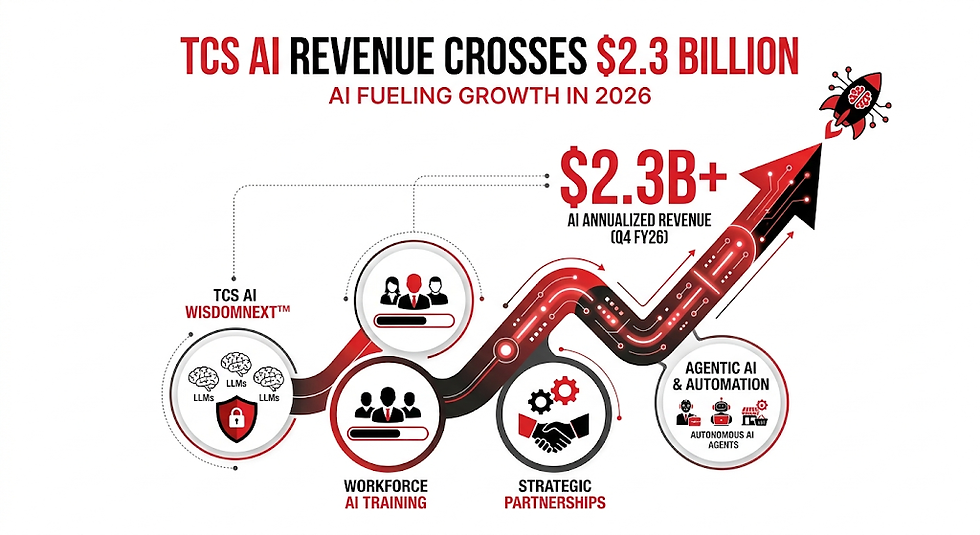
The global technology landscape has undergone a seismic shift, and as we navigate through April 2026, one name stands at the forefront of this revolution: Tata Consultancy Services (TCS). The company recently sent ripples through the financial world by announcing that its annualized TCS AI revenue crosses $2.3 billion, a milestone that cements its position as a global leader in the "Infrastructure-to-Intelligence" era.
This isn't just a number on a balance sheet; it is a testament to how enterprise AI has moved from experimental "Proof of Concepts" (PoCs) to large-scale, value-driving deployments. In this deep dive, we explore how TCS is leveraging its specialized platforms like TCS AI WisdomNext™ and strategic partnerships to redefine the future of IT services.
The $2.3 Billion Milestone: A New Era for TCS
For years, skeptics questioned whether Artificial Intelligence would cannibalize the traditional IT services model. The FY26 Q4 results have silenced those doubts. By reporting an annualized AI revenue exceeding $2.3 billion, TCS has proven that AI is not a threat, but a massive tailwind.
Key Financial Highlights (Q4 FY26)
Metric | Value | Year-on-Year (YoY) |
Annualized AI Revenue | $2.3 Billion+ | Significant Growth |
Consolidated Net Profit | ₹13,718 Crore | 12.2% Increase |
Quarterly Revenue | ₹70,698 Crore | 9.6% Increase |
Operating Margin | 25.3% | 4-Year High |
Total Contract Value (TCV) | $12 Billion | Record Highs |
The fact that TCS AI revenue crosses $2.3 billion indicates that AI now contributes approximately 7% of the company's total revenue run rate. This growth is fueled by three "mega deals" signed in the final quarter of 2026, signaling that global enterprises are ready to spend big on intelligent transformation.
How AI Is Fueling Growth at TCS in 2026
TCS hasn't just "added AI" to its portfolio; it has rebuilt its service delivery model around it. The strategy is centered on moving beyond simple automation to creating self-governing, autonomous enterprises.
1. Scaling with TCS AI WisdomNext™
One of the primary catalysts for this growth is the TCS AI WisdomNext™ platform. In an era where companies are overwhelmed by a plethora of Large Language Models (LLMs) and cloud providers, WisdomNext acts as an orchestration layer. It allows businesses to:
Compare and contrast LLMs: Choose the best model for specific tasks based on cost and performance.
Rapid Deployment: Use pre-built "AI Agents" for industry-specific tasks (e.g., mortgage processing or retail rebate management).
Ensure Governance: Maintain strict ethical and security guardrails—a must-have for BFSI (Banking, Financial Services, and Insurance) clients.
2. Strategic "Infrastructure-to-Intelligence" Partnerships
TCS has formed a powerhouse ecosystem to support its AI ambitions. Notable 2026 collaborations include:
Nvidia: The launch of the "Rapid Outcome AI" platform, which utilizes Nvidia Omniverse for creating digital twins and Nvidia's full-stack AI for real-time industrial monitoring.
OpenAI & AMD: Leveraging the HyperVault infrastructure platform to accelerate the deployment of generative AI solutions.
Cloud Giants: Deep integrations with Google Cloud, AWS, and Azure (specifically for Oracle-to-Cloud migrations) have ensured that the underlying data for AI is clean, accessible, and scalable.
Workforce Transformation: Building an AI-First Culture
You can't sell AI without an AI-ready workforce. As of April 2026, TCS boasts a headcount of 584,519 associates. What’s truly impressive is the scale of their upskilling:
270,000+ associates now hold high proficiency in AI/ML.
69 million learning hours were logged in FY26, a 23% increase YoY.
5.2 million competencies were acquired by the workforce in a single year.
By investing in human capital, TCS ensures that its consultants aren't just technologists—they are "contextual masters" who understand how to apply AI to solve specific business problems in manufacturing, retail, and life sciences.
Industry-Specific Impact: Where the Growth is Happening
The surge in revenue isn't limited to a single sector. In 2026, AI-led transformation is visible across the board:
Banking & Finance: Developing generative AI-powered digital assistants (like the one created for Deutsche Bank) for cross-border compliance.
Aviation & Logistics: Partnering with Swissport and Etihad Airways Engineering to streamline operations using AI-led predictive maintenance.
Consumer Goods: Automating complex financial reporting and rebate management using autonomous agents.
"FY26 marked a pivotal year... our annualized AI revenues surpassed $2.3 billion, driven by the accelerated deployment of AI solutions. We are strengthening our positioning across Infrastructure-to-Intelligence." — Aarthi Subramanian, President and COO, TCS
Future Outlook: FY27 and Beyond
While FY26 had its share of macroeconomic hurdles, the record $12 billion TCV in Q4 provides incredible revenue visibility for the upcoming fiscal year. Analysts from firms like Nomura and Nuvama have turned bullish, noting that as TCS AI revenue crosses $2.3 billion, the company is perfectly positioned for a massive recovery in FY27.
The focus will now shift toward "Agentic AI"—where AI doesn't just suggest actions but executes them autonomously within secure enterprise guardrails.
FAQ: Understanding TCS’s AI Growth
Q1: Why is it significant that TCS AI revenue crosses $2.3 billion?
A: It marks the transition of AI from a buzzword to a core revenue driver. At $2.3 billion, AI now accounts for roughly 7% of TCS's total revenue, proving that enterprise-scale AI deployment is a reality in 2026 and a primary engine for growth.
Q2: What is TCS AI WisdomNext™?
A: It is an industry-first GenAI orchestration platform. It helps enterprises navigate the complex landscape of AI models and cloud services by providing a unified interface to design, deploy, and govern AI workflows.
Q3: How many TCS employees are trained in AI?
A: TCS has one of the world's largest AI-ready workforces. Over 270,000 employees are highly proficient in AI and Machine Learning, backed by millions of hours of annual training.
Q4: Which partnerships are fueling TCS's AI success?
A: Key partnerships include Nvidia (for the Rapid Outcome AI platform), OpenAI, AMD, and major cloud providers like Google Cloud and AWS.
Conclusion: The Path Forward
The announcement that TCS AI revenue crosses $2.3 billion is a landmark moment for the Indian IT sector. It proves that with the right mix of specialized platforms, strategic alliances, and a massive focus on talent development, traditional service giants can lead the AI revolution.
As we look toward the remainder of 2026, the question is no longer if AI will drive growth, but how fast it will scale. For TCS, the answer seems to be "very fast."


Comments