Tech Compliance Costs: Why States Force Federal Privacy Laws
- 4 days ago
- 6 min read
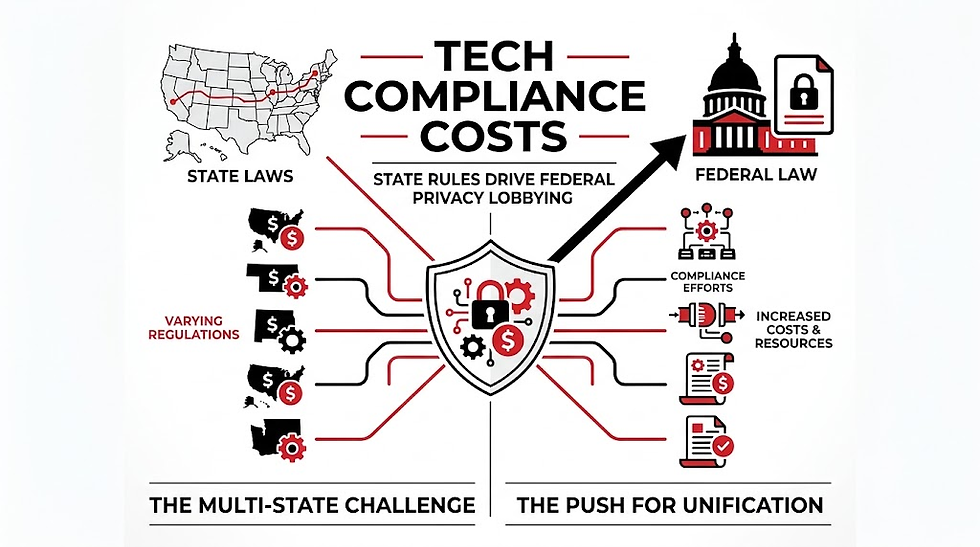
Imagine operating an enterprise e-commerce platform across the United States. A user in California exercises their right under the California Consumer Privacy Act (CCPA) to review privacy risk assessments for algorithmic profiling. Minutes later, a user in Texas submits an opt-out request for targeted advertising under the Texas Data Privacy and Security Act (TDPSA). Meanwhile, a resident in Rhode Island requests data deletion under an applicability threshold that kicks in at just 35,000 consumers—a fraction of other states’ requirements.
For years, corporate boardrooms viewed comprehensive federal privacy legislation with deep suspicion, viewing federal oversight as unnecessary government intervention. Today, the executive tone has flipped completely.
As state capitols across the country continue passing their own data protection
bills, corporate America is facing a fragmented legal landscape. The resulting tech compliance costs federal privacy laws could eliminate are no longer just an accounting line item; they have become a multi-billion-dollar tax on enterprise innovation. Tech giants, trade groups, and Fortune 500 companies are now leading the charge on Capitol Hill, aggressively lobbying for a single, preemptive federal privacy standard to end the multi-state regulatory mess.
The 2026 Patchwork: A Fragmentation Crisis
As of 2026, 24 U.S. states have enacted comprehensive consumer data privacy laws. While many of these statutes draw inspiration from the European Union's General Data Protection Regulation (GDPR) or early state models like Virginia's VCDPA, their operational differences are vast.
These structural disconnects mean that a data hygiene policy compliant in one zip code can lead to steep enforcement penalties just across the state line:
Varying Applicability Thresholds: While Texas and Virginia apply rules based on processing data from 100,000 consumers, Rhode Island lowered its threshold to 35,000 consumers. This single change instantly pulled thousands of mid-sized digital businesses into complex regulatory compliance overnight.
Opt-In vs. Opt-Out Frameworks: Most states enforce an opt-out model for targeted advertising and data sales, but almost all require affirmative opt-in consent for processing "sensitive personal data". What qualifies as sensitive, however, varies dramatically—ranging from neural data and precise geolocation down to specific health diagnoses and union memberships.
Data Broker Regimes & DROP Platforms: State-level mechanisms like California's Delete Request and Opt-out Platform (DROP) require registered data brokers to process centralized global deletion requests within strict 45-day windows, creating localized technical burdens that do not exist elsewhere.
The Expiration of Cure Periods: Early state laws granted businesses a 30- to 60-day "right to cure" alleged violations before fining them. As states modernize their frameworks, cure provisions are rapidly expiring or being repealed outright, exposing firms to immediate regulatory fines of up to $7,500 per deliberate violation.
Anatomy of the Escalating Tech Compliance Costs
Why are corporate legal teams and chief technology officers raising the alarm? Because managing dozens of distinct legal standards simultaneously requires staggering financial and operational resources.
The primary cost drivers crushing enterprise margins include:
1. Complex Data Mapping and Architecture Engineering
To honor Data Subject Access Requests (DSARs)—such as the right to know, correct, or delete personal information—organizations must know exactly where every byte of user data lives. Engineering teams spend thousands of hours building automated data-lineage tools capable of tagging data down to individual jurisdiction tags.
2. Algorithmic Risk Assessments and AI Auditing
State privacy mandates now heavily regulate automated decision-making and artificial intelligence. Regulators demand comprehensive, documented Data Protection Impact Assessments (DPIAs) before companies can run AI algorithms for targeted advertising, credit scoring, or customer profiling. In states like California and Connecticut, companies must prove their models do not produce unlawful discriminatory effects or train large language models (LLMs) on unconsented consumer data.
3. Legal Retainers and Continuous System Re-Engineering
Maintaining compliance across 24 distinct legal frameworks requires around-the-clock legal counsel. Every time a state legislature amends its privacy act or issues new agency enforcement rules, software engineering teams must pause product roadmaps to re-architect consent banners, preference centers, and backend APIs.
Compliance Cost Layer | Operational Impact | Estimated Cost Scale |
Data Discovery & Mapping | Continuous automated indexing across cloud databases, legacy systems, and third-party SaaS tools | $150,000 – $500,000 annually per enterprise |
DSAR Automation Software | Specialized privacy management software (e.g., OneTrust, BigID) to orchestrate cross-system deletions | $50,000 – $250,000 in software licensing |
Legal Counsel & DPIAs | External law firms mapping state variations and drafting mandatory privacy impact assessments | $300 to $800+ per billable hour |
Engineering Delays | Diverting software engineers from core revenue products to privacy consent infrastructure | Opportunity costs exceeding millions in delayed rollouts |
Key Industry Insight: Research from privacy trade groups indicates that managing a multi-state compliance model costs medium-to-large businesses upwards of $2.5 million annually—with more than 60% of those funds spent simply reconciling conflicting state definitions rather than improving actual user privacy.
Why Industry Leaders Are Lobbying for Federal Preemption
For decades, big tech and industry trade groups lobbied against federal privacy standards, fearing overly restrictive regulations. However, as the state-by-state regulatory burden metastasized, industry trade groups—including the Business Software Alliance (BSA) and the U.S. Chamber of Commerce—shifted their political strategy.
Industry is now actively lobbying Congress to enact a single comprehensive federal privacy law—such as draft legislation modeled around national data standards like the SECURE Data Act. Their lobbying efforts center around three critical demands:
1. Express Federal Preemption
This is the holy grail for enterprise lobbyists. Preemption means the federal privacy law would explicitly override and replace all 24 state privacy statutes. A preemptive federal statute gives companies one regulatory target. Instead of managing 24 different cookie-consent rules, opt-out thresholds, and profiling disclosures, tech platforms build one baseline system for all American users.
2. Barring the Private Right of Action
Industry leaders strongly oppose privacy laws that include a "Private Right of Action"—a provision that allows individual consumers or trial attorneys to sue companies directly for statutory privacy violations. Except for specific California data breach scenarios, almost all current state privacy laws restrict enforcement solely to State Attorneys General or dedicated privacy agencies. Corporate lobbies argue that a federal law allowing class-action lawsuits would spur frivolous litigation, making the tech compliance costs federal privacy laws were meant to reduce even worse.
3. Regulatory Predictability and FTC Centralization
Industry advocates want enforcement centralized under a single federal body—primarily the Federal Trade Commission (FTC)—working alongside State Attorneys General under unified guidelines. Centralized oversight brings national administrative consistency, clear advisory guidance, and predictable enforcement targets.
The Path to National Standardization
How can national enterprise organizations tame escalating privacy costs right now while waiting for Congress to act? Industry experts recommend moving away from fragmented, state-by-state reactive measures in favor of a highest-common-denominator privacy baseline.
1. Establish a Universal Privacy Baseline (Architecture Strategy)
Design system architecture to comply with the strictest active jurisdiction (typically California or Europe's GDPR). By building data pipelines that respect stringent opt-in consent for sensitive processing and honor universal opt-out signals across the board, you automatically satisfy milder state laws.
2. Deploy Universal Opt-Out Signal Recognition (Technical Integration)
Implement automated recognition for Global Privacy Control (GPC) signals. Allowing web browsers to automatically communicate a consumer's opt-out preference satisfies compliance obligations across almost all active state regimes without requiring localized form designs.
3. Automate Data Inventory and Lifecycle Policies (Governance & Engineering)
Replace manual spreadsheet tracking with automated data-discovery tools that index databases in real time. Enforce strict data-minimization schedules so that non-essential consumer records are systematically deleted, reducing risk surfaces during regulatory audits.
4. Standardize Algorithmic Impact Assessments (AI & Risk Management)
Create a centralized Data Protection Impact Assessment (DPIA) template covering automated profiling, AI model training, and sensitive data handling. Standardizing this document ensures your engineering teams can satisfy regulatory requests from any state Attorney General instantly.
Frequently Asked Questions (FAQ)
How do rising tech compliance costs federal privacy laws address help smaller businesses?
A unified federal privacy law lowers entry barriers for small and medium-sized enterprises (SMEs). Managing 24 different state legal frameworks requires expensive specialized legal retainers and automated compliance platforms that small businesses often cannot afford. A single federal standard allows growing businesses to invest their capital into core product engineering rather than multi-state legal compliance.
What is the difference between an opt-in and an opt-out data model?
Under an opt-out model, businesses can process or sell consumer data by default until the individual explicitly tells them to stop (e.g., clicking "Do Not Sell My Personal Information"). Under an opt-in model, companies are legally prohibited from collecting or processing data until the user gives explicit, affirmative consent—a standard widely required for sensitive data like precise location or health metrics.
Will federal privacy legislation completely replace state privacy laws?
That depends on whether Congress includes "express preemption" in the final text. If preemption is included, the federal law replaces state-level consumer privacy acts entirely. If Congress passes a "floor" rather than a "ceiling," states would retain the power to enforce stricter rules, meaning compliance fragmentation would persist.
Take Control of Your Enterprise Privacy Framework
Navigating complex multi-state privacy regulations doesn't have to paralyze your technology team or drain your operational budget. By shifting from reactive state-by-state patches to an automated, resilient privacy engine, your organization can protect consumer trust while controlling technology compliance costs.
Ready to audit your data architecture, streamline your DSAR pipelines, and prepare your tech stack for potential federal privacy legislation?


Comments