The Burning Arena: How Extreme Heat Is Changing Global Sports
- 7 days ago
- 6 min read
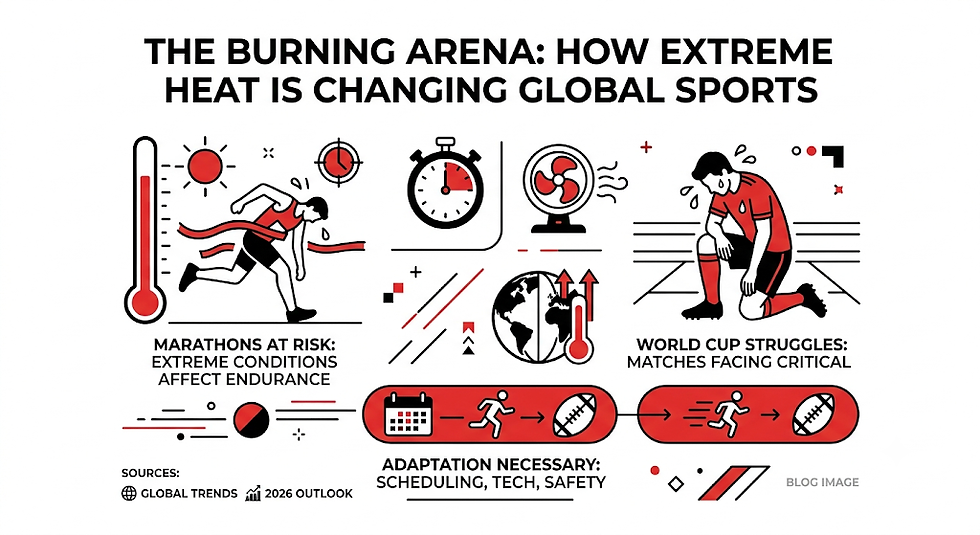
As the world warms, the boundaries of athletic endurance are being redrawn. Once considered a test of human will against the elements, athletic competition is now facing a direct, existential threat from climate change. In 2026, the global sports calendar is no longer just a showcase of human achievement; it is a high-stakes experiment in survival.
From soccer pitches in North America to legendary marathon courses across Europe, rising temperatures are transforming how games are played, when they are scheduled, and whether they can safely happen at all.
The Rising Stakes of the Global Sports Economy
The sports industry is an economic powerhouse. According to a 2026 World Economic Forum report, the global sports economy is valued at $2.3 trillion annually. However, this massive market faces a projected 14% decline in revenue by 2030 (over $517 billion) and up to an 18% drop ($1.6 trillion) by 2050 due to the dual threats of accelerating climate change and climate-induced physical inactivity.
Sporting events are no longer dealing with rare "freak" weather events. Instead, they are operating under a new, volatile baseline where extreme heat is the default opponent.
                          SPORTS ECONOMY AT RISK (WEF 2026 Data)

     Current Valuation: $2.3 Trillion
     ────────────────────────────────────────────────────────────────────────
     Projected Loss by 2030: █ █ █ █ █ █ 14% ($517 Billion)
     ────────────────────────────────────────────────────────────────────────
     Projected Loss by 2050: █ █ █ █ █ █ █ █ 18% ($1.6 Trillion)
Soccer on the Searing Pitch: The 2026 FIFA World Cup and Beyond
The crown jewel of the 2026 sporting calendar—the FIFA World Cup, co-hosted by Canada, Mexico, and the United States—serves as the ultimate case study for this climate-driven shift. With 48 teams playing 104 matches across 16 cities, millions of fans are witnessing first-hand how extreme heat is changing global sports.
Unprecedented Heat at Host Stadiums
A comprehensive analysis by Climate Central reveals that 14 of the 16 World Cup stadiums are experiencing significantly more extremely hot June-July days than during the first North American World Cup in 1970.
The Culprit: Carbon pollution accounts for roughly 49% of these extreme heat days since 1970.
The Hotspots: Cities like Miami, Mexico City, Houston, and Guadalajara are the hardest hit. At Mexico City’s historic Estadio Azteca, the annual frequency of extremely hot June-July days has surged from just two days in the 1980s to 11 days in 2026.
The Game Impact: Climate change has increased the probability of performance-impairing heat (temperatures above 28°C or 82.4°F) in 97 of the 104 scheduled matches. Nearly half of these matches (49) carry a 50% or higher probability of crossing this safety threshold.
The Physiological Limit: Wet Bulb Globe Temperature (WBGT)
Organizers are heavily reliant on Wet Bulb Globe Temperature (WBGT)—a metric combining temperature, humidity, wind, and solar radiation to measure heat stress on the human body.
Guidelines from the global players' union (FIFPRO) state that when the WBGT hits 26°C, cooling and hydration breaks are mandatory. If it reaches 28°C, conditions are deemed unsafe, and postponement is recommended. Historically, matches rarely reached these levels. In 2026, multiple open-air venues are regularly flirting with these critical limits during daytime kickoffs, forcing organizers to shift kickoff times to late evenings and invest heavily in hydration breaks and player-cooling technologies.
Running in the Red Zone: The Crisis Facing Marathons
While team sports can utilize substitutions and scheduled breaks, endurance athletics—specifically marathons—offer no such sanctuary. The human body acts as a thermodynamic engine; when running at high intensity for hours, it must dissipate massive amounts of metabolic heat. When ambient temperatures rise, this dissipation process fails.
                     THE ENDURANCE HEAT LIMIT

     Optimal Marathon Temp: ───►  8°C to 15°C (46°F - 59°F)
     Performance Decline Begins: ─►  Above 16°C (61°F)
     High Clinical Danger Zone: ──►  Above 25°C (77°F) [WBGT]
Falling Out of the Optimal Zone
In 2025 and 2026, the elite marathon calendar has been plagued by unseasonably high temperatures. Runners at the Berlin Marathon struggled under record-breaking heat, while participants at the 2026 Los Angeles Marathon faced conditions so severe that organizers took the unprecedented step of allowing runners to officially "finish" and receive medals at mile 18 to prevent widespread exertional heat stroke.
Recent sports science studies warn that the meteorological window for hosting safe, high-performance spring and autumn marathons is shrinking rapidly. Elite athletes are seeing their times drop as cardiovascular strain and dehydration limit oxygen delivery to muscles. For recreational runners, the risks are far more severe, often leading to a spike in emergency medical admissions for exertional heat illnesses.
How Extreme Heat Is Changing Global Sports: Adaptation vs. Mitigation
As the planet continues to warm, sports organizations are realizing that they cannot simply wait out the heat. They must adapt. Here is how governing bodies, teams, and venue operators are responding to how extreme heat is changing global sports:
1. The Death of the Summer Calendar
For decades, the summer months were the prime real estate for global sports. Now, we are witnessing a permanent shift in scheduling. The 2022 FIFA World Cup in Qatar pioneered the winter shift, and future bids for major tournaments are increasingly looking at shoulder seasons or winter months to protect athletes and spectators.
2. High-Tech Cooling Infrastructure
Stadiums are transforming into climate-controlled oases. At the 2026 World Cup, air-conditioned venues like Houston's NRG Stadium offer relief, but open-air stadiums are forced to innovate. Innovations include:
Advanced micro-climate cooling canopy systems to lower bowl temperatures.
Rapid-cooling "ice baths" and misting stations located directly on the sidelines.
Hyper-accurate wearable biometric sensors that track real-time core body temperatures to alert coaches before a player suffers heat exhaustion.
3. Rule Modifications and "Heat Breaks"
Traditional rules are being rewritten to accommodate the heat. The ATP and WTA tennis tours have standardized mandatory 10-minute cooling breaks between sets when extreme heat policies are triggered. Similarly, soccer now features official "cooling breaks" mid-half to allow players to rehydrate and apply cold towels.
The Turf Danger: It is not just the air temperature. Studies in 2026 show that artificial turf surfaces can absorb solar radiation and heat up to 60°C (140°F) hotter than natural grass, radiating skin-blistering surface temperatures of over 71°C (160°F) on mid-summer days. This has forced grassroots and youth sports organizations to abandon afternoon play entirely.
The Unequal Playing Field: Global Disparities in Adaptation
While elite sports leagues like the NFL, Premier League, or FIFA can afford multi-million dollar cooling infrastructures, grassroots, youth, and developing-nation sports are bearing the brunt of the climate crisis.
┌────────────────────────────────────────────────────────────────────────┐
│                        THE ADAPTATION GAP                              │
├──────────────────────────────────────┬─────────────────────────────────┤
│ Elite Sports                        │ Grassroots & Youth Sports        │
├──────────────────────────────────────┼─────────────────────────────────┤
│ • Climate-controlled stadiums        │ • Unshaded public parks         │
│ • On-site medical & thermal experts  │ • Overheated artificial turf    │
│ • High-tech cooling vests & sensors │ • Limited hydration/ice access   │
│ • Evening/night broadcast scheduling │ • Fixed, dangerous midday play  │
└──────────────────────────────────────┴─────────────────────────────────┘
In community sports, children are losing weeks of play because park equipment is too hot to touch and unshaded fields present a high risk of heat illness. This "adaptation gap" threatens to widen existing public health disparities, as access to safe outdoor exercise becomes a luxury.
Conclusion: A New Era for Athletics
Climate change has permanently altered the sports landscape. The question is no longer if extreme heat will disrupt our favorite pastime, but how we will adapt to save it. As we look beyond 2026, the survival of global sports depends on a rapid transition toward sustainability and a collective effort to protect the athletes who inspire us.
To explore more about how sports leagues are fighting climate change, visit the Climate Central Information Hub (https://www.climatecentral.org) or check out the latest initiatives by the World Economic Forum on Sustainable Sport (https://www.weforum.org).
Frequently Asked Questions
Q1: How extreme heat is changing global sports events today?
Answer: Extreme heat is fundamentally altering sports by forcing events to shift to winter months or later evening hours, introducing mandatory cooling breaks, and requiring massive investments in stadium cooling technologies to ensure the safety of both athletes and spectators.
Q2: What is Wet Bulb Globe Temperature (WBGT), and why is it used?
Answer: WBGT is a comprehensive environmental metric that measures heat stress by combining air temperature, humidity, wind speed, and solar radiation. It is widely used in sports because it provides a much more accurate representation of how the human body experiences thermal stress during physical exertion than standard temperature alone.
Q3: Why are artificial turf fields particularly dangerous in hot weather?
Answer: Artificial turf acts as a heat sink. It absorbs solar radiation and can reach surface temperatures up to 60°C (140°F) hotter than natural grass. On a hot summer day, this can create an extreme micro-climate just inches above the ground, putting players at immediate risk of heat exhaustion and skin burns.
Q4: Are spectators also at risk during hot-weather sporting events?
Answer: Yes, spectators face significant risks. While some stadiums feature shaded or cooled seating, fans are highly exposed during travel, queuing outside venues, and participating in outdoor fan festivals. Dehydration and heat stroke among fans are becoming increasingly common at major tournaments.
Join the Movement for Sustainable Sports
The games we love are on the line. As athletes, fans, and community members, we have a role to play in advocating for climate action and supporting sports organizations that prioritize green infrastructure.
Stay Informed: Read the UN Sports for Climate Action Framework (https://unfccc.int/climate-action/sectoral-engagement/sports-for-climate-action) to see how global leagues are committing to net-zero emissions.
Get Involved: Advocate for shaded areas, water stations, and safer scheduling policies at your local grassroots sports clubs.


Comments