The Fragile Grid: How Geopolitical Impacts on Technology Reshape Startup Funding and Tech Careers
The tech industry was once celebrated as a borderless digital utopia. Code crossed frontiers seamlessly, venture capital flowed wherever growth promised the highest returns, and talented software engineers could secure remote roles from almost anywhere on earth.
That borderless era has officially ended.
As we navigate 2026, the global tech ecosystem is deeply entangled with international relations. From trade restrictions and semiconductor crossfires between global superpowers to regional kinetic conflicts in Eastern Europe and West Asia, the macro-environment has fundamentally shifted. For startup founders seeking capital and engineers planning their professional trajectories, understanding the profound geopolitical impacts on technology is no longer optional—it is a core survival mechanism.
1. The Death of Borderless Venture Capital: High-Risk Capital Realignment
The global venture capital (VC) landscape has experienced a dramatic structural transformation. The "spray-and-pray" investment frameworks that dominated the turn of the decade have been replaced by extreme caution and high strategic selectivity.
The Rise of Capital Concentration and Transactionalism
According to recent venture data, global VC funding has entered a highly concentrated era. While total capital allocation remains resilient—with the average deal size in the Western hemisphere climbing past $20 million—investors are backing fewer, larger, and safer bets.
This environment is heavily driven by what economists call "transactional diplomacy." Alliances and trade frameworks are increasingly treated as negotiable deals by governments. For venture funds, this introduces immense regulatory friction, causing them to pull back from cross-border investments that could face retroactive scrutiny.
The Regional Funding Bottleneck
The localized shocks of international conflict have immediate, tangible downstream effects on capital availability:
West Asia & Emerging Ecosystems: Prolonged regional conflicts have directly triggered funding freezes. For example, startup hubs across South Asia saw early-stage venture inflows plummet by over 40% year-on-year in the first half of 2026 as global institutional investors pulled back to mitigate currency volatility and supply chain exposure.
The Return to Unit Economics: Pure user-growth metrics and high cash-burn strategies are heavily penalized by investors. In a world defined by geopolitical instability, VCs demand proof of robust unit economics, early profitability, and structural insulation from external supply chain shocks.
2. The Great Decoupling: Techno-Nationalism and AI Sovereignty
The intersection of industrial policy and national security has forced a deep fragmentation across digital infrastructure. Technology is no longer viewed simply as a commercial asset; it is now recognized as a primary instrument of state power.
Navigating Geopolitical Impacts on Technology in Infrastructure
Nations are racing to establish absolute digital and AI sovereignty. The European Union continues to scale local alternatives to reduce reliance on foreign hyperscalers, while other global powers maintain tightly monitored, closed digital ecosystems. This fragmenting landscape forces scaling tech companies to manage separate, localized infrastructure stacks to remain compliant with conflicting global frameworks, driving up operational overhead.
The Semiconductor and Compute Squeeze
The global hardware pipeline remains highly vulnerable. Ongoing investigations into advanced semiconductors and critical minerals frequently threaten new tariffs, import restrictions, and strict domestic-content rules. Startups developing compute-heavy applications—particularly foundation AI models—face strict export controls and rigorous customer due diligence frameworks, adding months of delay to product rollouts.
3. Tech Careers Re-Bordered: Layoffs, Visas, and Defensive Hiring
For technology professionals, the shifting geopolitical climate has fundamentally rewritten the rules of employment, talent mobility, and career progression.
The End of Remote Borderless Arbitrage
The golden era of the frictionless global remote worker has contracted. As regulatory regimes tighten data-privacy mandates, compliance frameworks often restrict developers residing in certain jurisdictions from accessing production environments or sensitive source code. Tech companies are actively replacing broad global outsourcing models with structured "friend-shoring" or "near-shoring" alternatives, moving engineering hubs exclusively to politically aligned nations.
The Rise of Dual-Use and Defensive Tech Demand
While general consumer tech startups face ongoing belt-tightening and selective engineering layoffs, specific tech sectors are experiencing unprecedented hiring booms. The rise of sophisticated, malicious agentic AI capabilities has forced critical financial and physical infrastructure networks to rapidly scale their defensive postures.
Consequently, career opportunities have skewed heavily toward:
Defensive AI Engineering: Building real-time AI agents tasked with autonomous vulnerability patching and frontline system defense.
National Security Tech (GovTech): Developing highly localized, secure software platforms tailored for public sector infrastructure.
Supply Chain Logic Optimization: Creating resilient logistics algorithms capable of routing around sudden maritime bottlenecks or airspace closures.
4. Playbook for Tech Leaders and Engineers
Thriving in an era of heightened geopolitical volatility requires proactive operational adjustment. Below are actionable frameworks for both founders and tech professionals.
Strategic Roadmap for Startup Founders
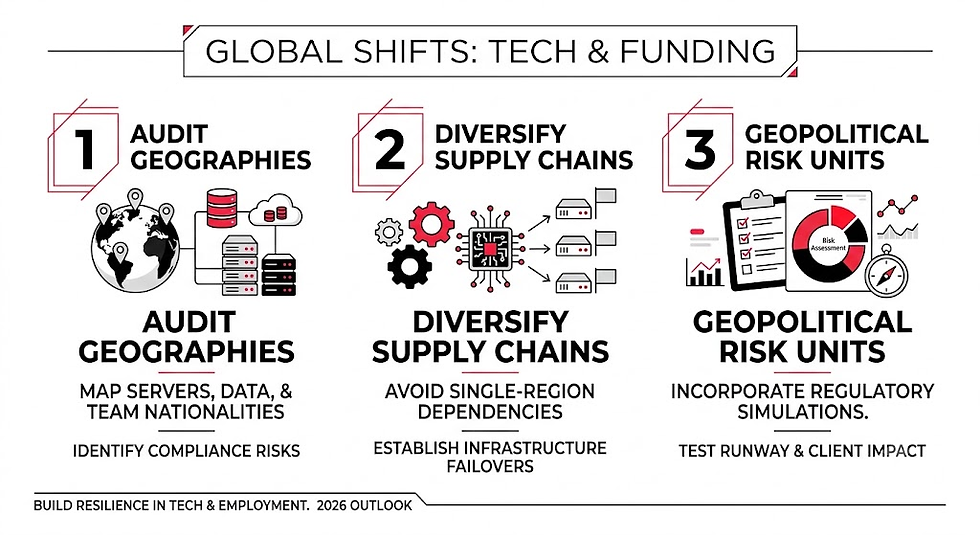
Audit Tech Stack Geographies (Prerequisite): Map out where your servers are hosted, where your data resides, and the nationalities of your core engineering team to identify potential compliance exposure.
Diversify the Supply and Compute Chain (Supply Chain Mitigation): Avoid single-region dependencies for hardware components or cloud compute. Establish alternative infrastructure failovers in geopolitically neutral or friendly zones.
Establish Geopolitical Risk Units (Operational Readiness): Incorporate regulatory simulations into quarterly planning. Test how a sudden tariff hike, data localization law, or regional conflict would impact your runway and active client base.
Career Roadmap for Tech Professionals
Pivot to Core Infrastructure Resilience: Focus skill acquisition on cybersecurity, defensive machine learning, and decentralized system architectures.
Understand Data Residency Realities: Familiarize yourself with local compliance frameworks. Engineers who understand how to design systems around data sovereignty laws are highly valued assets.
Target Well-Buffered Sectors: When evaluating startup opportunities, look closely at their funding sources and the geographic distribution of their customer base to gauge their stability.
5. Frequently Asked Questions
How exactly do global conflicts cause tech sector layoffs?
When regional conflicts escalate, they introduce macroeconomic instability, causing venture capitalists and corporate boards to reduce risk exposure. VCs tighten their checkbooks, forcing startups to cut operational costs to extend their financial runway. Additionally, strict compliance laws can prevent companies from working with remote engineering teams located in specific regions, resulting in targeted structural layoffs.
What industries are safest from geopolitical impacts on technology?
Industries deeply tied to national infrastructure, sovereign security, and physical supply chain resilience show strong stability. Sectors like defensive cybersecurity, GovTech, localized green energy infrastructure, and B2B SaaS focused on supply chain logistics continue to see robust investment and hiring demand, even during periods of high global tension.
Can a startup still secure cross-border venture capital in 2026?
Yes, but the compliance hurdles are much higher. VCs are conducting deeper due diligence regarding where a startup's data is stored, where its intellectual property is registered, and how vulnerable its operation is to international trade disputes. Startups with highly localized, compliance-first operations find it much easier to attract global institutional capital.
Proactive Resilience Strategies
The intersection of global politics and the digital economy has reshaped the path forward. By understanding these shifting macro trends, tech leaders and engineers can build resilient systems, protect their funding pipelines, and make informed career pivots that withstand external volatility.
Looking to safeguard your venture or elevate your tech career? Explore these resources to stay ahead of the curve:
Learn more about the latest macro investment trends by visiting the International Monetary Fund Economic Outlook.
Review emerging corporate risk strategies via the Boston Consulting Group Insights.
Track global risk data directly through the World Economic Forum Global Risks Hub.
To explore these shifts in motion, this Venture Capital Funding Analysis provides a clear breakdown of how recent international tensions directly trigger pullbacks in major startup ecosystems, offering real-world context on how these macro pressures play out on the ground.


Comments