The Global Semiconductor Race: Reliance's AI Vision and Global Peace Efforts
- Jun 18
- 6 min read
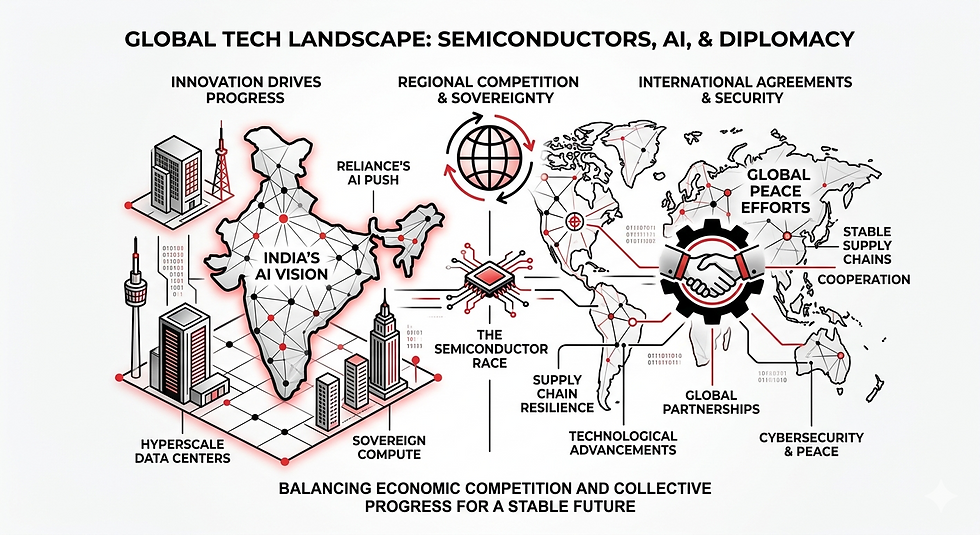
In 2026, the traditional markers of geopolitical power—territorial size, military headcount, and oil reserves—have been permanently superseded by a new, microscopic currency: the silicon transistor. The global semiconductor race has evolved from a standard industrial competition into the primary theater of economic security and international diplomacy.
The stakes could not be higher. Generative AI chips alone are projected to approach $500 billion in revenue in 2026, commanding roughly half of all global chip sales according to Deloitte. As nations realize that relying on external supply chains means "renting intelligence," the push for technological sovereignty is redefining corporate strategies and global peace efforts alike. At the epicenter of this shift is India, driven by the massive, multi-billion-dollar scale of the Reliance AI vision.
Understanding the New Silicon Geopolitics
To comprehend why world leaders are treating chip fabrication plants (fabs) like sovereign borders, one must look at the structural divergence occurring across industries. Computing chips, advanced memory solutions, and hyper-complex packaging are no longer just components inside consumer electronics; they are the baseline national infrastructure required to run autonomous economies, medical networks, and defensive systems.
For professionals and business leaders, paying attention to this ecosystem is no longer optional. A bottleneck in a single node can halt downstream manufacturing, spike cloud computing costs, or stall enterprise software rollouts. The race is no longer merely about winning a market—it is about securing the fundamental computational capacity to survive.
Key Trends and Developments in 2026
The current year has brought monumental shifts in how digital infrastructure is funded, regulated, and deployed globally. Three major pillars define the landscape in 2026:
1. Reliance Jio’s 10 Lakh Crore Infrastructure Gamble
At the recent India AI Impact Summit 2026, Reliance Industries Chairman Mukesh Ambani shifted the company's focus from digital ambition to hyper-scale execution. Reliance announced a staggering ₹10 lakh crore ($120+ billion) investment over the next seven years to build out an independent, national AI infrastructure.
Crucially, this includes an active partnership with Meta Platforms to develop a massive 168-megawatt, green-energy-powered data center in Jamnagar, Gujarat. By deploying the Jio AI Stack across healthcare (Jio Arogya AI), education (Jio Shiksha), and local languages (Jio Sanskriti AI), Reliance is actively ensuring that India avoids renting foreign computational models.
2. The Era of "Chips Act 2.0" and Tech Sovereignty
The legislative landscape has hardened. The European Union has moved forward with its Chips Act 2.0, reframing semiconductor policy as a core geopolitical capability rather than a simple industrial subsidy. Concurrently, the United States is building upon its original CHIPS and Science Act framework to enforce stricter geographical restrictions, keeping advanced logic and memory production within allied economic blocs.
3. The "Pax Silica" Diplomatic Framework
Paradoxically, the intense competition within the global semiconductor race has created a fragile ecosystem where stability is mandatory. Because highly specialized equipment and rare earth elements must be cross-sourced from multiple regions, major superpowers are participating in the "Pax Silica" initiative. This framework balances domestic manufacturing expansion with structured international partnerships, treating chip supply chain resilience as an alternative mechanism for global peace efforts.
Benefits, Challenges, and Strategic Opportunities
The convergence of artificial intelligence infrastructure and chip manufacturing presents a complex web of outcomes for modern enterprises.
Key Benefits
Democratized Intelligence: Massive localized data infrastructure brings down the cost of processing enterprise data, mimicking the way mobile data costs were optimized a decade ago.
Supply Chain Diversification: As foundries expand into the US, Europe, and India, businesses face a lower risk of single-point-of-failure disruptions from historic chip manufacturing hubs.
Cultural and Linguistic Customization: Sovereign AI models allow localized, multi-lingual enterprise tools to be built without losing structural meaning in western-trained base models.
Major Challenges
Extreme Value Concentration: Generative AI hardware consumes a massive portion of silicon wafers, threatening to cause severe shortages and potential 50% price spikes in legacy chips used by automotive and industrial automation sectors.
Gigawatt-Scale Energy Demands: Hyperscale data centers require immense power. Scaling AI requires simultaneous, massive investments in renewable energy and green cooling infrastructure.
Geopolitical Regulatory Compliance: Stricter export controls mean international businesses must navigate a fragmented regulatory environment regarding where data is processed and where hardware is sourced.
Strategic Opportunities
Green AI Data Centers: Enterprises specializing in sustainable utility management, desalinated cooling, and renewable energy grids have an unprecedented market opportunity to service new computing hubs.
Edge Compute Deployment: Integrating lightweight, highly efficient local models on edge networks minimizes the reliance on centralized, power-hungry cloud fabrics.
Industry Insights and Expert Analysis
The consensus among industry analysts in 2026 is clear: the semiconductor market is navigating a high-stakes paradox. While soaring AI-driven demand pushes industrial revenues toward the trillion-dollar mark, placing too many eggs in a single architectural basket introduces systemic volatility.
Thought Leadership Insight: "True corporate resilience in 2026 means moving beyond algorithmic capability. If your business model depends entirely on hosting data in a foreign cloud infrastructure, you do not own your operational destiny. The future belongs to those who build, secure, and power their own sovereign compute stacks."
If commercial monetization of consumer-facing generative AI slows down over the next three to five years, data center providers must be ready to pivot their special-purpose logic and advanced memory configurations toward biotechnology, advanced physics simulations, and climate forecasting to avoid severe market corrections.
Practical Recommendations for Decision Makers
To safeguard an organization against the volatility of the current technology landscape, business leaders should implement the following steps:
Conduct a Structural Silicon Audit: Identify where your critical software vendors host their models. Determine if your primary supply lines rely on legacy nodes vulnerable to capacity crowding from AI chip production.
Transition to Hybrid Sovereign Architecture: Avoid total dependence on singular global cloud providers. Map critical workloads to local, sovereign data infrastructure to meet regional data protection regulations.
Invest in Power-Efficient Models: Prioritize developers and platforms that use advanced compilation and quantized models to reduce computational overhead and rising processing fees.
Operational Checklist for Tech Procurement
[ ] Verify supplier compliance with regional export control laws (e.g., US CHIPS Act or EU Tech Sovereignty package).
[ ] Factor an estimated 30–50% volatility buffer into hardware and memory procurement budgets for mid-2026.
[ ] Review enterprise service-level agreements (SLAs) regarding localized data residency and offline backup availability.
Frequently Asked Questions
What exactly is the global semiconductor race?
The global semiconductor race is the intense geopolitical and corporate competition to control the design, fabrication, and packaging of microchips. These components serve as the foundational hardware for artificial intelligence, telecommunications, and defense systems worldwide.
How does the Reliance AI vision impact the average business?
The Reliance AI vision aims to democratize access to advanced computing infrastructure across India. By investing in gigawatt-scale, sustainable data centers and the Jio AI Stack, they are lowering the cost of computational intelligence, making specialized AI applications affordable for small and medium enterprises.
Why are chip manufacturing plants tied to global peace efforts?
Because the microchip supply chain is highly integrated and globally distributed, no single nation can achieve absolute technological insulation. Superpowers must engage in collaborative diplomatic frameworks, often dubbed "Pax Silica," to guarantee steady trade flows of raw materials and manufacturing equipment, turning economic interdependence into a tool for geopolitical stability.
What is the primary bottleneck in scaling AI infrastructure in 2026?
The greatest limitations are raw computing access, specialized memory components, and electrical grid capacity. Hyperscale data centers require massive power configurations, which is driving leaders to construct facilities powered exclusively by dedicated renewable energy grids.
How do modern regulations like the EU Chips Act 2.0 change corporate strategies?
These regulations encourage companies to establish manufacturing footprints within trusted allied trade blocs. Businesses must rebalance their international strategies, shifting away from highly concentrated manufacturing zones to comply with regional technological sovereignty mandates.
Conclusion
The global landscape has made one reality undeniable: computational power is national power. The global semiconductor race is no longer a localized issue for Silicon Valley or East Asian manufacturing hubs—it dictates the economic resilience of every modern enterprise. Through unprecedented infrastructure initiatives like the Reliance AI vision, the world is shifting away from centralized, rented technology models toward sovereign, sustainable, and democratized digital frameworks. Embracing this shift, diversifying hardware dependency, and integrating with localized computing networks will define the successful organizations of the coming decade.
Engage with the Future of Tech Sovereignty
As the global semiconductor race accelerates, staying ahead requires understanding the deep integration of hardware, software, and international policy. Organizations must actively redesign their digital roadmaps to capitalize on localized infrastructure and resilient supply networks.
Resources for Further Exploration
European Parliament Legislative Briefings: Detailed tracking and analysis of the Tech Sovereignty Package and Chips Act 2.0 frameworks.
SEMI Global Policy Portal: Up-to-date strategies regarding trade compliance, supply chain traceability, and material sourcing updates.
Reliance Industries Investor & Technology Disclosures: Official updates regarding the Jamnagar green data center development and Jio AI ecosystem applications.
For a deeper look into how these technological movements align on the global stage, you can watch this comprehensive breakdown on Jio's Tech Ecosystem at the AI Impact Summit. This video highlights how indigenous digital architecture is being positioned as a core national capability during major state leadership summits.


Comments