The Golden Shield: How Rising Inflation Is Driving India’s Gold Boom in 2026
- 15 hours ago
- 6 min read
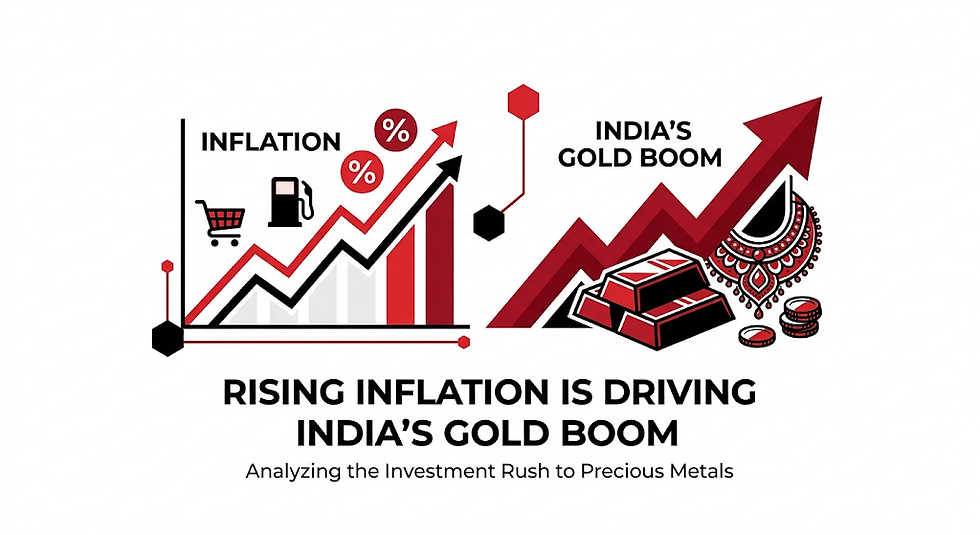
For centuries, gold has been woven into the cultural, social, and economic fabric of Indian society (Reetu, 2026). It is not merely a decorative metal kept in lockers; it is an active alternative currency, a celebration staple, and the ultimate financial safety net. As we navigate the economic landscape of 2026, a structural transformation is taking place across metropolitan cities like Mumbai and rural hubs alike.
Global geopolitical friction, fluctuating fiat strengths, and supply chain disruptions have pushed consumer prices upward. Once again, retail and institutional investors are turning to the yellow metal. Rising Inflation Is Driving India’s Gold Boom, signaling a collective flight to safety that is reshaping domestic wealth management and breaking previous market records.
The Macroeconomic Catalyst: Understanding the Inflation Trigger
To comprehend the scale of the current market shift, one must analyze the broader economic factors at play. The global economy in 2026 continues to struggle with the lingering effects of tariff changes and trade fragmentation (Shape, 0). Consequently, India's headline consumer inflation has faced upward pressure, with the Asian Development Bank projecting domestic inflation to climb toward 4.5% due to external challenges and energy import stresses (Asian Development Bank [ADB], 2026).
Global Tariff Shocks ──> Rising Energy/Import Costs ──> Domestic Inflation Spikes (4.5%) ──> Flight to Gold Assets
When the purchasing power of the Indian Rupee (INR) faces erosion, traditional savings instruments offering fixed yields become less attractive. This reality is compounded by currency depreciation, as the Rupee has faced a 4.5% depreciation against the U.S. Dollar under pressure from Middle Eastern conflicts and shifting global capital flows (ADB, 2026). When fiat currencies lose ground, physical tangible assets with intrinsic value naturally step in to fill the vacuum (Ji, 2026).
Historical Context: Gold as the Ultimate Wealth Preserver
The concept of using gold as a hedge against currency debasement is deeply rooted in empirical economic patterns (Ji, 2026). Unlike paper money, which central banks can print in response to structural deficits, the global supply of gold remains limited.
Historically, during periods of hyperinflation or stagflation, equity markets often exhibit extreme volatility, while fixed-income yields fail to keep pace with the real cost of living. In contrast, gold prices frequently exhibit a strong positive correlation with long-term inflation indicators, functioning as a reliable store of value when other asset classes falter (Ji, 2026).
Indian households hold the largest private stock of gold globally, with cumulative domestic holdings exceeding an estimated 25,000 tonnes (Reetu, 2026). This vast reserve underscores a long-held economic truth: when local market conditions turn unpredictable, the domestic population shifts its capital from liquid bank accounts into precious metals to preserve multi-generational purchasing power.
Analyzing the Elements: How Rising Inflation Is Driving India’s Gold Boom
The modern surge in precious metal accumulation is driven by a combination of retail demand, central bank policies, and financial innovation.
1. The Shrinking Value of Cash Savings
With core consumer prices remaining sticky, the real rate of return on standard bank fixed deposits (FDs) and savings accounts has diminished. Investors are increasingly aware that maintaining capital in cash means losing purchasing power over time. Gold provides an alternative vehicle that historically adjusts its baseline pricing alongside rising commodity costs.
2. Central Bank Accumulation Signals Market Direction
Retail investors are not the only ones moving into precious metals; institutional players are leading the way. Globally, central banks have aggressively expanded their reserves, with total official gold holdings reaching $3.909 trillion, nearly matching foreign official holdings of U.S. Treasury securities (Jan, 2026). The Reserve Bank of India (RBI) has participated actively in this diversification strategy, increasing its official sovereign gold reserves to 523 tonnes (Jan, 2026). This institutional shift provides strong validation for retail buyers seeking a long-term safe haven.
3. Geopolitical Risk and Safe-Haven Rallies
The global geopolitical environment in 2026—marked by tensions in the Persian Gulf and trade disputes—has fundamentally altered traditional market correlations (Jan, 2026). In exceptional crisis regimes, gold prices have rallied significantly, detaching from their historical inverse relationship with the U.S. Dollar Index (Jan, 2026). For Indian buyers, this means gold offers protection against both domestic inflation and global systemic volatility.
Physical vs. Digital: The Evolving Gold Investment Landscape
While physical jewelry, coins, and bars remain central to traditional household savings, the structural structure of India's capital markets has expanded considerably (Reetu, 2026). Modern investors can choose from a variety of gold-backed financial instruments, each featuring distinct cost models and liquidity profiles.
Investment Instrument | Annual Net CAGR (Average) | Lifecycle Cost Burden | Unique Structural Advantage |
Sovereign Gold Bonds (SGB) | ~13.29% | 0.00% (Maturity) | Fixed 2.5% annual coupon interest |
Gold Exchange Traded Funds (ETFs) | Intermediate | Low Management Fees | Dematerialized trading via stock exchanges |
Digital Gold Platforms | Intermediate | Transactional Spread | Fractional purchases starting at ₹1 |
Physical Gold Jewellery | ~8.03% | ~30.20% (High) | Tangible utility and cultural familiarity |
Empirical analysis indicates that Sovereign Gold Bonds offer the highest net compound annual growth rate (CAGR), largely due to zero lifecycle cost at maturity and a supplementary interest coupon (Reetu, 2026). Conversely, traditional jewelry carries a higher cost burden due to making charges and design premiums (Reetu, 2026).
However, the rise of fintech-driven digital platforms has democratized entry points, allowing tens of millions of mobile-first consumers to make fractional purchases starting at just one rupee (Reetu, 2026).
Consumer Behavior: The Shift in Household Portfolios
The impact of sticky inflation is visible in changing consumer choices across both urban and rural demographics. Historically, surplus agricultural income was directed almost exclusively toward physical jewelry during the post-harvest wedding season. In 2026, though physical demand remains robust, a distinct behavioral pivot toward wealth preservation is underway.
Middle-class households are increasingly reallocating portions of their monthly systematic investment plans (SIPs) away from highly valued mid-cap equities and into gold ETFs and digital gold. This shift does not reflect a loss of faith in India's long-term economic growth, which remains resilient at a projected 6.9% for the fiscal year (ADB, 2026). Instead, it shows a tactical decision to balance portfolios with non-correlated defensive assets as inflation markers fluctuate.
Expert Projections: What Lies Ahead for Gold Prices?
Market analysts use highly sophisticated hybrid forecasting models, incorporating convolutional neural networks (CNN) and online media sentiment mining, to project future gold price trajectories (Ji, 2026). Current market indicators point toward sustained upward pressure on precious metals through the remainder of 2026.
Given that domestic inflation is expected to remain above long-term baseline targets before stabilizing, consumer demand for gold is projected to remain strong (ADB, 2026). Any further depreciation of the rupee against global benchmarks will directly raise the local landed cost of gold imports, driving domestic spot prices higher regardless of international market movements.
Strategic Takeaways for Retail Investors
Navigating a gold bull market driven by inflationary pressures requires a disciplined approach to asset allocation.
Avoid Over-Concentration: While gold serves as an effective hedge, it remains a non-yielding asset (aside from SGB coupons). Financial advisors generally recommend maintaining a portfolio allocation of 10% to 15% in gold assets.
Match Instrument to Objective: If your goal is wearable utility and cultural celebration, physical jewelry remains the standard choice. However, if your goal is pure capital preservation, digital gold, ETFs, or sovereign bonds offer superior tracking efficiency and lower overhead costs (Reetu, 2026).
Monitor Macro Indicators: Keep a close eye on Reserve Bank of India repo rate announcements and consumer price index (CPI) updates. A shift toward aggressive monetary tightening could cool inflationary pressures and stabilize the gold rally.
Frequently Asked Questions (FAQs)
Why is rising inflation driving India's gold boom right now?
Rising inflation is driving India's gold boom because persistent price increases reduce the purchasing power of cash savings. When traditional bank deposits yield negative real returns after adjusting for inflation, investors move their capital into gold, which has historically maintained its value over time.
How does rupee depreciation impact domestic gold prices in India?
Because India imports the vast majority of its gold, international prices are denominated in U.S. Dollars. When the Indian Rupee depreciates against the dollar, it requires more rupees to import the same quantity of gold, automatically raising domestic prices for retail consumers.
Which is a better investment option during inflation: physical gold or digital gold?
From a financial efficiency standpoint, digital gold instruments like ETFs and Sovereign Gold Bonds tend to outperform physical jewelry. They eliminate making charges, storage risks, and resale liquidity deductions, allowing the investor to capture the pure price movement of the underlying asset (Reetu, 2026).
Conclusion: Balancing Growth and Protection
The current expansion in India's gold markets is a rational consumer response to complex macroeconomic pressures (Ji, 2026). As structural inflation and global trade adjustments test the purchasing power of fiat currency, the yellow metal continues to offer reliable protection (Shape, 0; ADB, 2026). By integrating strategic gold allocations into a balanced portfolio, investors can protect their wealth from inflationary pressures while participating in India's broader economic journey.
Take Action: Secure Your Wealth Today
Invest Smarter: Compare Top-Performing Gold Mutual Funds and ETFs on Groww
Sovereign Security: Read the Official Sovereign Gold Bonds Investor FAQ & Guide


Comments