The Ripple Effect: How Global Crude Price Petrol India Dynamics Shape Your Budget in 2026
- Mar 27
- 6 min read

If you’ve pulled up to a fuel station in New Delhi or Mumbai lately, you’ve likely felt the tension in the air. As of March 2026, the digital boards at the pump are more than just numbers—they are a reflection of a high-stakes global chess game involving superpowers, shipping lanes, and currency markets.
Understanding how Global Crude Price Petrol India movements interact is no longer just for economists; it’s essential for every Indian commuter. With the Rupee flirting with the 94-per-dollar mark and geopolitical flares in the Middle East causing crude to behave like a volatile tech stock, the "price per litre" has become a national obsession.
In this deep dive, we’ll unpack the complex machinery behind India's fuel pricing, the latest 2026 data on tax revisions, and why the "Strait of Hormuz" might be more important to your wallet than your local bank's interest rate.
The Anatomy of a Litre: What Are You Actually Paying For?
When you pay approximately ₹95 for a litre of petrol in Delhi, only a fraction of that is the actual cost of the oil. The journey from a derrick in Siberia or a well in Saudi Arabia to your fuel tank is expensive and heavily taxed.
1. The Base Price (The Global Factor)
India imports nearly 89.5% of its crude oil requirements. This means we are "price takers," not "price makers." When the Indian Crude Basket—the weighted average of sour and sweet grades India buys—swings, the base price moves in tandem. In March 2026, this basket saw a historic surge, jumping from $70 per barrel in February to nearly $156 on March 19th before stabilizing near $100.
2. Freight and Refining
Once the crude reaches Indian shores (at ports like Jamnagar or Mundra), it must be refined. Refineries like those run by IOCL, BPCL, and HPCL turn "black gold" into usable petrol. This adds refining margins and transportation costs (freight) to the mix.
3. Dealer Commission
The person running the petrol pump isn't doing it for free. As of 2026, dealer commissions typically range between ₹3.50 to ₹4.00 per litre, depending on the location and volume.
4. The Tax Heavyweights: Excise Duty and VAT
This is where the price doubles. The Central Government levies Excise Duty, while State Governments levy Value Added Tax (VAT).
Component (Estimated Delhi, March 2026) | Price (₹/Litre) |
Base Price + Freight | ₹55.20 |
Excise Duty (Post-March 26 Cut) | ₹11.90 |
Dealer Commission | ₹3.85 |
VAT (State Tax) | ₹23.82 |
Total Retail Price | ₹94.77 |
Global Crude Price Petrol India: The 2026 Geopolitical Storm
The primary reason for the recent volatility in the Global Crude Price Petrol India corridor is the 2026 West Asian crisis. Following military actions in the Middle East and the subsequent closure of the Strait of Hormuz—a chokepoint through which 20% of the world’s oil flows—global supply chains were thrown into chaos.
The $150 Barrel Scare
In mid-March 2026, Brent crude prices briefly touched $156.29 per barrel. For a country like India, every $10 increase in the price of crude oil expands the Current Account Deficit (CAD) by roughly 0.4% of the GDP.
The Government’s "Bailout" for Citizens
On March 26, 2026, the Union Government took a decisive step to prevent a domestic price explosion. They slashed the Special Additional Excise Duty on petrol from ₹13 per litre to just ₹3 per litre.
Expert Insight: "By taking a hit on its own tax revenue, the government ensured that Oil Marketing Companies (OMCs) could absorb the massive global price spike without passing it entirely to the consumer. Without this intervention, petrol would likely have crossed the ₹130 mark in major metros." — Hardeep Singh Puri, Union Minister (March 2026).
The "Double Whammy": Crude Spikes and Currency Slides
It isn't just the price of oil that matters; it's the currency we use to buy it. Crude oil is traded globally in US Dollars (USD).
In March 2026, the Indian Rupee (INR) faced significant pressure, approaching a record low of 94 per USD. This created a "double whammy" effect:
Direct Cost: The price per barrel of oil went up.
Conversion Cost: Each dollar needed to buy that barrel became more expensive to acquire.
When the Rupee weakens, "imported inflation" follows. Since fuel is a key input for transporting food and consumer goods, a higher Global Crude Price Petrol India impact quickly translates into higher prices for tomatoes, grains, and Amazon deliveries.
Why Is Petrol Cheaper in Delhi Than in Mumbai?
One of the most common frustrations for Indian travelers is seeing the price change as they cross state borders. As of March 2026, the disparity remains stark:
New Delhi: ₹94.77
Mumbai: ₹103.54
Bangalore: ₹102.96
Hyderabad: ₹107.50
The reason? VAT (Value Added Tax). While the Central Excise Duty is uniform across India, each state government sets its own VAT. States like Maharashtra and Telangana have historically maintained higher VAT percentages to fund state-specific welfare schemes and infrastructure projects.
There is an ongoing debate in 2026 about bringing petroleum products under the Goods and Services Tax (GST). If this were to happen, we could see a uniform price nationwide—likely capped at 28%. However, states are reluctant to give up this "sure-shot" revenue stream, making GST for petrol a distant dream for now.
The Biofuel Shield: Ethanol Blending to the Rescue
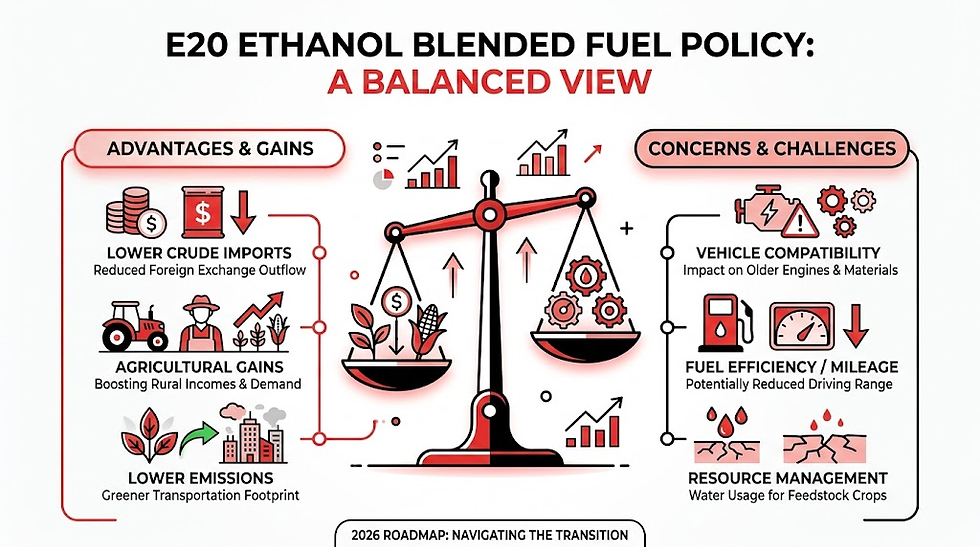
If there is a silver lining in 2026, it is India's aggressive push toward energy sovereignty. India successfully achieved 20% Ethanol Blending (E20) across the country by March 2025—five years ahead of the original 2030 target.
How Ethanol Blending Works
Ethanol is a biofuel derived primarily from sugarcane and food grains. By mixing 20% ethanol with 80% petrol, India reduces its reliance on imported crude.
Savings: Between 2014 and 2026, the ethanol program has saved India over ₹1.36 lakh crore in foreign exchange.
The 2026 Goal: The government is now eyeing E25 and E30 targets, with dedicated E100 (100% ethanol) pumps already operational in over 400 locations.
While ethanol has a slightly lower energy density (meaning a minor 5-7% drop in mileage for older vehicles), the trade-off is a much more stable price at the pump and a cleaner environment.
Future Outlook: What to Expect for the Rest of 2026?
The US Energy Information Administration (EIA) and Goldman Sachs project a "jumpy" year. While the Middle East crisis caused a massive spike in Q1 2026, many analysts expect a global supply surplus to build up by the end of the year as non-OPEC+ producers (like the US and Guyana) ramp up production.
For the Indian consumer, the mantra for 2026 is stability through subsidy. The government appears committed to using excise duty as a "shock absorber" to keep retail rates below the psychological threshold of ₹100–₹110 in most regions, even if global markets go rogue.
Frequently Asked Questions (FAQs)
Q1: How does the Global Crude Price Petrol India correlation work on a daily basis?
Since 2017, India has followed a Dynamic Fuel Pricing mechanism. Every morning at 6:00 AM, OMCs revise the retail price based on the 15-day rolling average of international benchmark prices (Brent Crude) and the USD-INR exchange rate. However, during periods of extreme volatility (like March 2026), the government often intervenes to freeze or subsidize rates to prevent inflation.
Q2: Why didn't petrol prices drop when crude oil fell briefly in February 2026?
Fuel pricing isn't always a one-to-one immediate reflection. When prices fall globally, OMCs often use those "excess" margins to recover losses incurred during previous periods when they chose not to hike prices despite rising crude costs. This is known as "recovering under-recoveries."
Q3: Will petrol ever come under GST?
While the GST Council has the power to include petrol and diesel, it requires a consensus among all state finance ministers. As of March 2026, most states prefer the current VAT system because it allows them to adjust taxes quickly to meet their budget requirements without waiting for GST Council approvals.
Q4: Does the Russia-Ukraine conflict still affect Indian petrol prices in 2026?
Yes, but less directly than in 2022. India has diversified its imports to over 41 countries. While Russia remains a major supplier, providing roughly 35-40% of our crude, the primary driver in 2026 has shifted toward the stability of the Middle Eastern shipping lanes and US-Iran relations.
Conclusion: Staying Informed in a Volatile World
The relationship between Global Crude Price Petrol India is a delicate balance of international diplomacy, domestic tax policy, and currency strength. While we cannot control the price of a barrel in London or New York, India’s transition to biofuels and strategic tax adjustments are proving to be effective shields for the common man.
As we move through 2026, keep an eye on the Rupee and the headlines from the Strait of Hormuz—they are the true barometers of what you'll be paying at the pump tomorrow.


Comments