The Ripple Effect: How Moscow’s Diesel Export Ban Impacts Global Fuel Supply
- Jul 14
- 5 min read
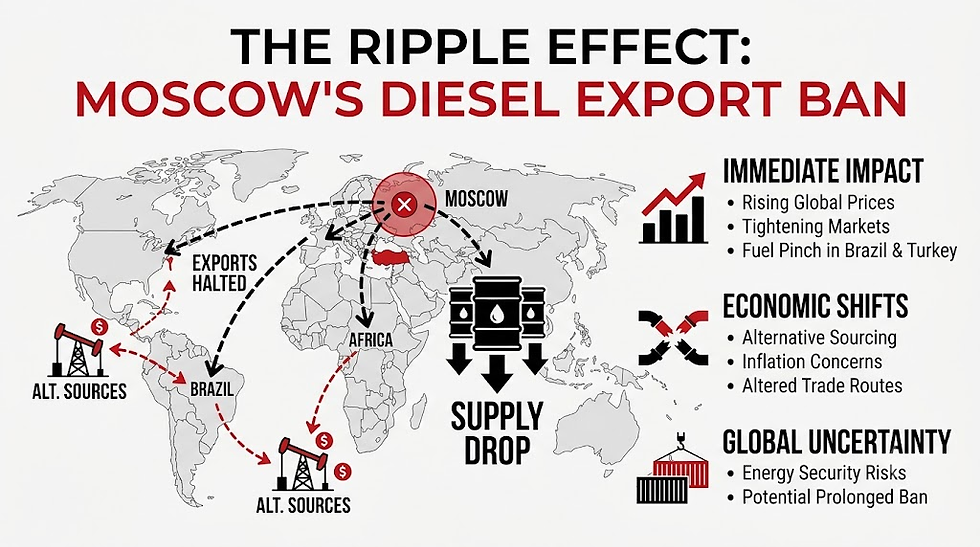
The global energy map is undergoing a seismic shift in 2026. On July 8, 2026, the Russian government announced a sweeping, immediate restriction on its fuel trade. Moscow’s diesel export ban, originally structured as a rolling series of interventions, has been formally solidified to halt all outbound shipments of diesel, marine fuel, and gas oil until at least July 31, 2026.
For a country that has historically acted as the world’s second-largest exporter of diesel, this structural pull-out has sent shockwaves through international logistics and energy grids. The decision was not born out of a conventional geopolitical power play; it is a defensive reaction to a domestic emergency.
Sustained, targeted Ukrainian drone campaigns have severely damaged or halted operations across roughly 30% of Russia’s primary oil processing facilities, including major nodes like the Omsk refinery. With citizens facing hours-long fuel queues and regional distribution networks near a breaking point, the Kremlin chose to isolate its remaining downstream output for domestic stabilization.
The immediate market reaction was swift. Benchmark European diesel margins skyrocketed to an unprecedented $60.17 per barrel, triggering intense competition for alternative barrels across both hemispheres. As supply streams dry up, a critical question emerges: which nations will feel the economic pinch first?
Anatomy of a Fuel Emergency: Why Russia Stopped Exporting
To understand the suddenness of the 2026 crisis, one must look at the sheer drop in volume preceding the official decree. Russia’s seaborne diesel and gasoil exports had already cratered by 39% month-on-month in June. By early July, outbound volumes plummeted to a mere 234,000 barrels per day (bpd)—a staggering 71% drop compared to the 2025 baseline average of 817,000 bpd.
Metric | Historical / Baseline | June 2026 | July 1–10, 2026 |
Russian Diesel Export Volumes | ~817,000 bpd (2025 Avg) | ~400,000 bpd | ~234,000 bpd |
European Diesel Margins | Historical Norms | Rising | $60.17 / bbl (Record) |
Refining Capacity Status | Fully Operational | ~30% Impaired | Extensive Rationing Globally |
Unlike previous restrictions that only targeted third-party trading intermediaries, this latest mandate applies directly to the oil producers themselves. In an ironic twist, Deputy Prime Minister Alexander Novak confirmed that Russia will actively import refined petroleum products from international partners like India to close its internal supply gaps. When a global supply titan transitions into a net buyer, the structural equilibrium of the energy market fractures.
The First Line of Exposure: Dominant Buyers Under Pressure
When Western nations imposed sweeping sanctions on Russian crude following the 2022 invasion of Ukraine, Moscow successfully rerouted its refined flows toward developing economies. Consequently, the immediate fallout of this export ban is concentrated among a handful of emerging markets that grew heavily reliant on discounted Russian distillates.
1. Brazil
Over the past few years, Brazil emerged as a top destination for Russian low-sulfur diesel, utilizing the affordable fuel to power its vast agricultural transport fleets and cross-country freight networks. With Moscow cutting the cord, Brazilian importers are forced to pivot back to the Gulf Coast of the United States. This sudden shift means paying premium global market rates and competing directly with European buyers for Western hemisphere supply.
2. Turkey
Acting as both a major consumer and a strategic transshipment hub, Turkey absorbed roughly half of Russia's available diesel cargoes alongside Brazil in the months leading up to the ban. The abrupt suspension forces Turkish industrial sectors to source fuel rapidly from Mediterranean alternatives, driving up manufacturing overhead and domestic inflation.
3. North and West Africa (Morocco, Egypt, Senegal)
Data tracking from mid-2026 highlights Morocco, Egypt, and Senegal as key importers of Russian diesel. For these nations, fuel security is tightly bound to macroeconomic stability. Finding alternative shipments on short notice requires pulling from a highly constrained global pool, which drains foreign exchange reserves and risks domestic pump price spikes.
Secondary Fractures: Central Asia and the Global South
Beyond the primary maritime buyers, neighboring regions tied to Russia's pipeline and rail networks are experiencing immediate supply friction.
Central Asian Disruptions: Focus on Uzbekistan
The constraints are vividly apparent in regional import data. During the first six months of 2026, Uzbekistan's diesel imports declined by 18.7% compared to the previous year, while the average cost per ton climbed nearly 10%.
By June, as Russian domestic shortages intensified, Uzbekistan's imports from Russia slowed to a mere fraction of their typical seasonal allocations. With a projected demand of 776,000 tons for the upcoming autumn-winter season, Central Asian economies are racing to boost domestic production and secure alternative energy corridors before winter logistics demand peaks.
The Broader Economic Impact of Moscow’s Diesel Export Ban
The consequences of this supply freeze reach far beyond the borders of countries that directly purchase Russian oil products. Diesel is the foundational workhorse of the modern global economy. It fuels public transit, transcontinental shipping, heavy mining machinery, agricultural tractors, and industrial electrical generators.
The US and Europe: Caught in a Bidding War
While the US and Europe have completely banned direct imports of Russian fuel, they cannot escape the reality of an interconnected global market. The removal of Russian supply means that prior buyers must source their diesel from other global entities, such as refineries in the Middle East, India, and the US Gulf Coast.
With US commercial distillate stocks sitting roughly 6% below their historical five-year average, Western markets face a tight supply environment. European buyers must now outbid Latin American and Asian counterparts for every available swing cargo coming out of the Atlantic basin. This reality stokes core inflation concerns for central banks worldwide, as higher transport costs inevitably translate to elevated consumer prices for everyday retail goods.
Looking Ahead: Will the Crisis Extend Past July?
Though Moscow has officially slated the export suspension to last until July 31, 2026, energy analysts remain cautious. Repairing highly intricate, custom-engineered hydrocracker units and distillation towers damaged by drone attacks is an incredibly complex task. Sanctions on specialized industrial components add layers of lead time to these domestic refinery repairs.
If Russia's domestic fuel storage levels fail to recover sufficiently before the critical late-summer agricultural harvesting window, the Kremlin may be forced to prolong the restrictions into the third quarter of 2026. Such an extension would solidify structurally higher diesel premiums, altering global trade routes permanently as buyers seek long-term supply agreements elsewhere.
Frequently Asked Questions (FAQs)
What triggered the implementation of Moscow’s diesel export ban in 2026?
The implementation of Moscow’s diesel export ban was a direct defensive response to internal fuel shortages caused by systematic Ukrainian drone strikes on major Russian oil refineries. These strikes disabled roughly 30% of the nation's domestic refining capacity, leading to rationing and extensive lines at local filling stations. The ban was enacted to prioritize internal supply stability.
Which countries are facing the most immediate impact from the fuel ban?
Brazil and Turkey are the most immediately impacted, as they were absorbing over half of Russia's remaining seaborne diesel cargoes prior to July 2026. Developing economies across North and West Africa (such as Morocco, Egypt, and Senegal), along with Central Asian nations like Uzbekistan, are also experiencing sharp supply drops and rising alternative import costs.
How does a Russian export ban affect countries like the US and Europe that don't buy Russian oil?
Because energy markets are globally integrated, the sudden disappearance of Russian diesel causes former buyers to compete directly for supply from the US, India, and the Middle East. This broad surge in demand drives up global benchmark prices everywhere, raising shipping, transport, and manufacturing costs in both Europe and the United States.
Are there any exemptions to the diesel export ban?
Yes. The Russian government has specified that fuel shipments made under pre-existing, formal international intergovernmental agreements—such as Russia's ongoing supply commitments to Mongolia—are explicitly exempt from the temporary export restrictions.
Navigating Volatile Energy Markets
As structural disruptions rewrite international supply lines, staying ahead of volatile energy swings requires deep market intelligence, real-time tracking, and adaptive trade strategies. Navigating these shifts demands access to reliable data and robust economic resources.
Explore comprehensive global trade data and policy interventions via the Global Trade Alert Repository.
Monitor changing international shipping updates and commercial metrics through Reuters Commodities Intelligence.
Review updated regional development frameworks and market impacts via the Daryo Central Asia News Network.



Comments