The Rise of AI-Powered Search Advertising: How Digital Marketing Is Changing in 2026
- 1 day ago
- 6 min read
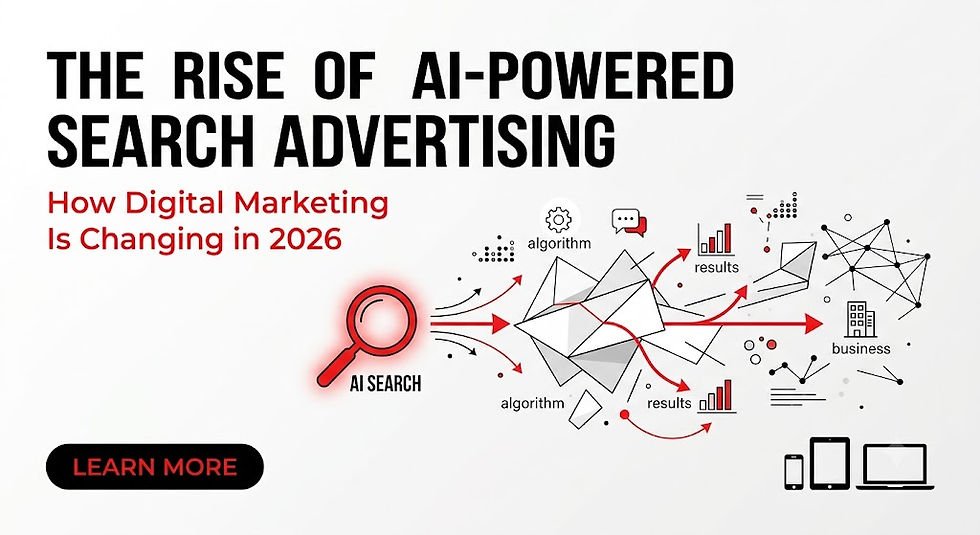
The digital marketing landscape has undergone its most dramatic transformation since the advent of the commercial internet. If the early 2020s were defined by the initial testing of artificial intelligence tools, 2026 is officially the year AI infrastructure took over performance marketing.
Search engines are no longer passive directories serving up a list of blue links. They have evolved into active, conversational intelligence hubs that answer complex questions, synthesize multi-source reviews, and perform transactions without sending users to an external website.
At the center of this shift is the explosive growth of AI-powered search advertising. From Google’s AI Mode and native conversational ads to OpenAI opening its self-serve ad network on ChatGPT, advertising inside generative results is now standard practice.
This article explores how digital marketing is changing, what the metrics look like today, and how forward-thinking brands can adapt their strategy to win in the era of generative discovery.
The Paradigm Shift: From Keywords to Intent & Conversation
For over two decades, search engine marketing relied on a simple premise: match user keywords with relevant ad copy and landing pages. In 2026, that linear funnel has largely collapsed.
The Rise of Conversational Queries
Search queries are longer, more specific, and deeply goal-oriented. Instead of typing "best running shoes," users now input multi-layered prompts:
"Recommend a durable running shoe for a marathon runner with flat feet, prioritizing high cushion and stability, available to buy immediately."
AI engines dissect these prompts through query expansion and intent analysis, delivering a single, synthesized response. Consequently, bidding on isolated keywords has given way to intent-based targeting, where AI ad platforms evaluate the context of the entire conversation before rendering an ad.
High Zero-Click Search Rates
With AI Overviews appearing in nearly half of all informational searches and full AI conversational modes expanding across major engines, user behavior has changed radically:
Classic SERP Zero-Click Rate: ~58–60%
AI Overview Zero-Click Rate: ~83%
Dedicated AI Mode Zero-Click Rate: ~93%
Because users get complete, multi-perspective answers directly on the search engine results page (SERP), traditional organic click-through rates (CTRs) for standard blue links have declined significantly. To capture attention in this environment, marketers are turning directly to AI-powered search advertising to secure placement inside the generated response itself.
How AI-Powered Search Advertising Operates in 2026
Advertising platforms have redesigned their ad formats to sit naturally inside generative responses. Ad placements are no longer banished to the top banner or side rail—they are interwoven into the answer narrative.
+--------------------------------------------------------------------------------+
|  USER QUERY: "What is the best CRM for a 50-person SaaS company?"               |
+--------------------------------------------------------------------------------+
                                       |
                                       v
+--------------------------------------------------------------------------------+
|  GENERATIVE AI RESPONSE                                                        |
|  - Compiles top 3 solutions based on feature matching & sentiment.             |
|  - Cites technical reviews, pricing structures, and user testimonials.         |
|                                                                                |
|  [ NATIVE CONVERSATIONAL AD ]                                                  |
|"Looking for instant deployment? Try BrandX. Talk with our Business Agent     |
|   below to calculate custom pricing or schedule a demo right now."              |
|                                                                                |
|  [ Interactive Chat / Direct Checkout Module Embedded Inside Search ]           |
+--------------------------------------------------------------------------------+
Key Ad Formats Dominating the Market
1. Conversational Discovery Ads
These ads appear as sponsored suggestions or highlighted recommendations within an AI-generated summary. Rather than looking like traditional search ads, they match the tone and context of the AI's answer, complete with dynamic product badges and real-time inventory updates.
2. Business Agents for Lead Generation
Instead of directing users to an external landing page or web form, modern search ads integrate brand-trained AI chat agents. Users can ask technical follow-ups, resolve pricing questions, or submit lead information entirely within the search interface.
3. Native Universal Checkout
Platforms like Google's Universal Cart enable direct conversion right inside the search answer. A user researching products can select items, apply discounts, and complete payment without leaving the generative engine.
Key Industry Benchmarks: 2026 Data & Trends
To understand the magnitude of this shift, consider the latest data defining digital marketing this year:
Metric / Trend | 2026 Industry Benchmark | Impact on Marketing Strategy |
Global Digital Ad Spend | $786.2 Billion (+13.9% YoY) | Ad budgets are expanding, with performance digital channels capturing the majority of total global ad spend. |
US AI Search Ad Spend | $2.08 Billion | Rapid acceleration as ad networks monetize generative answers and conversational platforms. |
AI Overview Ad Coverage | ~25.5% of AI search results contain ads | One in four AI summaries now features a sponsored product, service, or citation. |
Daily AI Marketing Adoption | 75% of Marketers use AI daily | AI is no longer optional; it forms the backbone of bidding, asset creation, and attribution workflow. |
Social Product Discovery | 60% of journeys begin on Social/Video | TikTok, YouTube, and Instagram are rivaling traditional search engines for initial product discovery. |
Key Takeaway: While total ad budgets continue to climb, cost-per-click (CPC) efficiency depends heavily on how effectively campaigns incorporate dynamic assets and structured feeds built for AI ingestion.
Beyond Organic Search: Generative Engine Optimization (GEO)
As organic search traffic compresses, SEO professionals are embracing a new discipline: Generative Engine Optimization (GEO).
GEO focuses on ensuring a brand's products, services, and content are referenced as authoritative sources inside AI-generated summaries.
TRADITIONAL SEO                           GENERATIVE ENGINE OPTIMIZATION (GEO)
+-------------------------------+         +-------------------------------+
| Target: Keyword Rankings      |         | Target: Brand Citations       |
| Metric: Click-Through Rate    |  ====>  | Metric: Mention Share in AI   |
| Asset: Web Page Text          |         | Asset: Structured Knowledge   |
| Goal: Drive On-Site Traffic   |         | Goal: Presence in AI Answer   |
+-------------------------------+         +-------------------------------+
Pillars of a Modern GEO and AI Ads Strategy
Brand Authority & Citations: AI models rely on verified web sources, review aggregators, and digital PR mentions to generate answers. Being cited across third-party media outlets directly increases the likelihood of being featured in organic AI summaries and AI ad placements.
Schema and Structured Data: AI agents require clean, machine-readable data. Implementing complete Schema.org markup, structured pricing, inventory API feeds, and clear FAQ schemas ensures LLMs accurately comprehend your product catalog.
First-Party Data Integration: As third-party tracking vanishes, paid media performance relies on feeding clean conversion data, customer lifetime value (LTV), and real-time offline conversion signals back into ad platform machine learning algorithms.
4 Crucial Action Steps for Marketing Leaders
To maintain competitive efficiency in 2026, marketing teams must adjust their operating playbooks:
1. Upgrade Content for Goal-Oriented Queries
Eliminate thin, fluff-heavy content written purely for keyword density. Modern search engines evaluate overall context, depth, and factual verification. Build content assets that address complex, multi-step customer problems, offer side-by-side product comparisons, and present unique first-party data.
2. Transition to Fully Automated Bidding Architectures
Manual keyword management is largely obsolete. Smart campaigns dynamically synthesize creative variations, adjust bid strategies per context, and serve hyper-personalized copy to targeted users in real time.
3. Measure Share of Model (SoM) alongside Share of Voice (SoV)
Track how frequently your brand appears inside generated responses on major search engines and conversational platforms. High visibility within AI-generated answers directly correlates with higher conversion rates on paid AI search ads.
4. Optimize for Zero-Click Conversions
Ensure your paid search campaigns leverage native extensions—such as click-to-call, conversational chat agents, and universal checkout integration—so customers can convert instantly without friction.
Frequently Asked Questions (FAQ)
What is AI-powered search advertising?
AI-powered search advertising refers to paid promotional campaigns served dynamically within generative AI search results and conversational interfaces. Instead of relying solely on exact keyword triggers and basic text ads, these systems evaluate user intent and conversational context to weave sponsored recommendations directly into generated answers.
How does AI-powered search advertising differ from traditional search marketing?
Traditional search ads appear above or below organic link listings based on keyword matches. AI-powered search advertising embeds ads directly into synthesized answers, using real-time generative capabilities to match detailed user prompts, enable interactive lead capture, or allow direct checkout inside the search experience.
Will zero-click searches kill digital advertising ROI?
No, but it alters where conversions happen. While zero-click queries lower traditional traffic to website landing pages, sponsored placements inside AI results capture users at the peak of buying intent. Brands adapting to native checkout and interactive chat units inside search results are seeing improved conversion rates.
What is Generative Engine Optimization (GEO)?
Generative Engine Optimization (GEO) is the practice of optimizing digital content and brand authority so that generative AI models accurately cite, summarize, and recommend your business in their responses. It complements paid search campaigns by building long-term organic visibility across AI platforms.
How can small businesses afford to compete in AI search ads?
Small businesses can compete by focusing on hyper-targeted niche strategies, maintaining clean structured data feeds, and leveraging automated bidding tools. Bidding on specific, high-intent conversational prompts often yields lower acquisition costs compared to broad commercial keywords.
Scale Your Brand in the Era of AI Search
The shift toward generative search isn't coming—it's already here. Marketers who rely on legacy keyword strategies risk losing visibility as consumers increasingly rely on conversational recommendations and zero-click answers.
To stay ahead, audit your digital presence for generative search readiness, upgrade your product feeds, and deploy smart ad formats built for conversational discovery.
Need expert guidance to modernize your paid media and search strategy? Explore the latest advertising benchmarks and tools at Google Marketing Live or analyze your site’s SEO performance with Semrush to build your strategy today.


Comments