The Ultimate Guide: How to Use ChatGPT for Studying in 2026
- 11 hours ago
- 6 min read
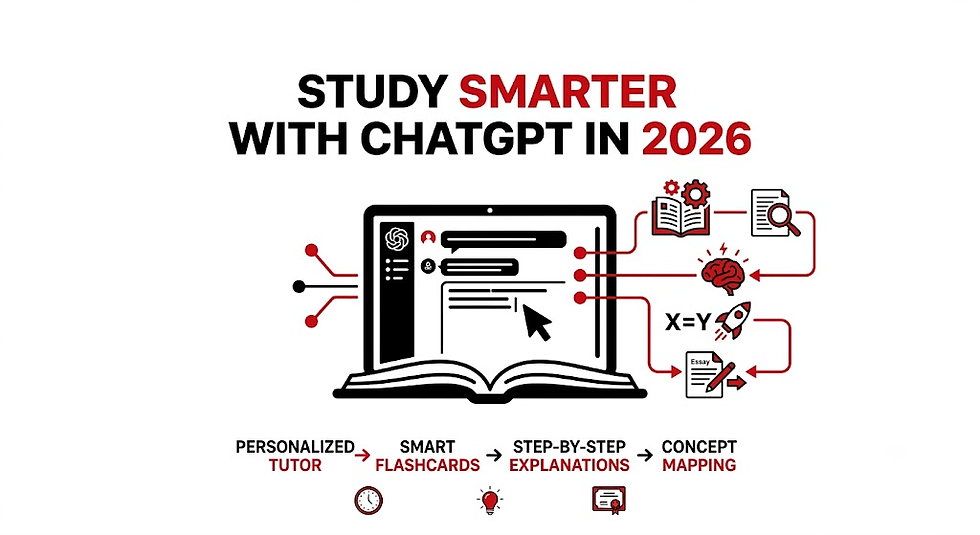
The educational landscape has shifted permanently. Gone are the days of pulling late-night study sessions buried under a mountain of static textbooks and disorganized highlighters. In 2026, AI-driven learning is no longer a futuristic novelty; it is a fundamental academic staple. Recent educational data indicates that over 78% of higher education students now integrate large language models into their daily study routines.
However, there is a massive difference between using AI as a shortcut and using it as a sophisticated cognitive bicycle. If you are just asking it to "write my essay," you are missing out on its true power. When leveraged correctly, generative AI functions as a 24/7 personalized tutor, an interactive sounding board, and a hyper-efficient study clerk.
This comprehensive guide will show you exactly how to use ChatGPT for studying to maximize your retention, ace your exams, and reclaim your free time.
1. Transforming ChatGPT into Your Personal 24/7 Tutor
The greatest limitation of a traditional classroom is the fixed pace. If a professor’s explanation of macroeconomics doesn't click for you, the lecture keeps moving anyway. ChatGPT solves this by allowing you to customize explanations to your precise cognitive level.
The "Explain It Like I'm 5" (ELI5) Technique
When tackling dense, abstract, or highly technical subjects, use prompting to strip away academic jargon.
Prompt Example: "Explain the concept of quantum entanglement using the analogy of two halves of a split coin. Keep it simple enough for a high school student to understand."
Socratic Method Coaching
Instead of asking for direct answers—which erodes critical thinking—instruct the AI to guide you toward the solution yourself. This active recall method is scientifically proven to build stronger neural pathways.
Prompt Example: "I am studying organic chemistry mechanisms. Do not give me the answers directly. Act as a Socratic tutor. Ask me one question at a time to help me deduce the mechanism for an S_N2 reaction."
2. Advanced Active Recall and Spaced Repetition
Passive reading is the enemy of effective studying. According to cognitive psychology research, long-term memory retention relies on active retrieval practice. ChatGPT can generate tailored testing materials on demand.
[Paste Syllabus/Textbook Notes]
       │
       ▼
[ChatGPT Processes Text]
       │
       ├─► Generates Flashcards (Anki-ready)
       ├─► Creates Case Studies & Mock Exams
       └─► Designs Custom Rubrics
Automatic Flashcard Generation
You can instantly transform your messy lecture notes into structured flashcards optimized for software like Anki or Quizlet.
The Prompt: "Review the text below. Extract the top 10 core concepts and format them as a table with two columns: 'Front of Card (Question)' and 'Back of Card (Answer)'. Keep answers concise."
High-Fidelity Mock Exams
Do not rely solely on the limited practice tests provided by your instructors. Use the AI to build dynamic, unpredictable exam environments.
The Prompt: "Based on the attached syllabus for Linear Algebra, generate a 5-question conceptual exam. Include a mix of multiple-choice and short-answer questions. Wait for me to submit my answers before providing the grading rubric and detailed feedback."
3. Mastering the Art of AI-Powered Summarization
In 2026, academic information overload is a common hurdle. Students are assigned hundreds of pages of research papers, case studies, and literary works weekly. ChatGPT is an exceptional tool for distilling this ocean of text into actionable insights, provided you give it structural guardrails.
The TL;DR Breakdown
When faced with a complex 30-page PDF, do not just ask for a generic summary. Force the AI to organize the information logically.
💡 Pro-Tip for Summarization:
Always ask ChatGPT to break down texts into three distinct components:
1. The Core Thesis (The main argument in one sentence)
2. Methodology or Supporting Arguments (3-5 bullet points)
3. Major Limitations or Criticisms (Why it matters)
The Concept Connector
True mastery requires linking new information to what you already know. You can use ChatGPT to find intersectional themes between different subjects. For instance, you can ask it to explain how the psychological principles of behavioral economics directly influenced historical events like the Great Depression.
4. Coding, Math, and STEM Problem Solving
For STEM students, ChatGPT is a powerful tool for diagnosing logical errors and debugging code. The releases of advanced reasoning models in 2026 have vastly improved the AI's step-by-step mathematical calculation capabilities, making it highly reliable for technical subjects.
Debugging and Code Commenting
If your Python script or C++ program is throwing a cryptic error, do not just paste the error code. Use the opportunity to learn why it failed.
Prompt: "Here is my code and the resulting error message. Do not just give me the corrected code. Explain the structural flaw in my logic that caused this exception, and provide a hint on how to fix it."
Step-by-Step Mathematical Derivations
If you are stuck on a calculus or physics problem, you can upload a photo of your handwritten work or paste the equation. Instruct the AI to break down the derivation line by line, explaining the specific algebraic rule or calculus theorem applied at every stage.
5. Overcoming Writer's Block: Ideation and Structuring
Let’s be entirely clear: using AI to ghostwrite your academic essays is plagiarism and a violation of academic integrity. However, using it as an architectural tool for your writing is highly encouraged.
The Outline Architect
The hardest part of writing a term paper is staring at a blank cursor on a white screen. You can use ChatGPT to build a structural blueprint.
Step 1: Input your research topic and thesis statement.
Step 2: Ask ChatGPT for an essay outline structure.
Step 3: Refine the outline sections to match your unique voice and sources.
Style and Tone Polishing
Once you have written a rough, disorganized draft, you can use the AI as an editor. Ask it to look for logical leaps, passive voice, repetitive phrasing, or weak transitions. This ensures that the final output remains entirely your own work, while benefiting from professional-grade editing.
Ethical Boundaries: The Rules of Engagement in 2026
As universities implement highly advanced AI detection protocols and updated academic integrity policies, navigating the ethical boundaries of AI usage is paramount.
What is Ethical ✅ | What is Unethical ❌ |
Asking for analogies to understand a complex theory. | Copying and pasting AI-generated essays to turn in. |
Generating practice questions based on your notes. | Using AI to solve live exam questions in real-time. |
Having AI proofread your own writing for grammar. | Asking AI to find fabricated sources to back up a claim. |
Creating an optimized study timetable. | Outsourcing critical thinking and analytical conclusions. |
Always cross-reference factual claims, historical dates, and mathematical calculations. While modern LLMs are incredibly advanced, they can still occasionally generate confident inaccuracies (hallucinations).
Frequently Asked Questions (FAQs)
How can I make sure ChatGPT isn't giving me incorrect information when I study?
To ensure accuracy, always use a verification workflow. Provide ChatGPT with trusted source text (like your lecture notes or textbook chapters) and instruct it to draw information only from that provided text. Additionally, cross-reference critical data, formulas, and historical timelines with your official course materials.
Can professors detect if I used ChatGPT for my homework?
Yes, modern academic institutions utilize sophisticated detection tools that analyze syntax patterns, perplexity, and burstiness. More importantly, professors are highly familiar with your unique writing style. If your work suddenly shifts in tone or vocabulary, it raises immediate red flags. Use AI as a study aid and structural guide, never as a substitute for your own writing.
Is it considered cheating to learn how to use ChatGPT for studying?
No, learning how to use ChatGPT for studying as an interactive tutor, flashcard generator, or conceptual guide is widely considered an advanced, ethical study technique. It is equivalent to using a calculator, a grammar checker, or a private tutor. Cheating only occurs when you submit AI-generated text as your own original work or use it to bypass evaluation rules.
How do I use ChatGPT to study for standardized tests like the SAT, GRE, or MCAT?
You can train ChatGPT on the specific format of these exams. Prompt it by stating: "Act as an expert MCAT tutor. Generate three difficult passage-based questions focusing on biochemistry. Provide an in-depth breakdown for why the correct answer is right, and why the other options are distractors."
Can ChatGPT grade my practice essays?
Absolutely. You can paste the official grading rubric provided by your teacher or exam board along with your practice essay. Ask ChatGPT to evaluate your writing strictly against that rubric, assign a mock grade, and provide actionable bullet points on how to elevate the essay to the next tier.
Maximize Your Academic Potential Today
The future of education belongs to those who know how to collaborate effectively with artificial intelligence. By integrating these prompting strategies into your routine, you can cut your study time in half while drastically improving your comprehension.
Don't just read about it—put it into practice right now. Open your current study materials, head over to OpenAI's ChatGPT, and use one of the custom prompts from this guide to kickstart your next study session.
For more actionable insights on optimizing your productivity and academic performance through technology, bookmark our Education Innovation Hub and subscribe to our weekly newsletter.


Comments