Top Mistakes Students Made in NEET 2026 (Avoid These Next Year)
- Apr 15
- 4 min read
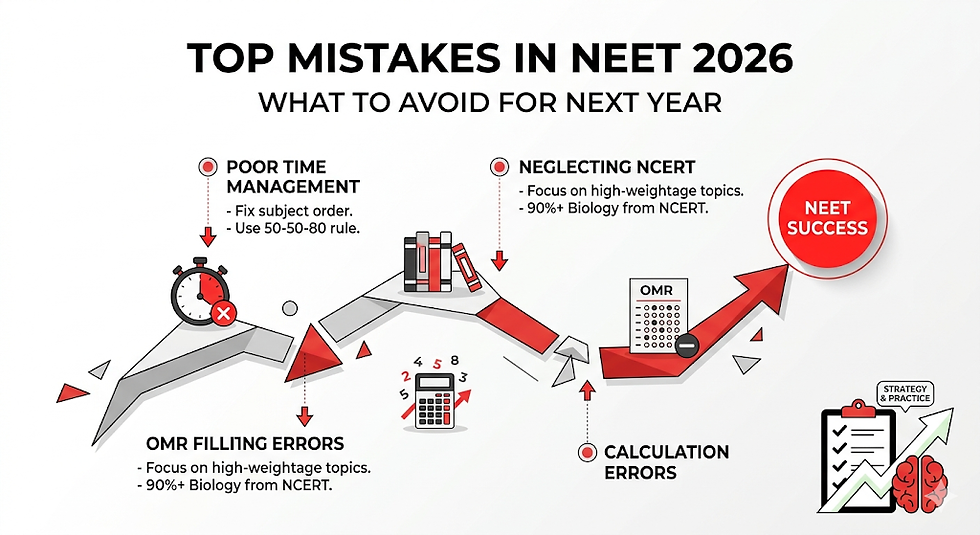
The NEET 2026 exam has once again proven to be a high-stakes battleground where even a single mark can shift a student’s All India Rank (AIR) by thousands.
As the dust settles on the NEET 2026 cycle, it’s clear that while the syllabus remained constant, the strategy required to conquer it has evolved. Many brilliant students who spent years preparing found themselves falling short not because of a lack of knowledge, but due to avoidable tactical errors.
If you are a 2027 aspirant or a dropper aiming for a comeback, learning from the top mistakes students made in NEET 2026 is your first step toward success. In this comprehensive guide, we analyze the pitfalls of this year’s paper and provide a roadmap to ensure you don’t repeat them.
The Strategic Shift: Why NEET 2026 Was Different
Before diving into the errors, let’s look at the data. NEET 2026 followed the pattern of 200 questions (180 to be attempted) within 200 minutes. While Biology remained largely NCERT-centric, Physics and Chemistry saw a shift toward multi-concept application questions. The competition reached an all-time high, making the "safe score" for a General Category government MBBS seat climb toward the 650–670 range.
The biggest takeaway? Consistency outperformed intensity. Students who studied 14 hours a day but lacked a structured revision plan struggled more than those who followed a disciplined, lower-intensity routine.
Top Mistakes Students Made in NEET 2026 (Avoid These Next Year)
To help you navigate your preparation, we have categorized the most frequent blunders into five critical areas.
1. The "NCERT is Enough" Myth for Physics and Chemistry
One of the most common top mistakes students made in NEET 2026 was applying the "NCERT-only" rule to Physics. While Biology is almost 95% direct from NCERT lines, the 2026 Physics section demanded a deep understanding of derivations and numerical applications.
The Mistake: Only reading the theory without practicing varied numerical types.
The Fix: Use NCERT for concepts, but supplement Physics with a high-quality question bank that focuses on Mechanics, Modern Physics, and Current Electricity.
2. Poor Time Management and the "Subject Order" Trap
Time management remains the silent killer in competitive exams. In 2026, many students spent over 70 minutes on Physics, leaving them panicked during the OMR filling of the Biology section.
The Mistake: Not having a pre-decided subject order or spending too much time on a single difficult MCQ.
The Fix: Aim for the "50-50-80" rule: 50 minutes for Biology, 50 for Chemistry, and 80 for Physics, leaving 20 minutes for final OMR checking and buffer.
3. Neglecting the "Section B" Strategy
The introduction of Section B (choice-based questions) was meant to be an advantage, but it became a hurdle for many. Students wasted precious minutes reading all 15 questions before deciding which 10 to attempt.
The Mistake: Indecisiveness in Section B leading to time exhaustion.
The Fix: Practice "Triage." Scan quickly, pick the 10 you are 100% sure about, and move on. Don't let the luxury of choice become a burden.
4. Ignoring Negative Marking in a High-Cutoff Year
With the cutoffs soaring, many students felt pressured to attempt 175+ questions to stay in the race. This led to "blind guessing," which decimated their final scores.
The Mistake: High frequency of incorrect guesses in calculation-heavy Chemistry and Physics.
The Fix: Only guess if you can eliminate two options. Remember: A skipped question is 0 marks, but a wrong guess is -1. In a competitive field, -1 is more damaging than 0.
5. The "Mock Test Without Analysis" Syndrome
Taking a mock test every Sunday is great, but it’s useless if you don't spend three hours analyzing why you got those 15 questions wrong.
The Mistake: Focusing on the total score instead of the "Error Log."
The Fix: Maintain an Error Notebook. Categorize your mistakes into:
Silly Mistakes (Calculation/Reading errors)
Conceptual Gaps (Didn't understand the topic)
Time Gaps (Ran out of time)
Data Insights: NEET 2026 High-Weightage Chapters
To avoid the top mistakes students made in NEET 2026, you must prioritize your time based on the actual weightage seen in this year's paper.
Subject | High-Weightage Chapters in 2026 | Estimated Questions |
Biology | Genetics & Evolution, Human Physiology, Ecology | 35-40 |
Physics | Modern Physics, Current Electricity, Thermodynamics | 15-18 |
Chemistry | Organic Chemistry (GOC), Chemical Bonding, p-Block | 18-20 |
FAQs on NEET 2026 Pitfalls
Q: What were the most frequent top mistakes students made in NEET 2026 during the actual exam?
A: Most students reported that their biggest error was poor OMR management—leaving the bubbling for the last 15 minutes, which led to panic and misalignment of answers.
Q: Was the 2026 Biology paper completely from NCERT?
A: Yes, approximately 92% of the questions were directly from NCERT lines. However, the "Statement-based" and "Assertion-Reason" questions were trickier than in previous years, requiring deeper comprehension rather than just rote memorization.
Q: How many mock tests should I take to avoid these mistakes?
A: Aim for at least 30 full-length mock tests in the final three months. The key is to simulate the exact 2 PM to 5:20 PM time slot to build your biological clock.
Roadmap for NEET 2027: How to Stay Ahead
Start with Botany & Zoology: Secure your 360 marks first. NCERT should be your Bible.
Master Physics Formulas: Create a formula sheet for every chapter. The top mistakes students made in NEET 2026 often involved forgetting basic formulas under pressure.
Chemical Reactions: For Organic Chemistry, maintain a separate "Named Reactions" diary and revise it every morning.
Health & Mental Well-being: Burnout is real. Ensure 7 hours of sleep and short breaks to keep your brain sharp.
Helpful Resources & CTA
Ready to ace your preparation and avoid the pitfalls of the past? Check out these resources:
Official Syllabus & Updates: Stay informed with the latest notifications on the NTA NEET Official Website.
Master the Basics: Read and download your digital textbooks at the NCERT Official Portal.
Practice with Precision: Analyze previous trends using the NTA Quiz and Mock Test Portal.
College Research: Plan your target score by checking previous year cut-offs on the Medical Counselling Committee (MCC) Site.
Stay Updated: Follow the latest educational news via Press Information Bureau (Education).


Comments