Top Most Important Questions for SSC Science 1 Exam 2026 (Physics & Chemistry)
- Feb 24
- 4 min read

SSC Science 1 Important Questions 2026 is the most searched query by Class 10 students as the board exams approach. With the Maharashtra State Board (MSBSHSE) introducing more application-based and "HOTS" (Higher Order Thinking Skills) questions in the 2026 curriculum, relying on old patterns isn't enough.
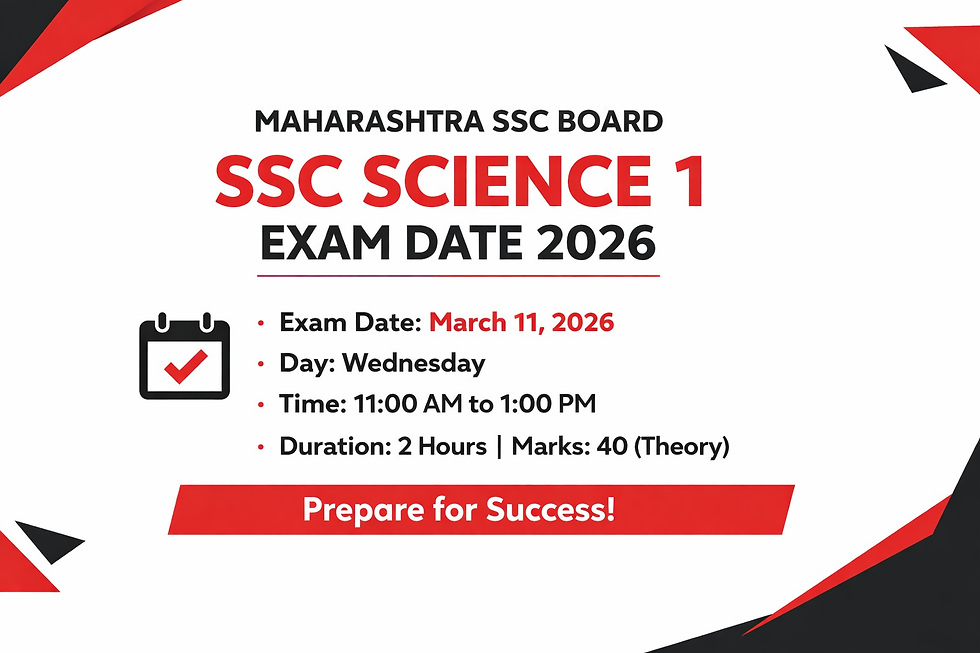
Science 1, which primarily covers Physics and Chemistry, is a 40-mark paper that requires a blend of conceptual clarity and numerical precision. Based on the latest syllabus shifts and weightage analysis for the year 2026, we have curated a list of must-solve questions to help you secure a top-tier percentage.
SSC Science 1 Paper Pattern & Marking Scheme 2026
Before diving into the questions, it is vital to understand the 2026 marking structure. The 40-mark theory paper is divided as follows:
Question Type | Number of Questions | Total Marks |
Q1 (A) MCQs | 5 (1 Mark each) | 5 Marks |
Q1 (B) Objective Type | 5 (1 Mark each) | 5 Marks |
Q2 (A) Scientific Reasons | Solve 2 out of 3 | 4 Marks |
Q2 (B) Short Answers | Solve 3 out of 5 | 6 Marks |
Q3 Short Answers/Numericals | Solve 5 out of 8 | 15 Marks |
Q4 Long Answer/Diagram | Solve 1 out of 2 | 5 Marks |
Pro Tip: In Q2(A), the board always ensures at least one question from Physics and one from Chemistry. Balance your preparation accordingly!
Must-Solve SSC Science 1 Important Questions 2026
Physics: Gravitation, Effects of Electric Current, and Lenses
Physics accounts for approximately 20-22 marks of the paper. For 2026, the focus has shifted toward numerical problems involving the Universal Constant ($G$) and Lens Power.
Gravitation:
State and explain Kepler’s Three Laws of Planetary Motion with a neat diagram.
Distinguish between Mass and Weight. (Highly likely for a 2-mark question).
Explain why the value of $g$ (acceleration due to gravity) is zero at the center of the Earth.
Numerical: An object takes 5 seconds to reach the ground from a height of 5m on a planet. What is the value of $g$ on that planet?
Effects of Electric Current:
Explain the working of an Electric Motor with a labeled diagram.
Define Joule’s Law of Heating and its applications in daily life (like fuse wires).
Differentiate between Fleming’s Left Hand Rule and Right Hand Rule.
Lenses & Refraction:
Draw ray diagrams for the position of an image when an object is placed at $2F_1$ of a convex lens.
Explain Myopia (Nearsightedness) and Hypermetropia (Farsightedness) along with their correction methods.
Numerical: A person uses a lens of power -2.0 D. Identify the type of lens and calculate its focal length.
Chemistry: Periodic Classification, Metallurgy, and Carbon Compounds
Chemistry requires a strong grip on the Modern Periodic Table and chemical reactions.
Periodic Classification of Elements:
State the Modern Periodic Law.
Explain the periodic trends in Atomic Radius and Metallic Character as you move from left to right in a period.
What are the merits and demerits of Mendeleev’s Periodic Table?
Chemical Reactions & Equations:
Define Redox Reaction with a balanced chemical example.
What is the role of a Catalyst in a chemical reaction?
Identify the type of reaction
Metallurgy:
Describe the Extraction of Aluminium via electrolytic reduction (Hall-Heroult process).
Explain the Froth Floatation Method for concentrating sulfide ores.
Define Anodizing and Galvanizing as methods to prevent corrosion.
Internal Link Opportunity: If you are also preparing for technical streams in higher secondary, check out the HSC 12th CS-1 Important Questions 2026 for a head start on Computer Science.
Chapter-Wise Weightage for SSC Science 1 2026
Focusing on high-weightage chapters ensures you hit the 35+ mark threshold easily.
Refraction of Light & Lenses: 7-9 Marks
Effects of Electric Current: 5-7 Marks
Carbon Compounds: 5-7 Marks
Periodic Classification: 4-6 Marks
Metallurgy: 4-6 Marks
Gravitation: 3-5 Marks
How to Score 40/40 in Science 1?
Stick to the Textbook: For 2026, the board is picking objective questions directly from the "Do you know?" and "Use your brain power" boxes.
Practice Diagrams: Labels carry half the marks. Ensure diagrams for Hope's Apparatus, Electric Motor, and Ray Diagrams are practiced at least thrice.
Numerical Accuracy: Always write the given data, the formula used, and the final answer with proper units (e.g., $m/s^2$ for acceleration, $W$ for Power).
Success Resource: For those looking to pursue vocational streams after 10th, don't miss the 12th HSC CS-2 Most Important Questions 2026 to understand the logic of microprocessors.
Frequently Asked Questions (FAQs)
Q1: What are the most repeated SSC Science 1 Important Questions 2026?
Historically, Kepler's Laws, the working of the Electric Motor, the Modern Periodic Law, and the extraction of Aluminium are the most repeated questions in the Science 1 board paper.
Q2: Are numericals compulsory in the Science 1 exam?
While there is often an option between a theory question and a numerical in Q3, having a basic understanding of gravitation and lens formulas is essential for scoring full marks in the objective sections.
Q3: How many scientific reasons should I write in Q2(A)?
You must solve 2 out of 3. Ensure you provide at least 2-3 logical points for each reason to secure full marks.
Q4: Which chapter has the highest weightage in Chemistry?
Carbon Compounds and Periodic Classification usually carry the highest weightage, often reaching up to 7 marks including options.
Conclusion
Mastering the SSC Science 1 Important Questions 2026 is not about rote learning but about understanding the "why" behind every scientific phenomenon. By focusing on the 2026 paper pattern and prioritizing high-weightage chapters like Lenses and Effects of Electric Current, you can turn this challenging subject into your highest-scoring one.


Comments