UP Gram Pradhan Administrator Ordinance Challenged in High Court: What the Uttar Pradesh Panchayat Governance Dispute Means for Villages
- 7 hours ago
- 4 min read
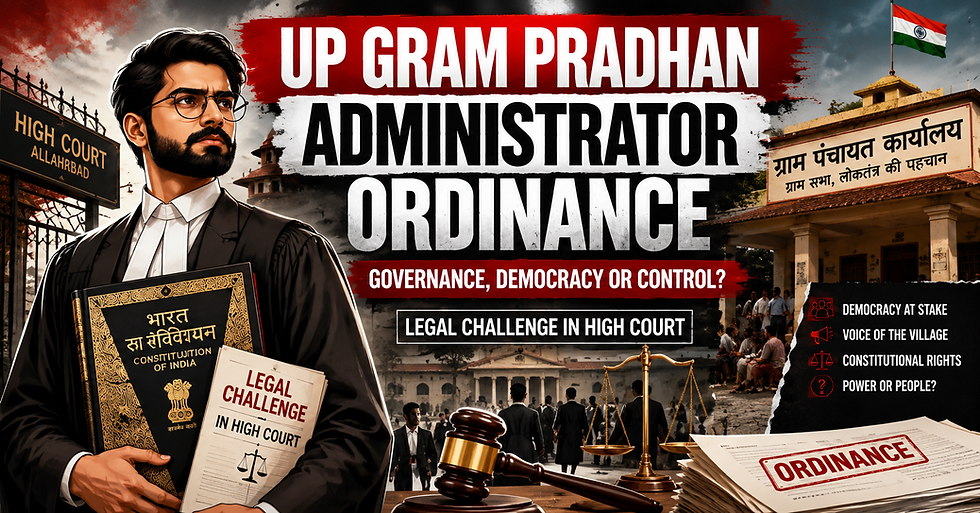
The UP Gram Pradhan Administrator Ordinance has become the center of a significant legal and political debate after being challenged before the High Court. The controversy revolves around the Uttar Pradesh government's decision regarding the appointment of administrators in Gram Panchayats, a move that critics argue could impact local democratic governance and elected village leadership.
As the case moves through judicial scrutiny, legal experts, political observers, and rural governance stakeholders are closely monitoring its potential implications for Panchayati Raj institutions across Uttar Pradesh.
What Is the UP Gram Pradhan Administrator Ordinance?
The UP Gram Pradhan Administrator Ordinance is linked to the administration of Gram Panchayats after the tenure of elected village representatives comes to an end.
Under the disputed framework, administrators may be appointed to manage Panchayat affairs until fresh elections are conducted. Supporters argue that such arrangements ensure continuity in governance and uninterrupted delivery of public services.
However, opponents claim that replacing elected representatives with administrators could weaken democratic accountability at the grassroots level.
The challenge before the High Court seeks judicial examination of whether such appointments are constitutionally and legally justified.
Why Has the Ordinance Been Challenged?
The petitioners have raised concerns regarding:
Democratic representation in villages.
Continuity of elected local governance.
Constitutional provisions related to Panchayati Raj institutions.
Administrative powers exercised through ordinances.
Potential delays in conducting Panchayat elections.
Critics argue that elected representatives should continue to have a role in governance rather than allowing administrative control to shift entirely to appointed officials.
The legal challenge aims to determine whether the ordinance aligns with constitutional principles governing local self-government.
Understanding the Panchayati Raj System
India's Panchayati Raj system was designed to strengthen grassroots democracy and ensure that local communities participate directly in governance.
Gram Panchayats serve as the first level of democratic administration in rural India and are responsible for:
Local infrastructure development.
Water management.
Sanitation projects.
Welfare scheme implementation.
Rural development initiatives.
Public grievance resolution.
Any legal dispute affecting Panchayat functioning naturally attracts significant public attention because millions of rural citizens depend on these institutions.
High Court Proceedings: What Happened?
During the latest hearing, the High Court granted time for amendments to the petition challenging the ordinance.
This procedural development means the petitioners may refine or expand their legal arguments before the matter proceeds further.
Legal observers note that the court's decision to allow amendments does not indicate a final view on the merits of the case. Instead, it provides an opportunity for a more comprehensive examination of the constitutional and administrative issues involved.
The matter is expected to continue through further hearings as the court reviews submissions from all parties.
Constitutional Questions Raised by the Case
The UP Gram Pradhan Administrator Ordinance raises several important constitutional questions:
Can Administrators Replace Elected Representatives?
One of the key issues is whether administrators can legally perform functions traditionally handled by elected Panchayat bodies.
Does the Ordinance Affect Democratic Governance?
Petitioners may argue that local self-governance is a constitutionally protected democratic principle that should not be diluted through administrative appointments.
What Happens Until Elections Are Conducted?
The government is expected to argue that temporary administrative arrangements are necessary to maintain continuity and avoid governance gaps.
These questions could shape future interpretations of local governance laws in Uttar Pradesh.
Political Significance of the Dispute
Beyond legal considerations, the controversy has political implications.
Village-level governance plays a crucial role in:
Rural development planning.
Welfare distribution.
Agricultural support programs.
Local political participation.
Any change in administrative control can influence how governance is perceived at the grassroots level.
Political parties and civil society organizations are therefore likely to monitor the outcome closely.
Impact on Villagers and Local Governance
For ordinary villagers, the primary concern is uninterrupted public service delivery.
Residents depend on Panchayats for:
Road maintenance.
Drinking water projects.
Rural employment initiatives.
Public welfare schemes.
Community development programs.
Regardless of the legal outcome, ensuring efficient administration remains essential for rural communities.
Expert Views on the Ordinance
Governance experts suggest that balancing administrative efficiency with democratic accountability is the central challenge in this case.
Some experts argue that temporary administrative arrangements may be necessary under exceptional circumstances.
Others believe that elected institutions should remain central to local governance and that prolonged administrative control could weaken democratic participation.
The High Court's eventual ruling may provide important clarity on these competing concerns.
What Happens Next?
The next phase of the case is expected to involve:
Submission of amended petitions.
Government responses.
Constitutional arguments from both sides.
Detailed judicial examination of Panchayati Raj provisions.
The outcome could influence not only Uttar Pradesh but also future discussions on local governance structures in other states.
Conclusion
The UP Gram Pradhan Administrator Ordinance challenge has emerged as an important legal battle concerning democracy, local governance, and constitutional principles. As the High Court continues to hear the matter, the case is likely to attract widespread attention from policymakers, legal experts, and rural communities alike.
Its final outcome could help define the balance between administrative continuity and democratic representation in India's Panchayati Raj system for years to come.



Comments