UPSC 2027 Preparation Strategy for Beginners: The Ultimate Blueprint for Success
- 20 hours ago
- 7 min read
Cracking the Union Public Service Commission (UPSC) Civil Services Examination (CSE) is widely considered one of the most rigorous academic and psychological pursuits in India. As we cross the mid-way mark of 2026, the preparation window for the 2027 cycle has officially arrived. For a beginner stepping onto this track, the landscape can appear remarkably daunting, filled with vast syllabi, endless booklists, and evolving exam dynamics.
The year 2026 brought massive structural wake-up calls for aspirants. The Civil Services Preliminary examination held on May 24, 2026, shattered legacy assumptions with unprecedented shifts in subject weightage and question architecture. Factual memorization has completely surrendered to deep conceptual synthesis, analytical reasoning, and real-world application.
If you are aiming for a top rank in the 2027 cycle, you cannot rely on outdated study frameworks. This exhaustive guide provides a comprehensive, trend-aligned blueprint tailored explicitly for first-time aspirants looking to streamline their efforts over the next 12 to 14 months.
The UPSC CSE 2027 Official Timeline & Framework
Planning your preparation requires a concrete understanding of the operational timeline set by the Commission. According to the official UPSC Annual Exam Calendar released on May 20, 2026, the 2027 exam cycle is highly streamlined to reduce the overall duration of the selection process. Mark your study calendar with these non-negotiable dates:
Official Notification Release: January 13, 2027
Last Date for Applications: February 2, 2027
Preliminary Examination Date: May 23, 2027 (Sunday)
Main Examination Commencement: August 20, 2027 (Spanning 5 days)
Personality Test / Interviews: Commencing December 2027
Understanding the three distinct filters of this examination remains the foundation of your journey:
The Preliminary Stage: Two objective papers of 200 marks each, conducted on a single day. General Studies (GS) Paper I determines your merit rank to qualify for Mains, while GS Paper II (CSAT) acts as a mandatory qualifying hurdle where you must secure a minimum of 33%.
The Main Stage: A descriptive, written battle consisting of 9 papers totaling 1750 marks. It evaluates your analytical depth through an Essay paper, 4 General Studies papers, and 2 Optional Subject papers, alongside two qualifying regional language papers.
The Personality Test: A comprehensive evaluation interview worth 275 marks designed to judge an aspirant's mental alertness, ethical integrity, and bureaucratic aptitude.
Analyzing Post-2026 Macro Trends: What Beginners Must Learn
The 2026 Prelims paper sent shockwaves through the coaching industry and self-study circles alike, marking a structural turn in the evaluation style of the UPSC. Beginners preparing for 2027 must understand these emerging trends to avoid wasting hundreds of hours on low-yield material:
The Death of Partial Elimination
The popular "elimination techniques" taught by legacy institutes have been permanently dismantled. In the 2026 papers, multi-statement questions skyrocketed to encompass 67% of the entire General Studies Paper I. A significant fraction of these questions used absolute evaluation formats like "How many of the above statements are correct?" (Only one, Only two, All three, None). This forces candidates to evaluate every single statement independently with absolute certainty.
Drastic Subject Weightage Rebalancing
Legacy strategies heavily over-indexed on subjects like standalone Environment and basic NCERT biology. The recent trend shows:
Medieval History Decline: Pure Medieval History questions dropped significantly, shifting instead toward cultural components such as architecture, literature, and temple art inside the Art & Culture domain.
Advanced Science & Technology: Questions have decisively shifted away from textbook biology into cutting-edge applied fields including semiconductors, quantum computing, artificial intelligence models, and space defense logistics.
Embedded Current Affairs: The concept of reading current affairs in isolation via monthly compilation booklets is failing. The exam now embeds contemporary developments directly inside static conceptual questions. For instance, an international treaty signed in the news is tested against historical geopolitical shifts or constitutional provisions.
Step-by-Step UPSC 2027 Preparation Strategy for Beginners
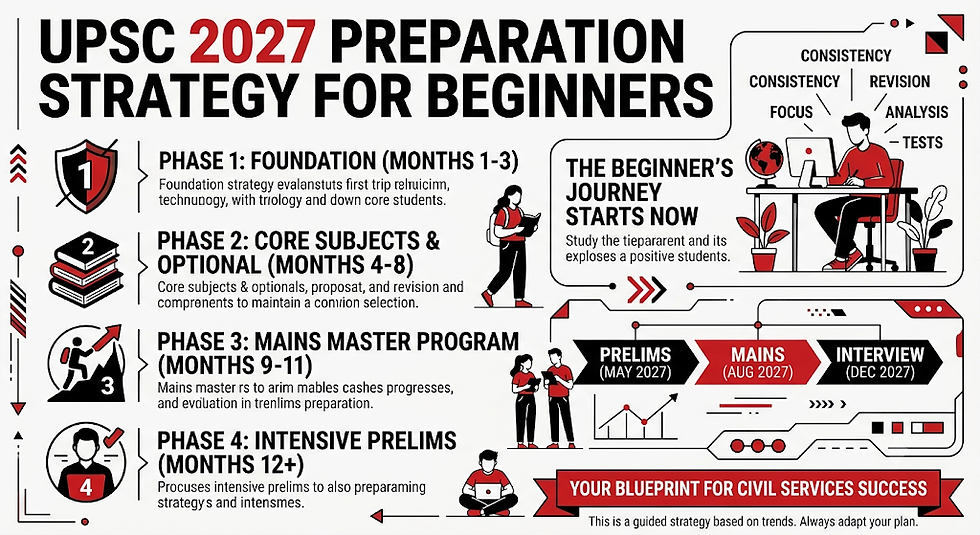
To comfortably navigate these shifts, you must break your timeline into structured, manageable phases. Here is your actionable UPSC 2027 preparation strategy for beginners to optimize performance from day one.
Phase 1: Foundational Literacy and Concept Building (Months 1–3)
Your initial months should focus entirely on understanding core concepts rather than trying to memorize dense reference volumes.
Master the Syllabus: Download the official UPSC CSE syllabus. Memorize the major sub-topics of GS Papers I through IV. When you read a news story, your brain should automatically map it to a specific syllabus pointer.
The NCERT Framework: Spend your first 90 days building absolute conceptual clarity by studying foundational NCERT textbooks (Classes VI to XII). Prioritize History (New NCERTs), Geography (Class XI and XII), Indian Society, and Political Science. Do not skip this phase; it forms the baseline vocabulary for analytical answers.
Phase 2: Core Subject Integration and Optional Selection (Months 4–8)
Once your foundation is robust, transition to core standard textbooks and choose your optional subject wisely.
       [Month 1-3: Foundations]   --> Focus on NCERTs + Syllabus Mapping
                   │
                   ▼
       [Month 4-8: Core Subjects] --> Standard References + Optional Subject Finalization
                   │
                   ▼
       [Month 9-11: Mains Mastery]--> Answer Writing Drills + GS 4 (Ethics) & Essay
                   │
                   ▼
       [Month 12+: Prelims Focus] --> Intensive Mock Tests + CSAT + High-Yield Revisions
Standard Reference Anchors: Move into core reference materials systematically:
Polity: Indian Polity by M. Laxmikanth.
Economy: Focus on core macro-indicators, monetary policy, and structural systems using conceptual materials or comprehensive notes.
Modern History: A Brief History of Modern India (Spectrum).
Geography: Supplement textbook learning with extensive World and Indian Atlas mapping routines.
Optional Subject Finalization: Your optional subject accounts for 500 marks in the Main examination. Choose this based on your academic interest, background, and the availability of high-quality study resources or mentorship—not based on temporary scoring trends. Dedicate at least 3 to 4 hours daily during this phase to finish your optional syllabus completely.
Phase 3: The Mains Mastery Program (Months 9–11)
The gap between Prelims and Mains is notoriously tight. Therefore, your Mains preparation must be fully wrapped up before your dedicated Prelims revision begins.
GS Paper IV (Ethics) and Essay: These two papers are the highest-yielding variables in the Mains total. Dedicate time to studying ethical theories, building personal case-study repositories, and practicing structured essay outlines.
Daily Answer Writing: Do not wait to finish the entire syllabus before writing your first answer. Start by analyzing Previous Year Questions (PYQs). Practice writing structured answers containing clear introductions, categorized bullet-point body arguments, and forward-looking conclusions.
Phase 4: Dedicated Prelims Mode (3 to 4 Months Prior to May 23, 2027)
As the preliminary exam approaches, suspend active descriptive learning and shift completely to objective-mode testing.
The Simulation Strategy: Enroll in a high-quality test series that mirrors the post-2026 trends. Train your brain to handle high-uncertainty multi-statement blocks. Focus heavily on analyzing the mock tests afterwards to isolate structural knowledge gaps.
The CSAT Imperative: Do not relegate the Civil Services Aptitude Test to the final week. With the growing complexity of quantitative aptitude and logical puzzles, allocate regular weekly study blocks to solve past CSAT papers to guarantee you comfortably pass the 33% threshold.
Essential Reference Matrix for Beginners
Functional Domain | Primary Reference Resources | Strategic Focus Areas |
Indian Polity & Governance | Class XI NCERT, M. Laxmikanth, Major Supreme Court Judgments | Constitutional amendments, Federal dynamics, Fundamental Rights. |
Indian Economy | Macroeconomics NCERT, Standard Conceptual Manuals, RBI Policy Updates | Banking structures, inflation, fiscal policy trends, infrastructure budgeting. |
History & Art & Culture | Themes in Indian History (I, II, III), Nitin Singhania | Transition of Medieval assets into Art & Culture, architectural evolutions. |
Applied Science & Tech | Daily Newspapers (The Hindu / Indian Express), ISRO & Global Space Feeds | Quantum computing breakthroughs, semiconductor missions, AI applications. |
International Relations | Ministry of External Affairs Briefings, Daily Editorials | Multilateral groupings, geopolitical choke points, maritime security frameworks. |
Frequently Asked Questions (FAQs)
Q1. How do I start executing my UPSC 2027 preparation strategy for beginners effectively?
To kickstart your UPSC 2027 preparation strategy for beginners, your immediate steps should be downloading the official syllabus document and reading standard Class VI to XII NCERT textbooks. Avoid diving into thick reference books on day one. Focus the first three months entirely on building a high-yield baseline vocabulary in core areas like polity, history, and basic economics.
Q2. Given the highly analytical nature of the 2026 Prelims, how should a beginner read newspapers?
Beginners should stop treating current affairs as an isolated subject. When reading publications like The Hindu or The Indian Express, look at events through the lens of static topics. For instance, if there is an article about a governor's decision, immediately open your Polity textbook to study the constitutional powers and limitations associated with that office.
Q3. Is coaching mandatory to clear the UPSC Civil Services Examination in 2027?
No, coaching is not mandatory. With the democratization of high-quality educational resources, comprehensive topic-wise analysis, and mentorship online, thousands of aspirants clear the exam purely via structured self-study. However, maintaining strict daily routine discipline, practicing previous year papers, and joining a reliable test series for objective evaluation remain absolute prerequisites.
Q4. How much time should a beginner allocate to CSAT preparation?
You should gauge your current aptitude level by solving the last 3 to 4 years of official UPSC CSAT papers under exam conditions. If your score lands consistently above 100 marks, a weekly revision session will suffice. However, if you struggle near or below the 66-mark line, you must dedicate at least 30 to 45 minutes daily to practicing basic numeracy, analytical reasoning, and reading comprehension passages.
Advance Your Strategic Preparation
Consistency over an extended timeline is the ultimate discriminator in the Civil Services Examination. Do not get overwhelmed by the scale of the challenge; focus entirely on winning your daily study targets, refining your conceptual retention, and practicing structured evaluation sheets.
To access verified official materials, check structural updates, and analyze past trends, explore the resources detailed below:
Official Commission Notifications & Calendars: Download historical exam guidelines, application portals, and the annual framework directly via the Union Public Service Commission (UPSC) Official Website.
Detailed Previous Year Question Archives: Access the comprehensive database of past descriptive and objective exam booklets on the UPSC PYQ Examination Repository.
Macroeconomic Data and Surveys: Review official economic surveys, national indicators, and development reports via the Press Information Bureau (PIB) India Portal.


Comments