What After BITSAT 2026? Why Students Are Exploring Scaler School of Technology & Other New-Age Tech Campuses
- 12 hours ago
- 8 min read
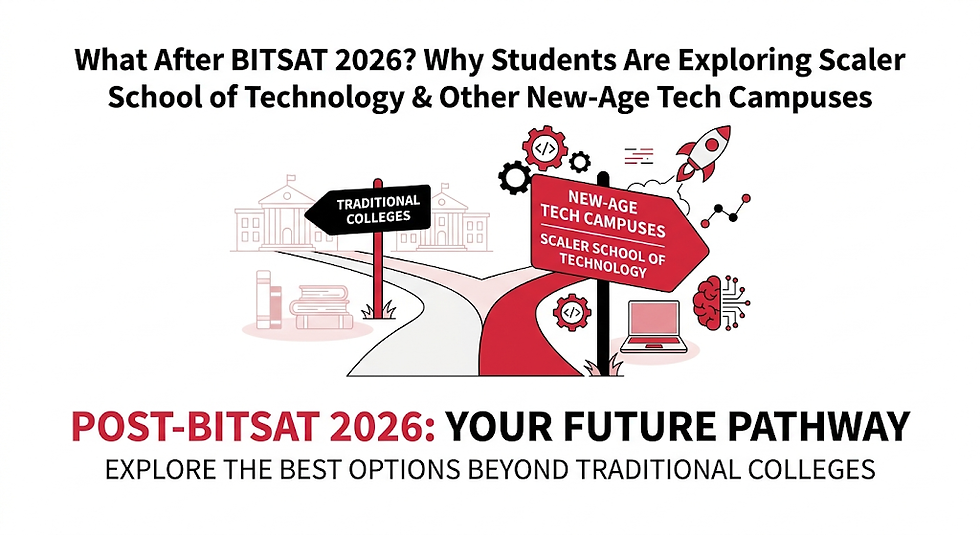
The BITSAT 2026 Session 2 exams wrapped up between May 25 and May 27, 2026. For over three lakh engineering aspirants across India, this marks the end of a grueling, high-pressure entrance season. Millions of hours spent mastering calculus, memorizing organic reactions, and solving complex physics derivations have culminated in a raw score.
Now comes the hardest part: the waiting period, the intense counseling sessions, and the reality check of cutoffs.
While Birla Institute of Technology and Science (BITS) Pilani remains one of India’s most premium engineering destinations, the sheer competition for Computer Science Engineering (CSE) has reached an absolute boiling point. To secure a seat in CSE at the premier Pilani campus this year, trends indicate students need an elite score of 340+ out of 390. Even for BITS Goa or Hyderabad, a score below 300 makes landing a pure software track highly uncertain.
This hyper-competitive barrier is causing a structural shift in how young tech talent plans their future. Students are asking a fundamental question: What after BITSAT 2026?
Instead of compromising on their passion for coding by picking low-demand engineering branches at traditional universities, a growing cohort of elite candidates is pivoting. They are turning toward hyper-specialized, industry-integrated ecosystems designed for the modern economy. Foremost among these alternative paths is the Scaler School of Technology (SST) in Bangalore, alongside other new-age tech campuses.
If you are trying to map your next steps, it is essential to look at the shifting landscape of tech education, evaluate real data, and understand why thousands of software aspirants are choosing a different blueprint for their undergraduate years.
The Reality of BITSAT 2026: Analyzing the Cutoffs and Tier-1 Crunch
The competitive landscape of Indian engineering has evolved dramatically. In 2026, a high score on an entrance exam no longer guarantees admission into the branch you actually want to pursue. Let’s break down the realistic expectations for BITSAT 2026 based on initial student reactions and difficulty trends from the recent May shifts.
The Mathematics and Physics sections across major shifts (like the afternoon slots) were reported as exceptionally lengthy and calculative. While the moderation process may adjust raw scores slightly, the absolute threshold for tier-1 branches remains punishingly high.
BITSAT 2026 Expected Campus-Wise Cutoffs
To give you a clear understanding of where your score might land you, here is a compilation of the expected cutoff scores across the three main Indian campuses for the 2026 admissions cycle:
BITS Degree Program (B.E.) | Expected Pilani Cutoff (Out of 390) | Expected Goa Cutoff (Out of 390) | Expected Hyderabad Cutoff (Out of 390) |
Computer Science Engineering (CSE) | 340 – 355 | 300 – 316 | 295 – 310 |
Mathematics and Computing | 328 – 348 | 285 – 305 | 280 – 295 |
Electronics & Communication (ECE) | 300 – 325 | 277 – 297 | 285 – 315 |
Electrical & Electronics (EEE) | 285 – 305 | 268 – 288 | 246 – 290 |
Mechanical Engineering | 260 – 290 | 244 – 264 | 250 – 285 |
Chemical Engineering | 240 – 270 | 216 – 249 | 200 – 245 |
The "Branch vs. College" Dilemma
What happens if you score a respectable 260 or 270? In a traditional setup, you are faced with a painful compromise. You have the merit to enter a prestigious brand like BITS, but you will likely be allocated Chemical, Civil, or Manufacturing Engineering.
For an individual whose core goal is to build autonomous AI systems, design large-scale backend architectures, or launch a deep-tech startup, four years spent studying fluid mechanics or industrial manufacturing can feel like a detour. Historically, students took these core branches and tried to learn coding on the side. However, in the current tech landscape, that approach is becoming highly inefficient.
The industry is moving too fast, prompting students to explore modern alternatives where their primary focus from day one remains squarely on computer science.
Why Students Are Exploring Scaler School of Technology & Other New-Age Tech Campuses
The traditional four-year engineering degree structure was built for an era before generative AI, large language models, and cloud-native computing. Today, a standard university curriculum takes years to update its syllabus due to rigid academic regulations.
New-age campuses like the Scaler School of Technology have reimagined this framework entirely. Located in India’s Silicon Valley—Bangalore—SST offers a 4-year residential undergraduate program in Computer Science and Artificial Intelligence that acts less like a traditional college and more like a high-intensity tech incubator.
Exclusive Admission Benefit: If you are ready to skip the outdated systems and want to apply for the upcoming cohort, you can use the official registration portal. Make sure to apply using the link Scaler School of Technology Admissions and apply the Coupon Code CS500 to avail of a special ₹500 discount on your application fees.
Let’s look at the core reasons why BITSAT aspirants are choosing these modern tech ecosystems over conventional choices.
1. An AI-First Curriculum Updated Every 6 Months
In a traditional college, you might spend your entire first year studying engineering drawing, workshop practice, and general chemistry. At SST, you dive directly into software building, data structures, and algorithmic thinking from the first semester.
Crucially, their curriculum is updated every six months alongside 100+ industry leaders. AI isn't an elective you pick in your final year; tools like GitHub Copilot, vector databases, and Generative AI frameworks are deeply integrated into daily labs and assignments.
2. The Power of Industry Immersion & Real Placements
Traditional colleges place an immense emphasis on theoretical mid-semester and end-semester exams. New-age programs shift the entire focus toward verifiable skill building.
The internship and outcome metrics coming out of SST highlight this difference clearly. Instead of waiting until graduation to experience corporate tech, students undergo a mandatory 1-year industry immersion. Look at the real data achieved by their early batches:
96.3% Internship Selection Rate: Nearly the entire eligible cohort secures professional internship roles by their second year.
₹2 Lakhs/Month Highest Stipend: Top-tier global tech companies and product startups are compensating these students at rates that rival full-time salaries in other fields.
Global Access: Students have secured international internship offers across tech hubs like Singapore, Bali, and Germany, including placement in elite programs like the Apple Developer Academy.
Pre-Placement Offers (PPOs): Early full-time PPOs from top product companies are clocking in at packages of 30 LPA, 38 LPA, 44 LPA, and up to 46 LPA.
3. Incubation and Deep Tech Labs
For students interested in emerging hardware-software integration, standard classrooms rarely suffice. Modern alternative ecosystems invest heavily in experiential spaces. For instance, SST houses active, dedicated spaces for builders:
Robotics Lab & Internet of Things (IoT) Lab
AI/ML and Augmented/Virtual Reality (AR/VR) Labs
Drone Technology Centers
These labs don't just sit empty; they host real-world builders. A notable success story includes NeoSapiens, an AI-native wearable pendant startup incubated right on campus that successfully secured funding on Shark Tank India. Another student project, Percevia, beat out over 20,000 national entries to win the 'Samsung Solve for Tomorrow' competition by creating specialized AI glasses for the visually impaired.
Traditional Tier-1 Engineering vs. New-Age Tech Campuses
To make an informed decision during this post-BITSAT counseling phase, it is highly valuable to contrast the core components of traditional premier institutes against specialized tech campuses.
Feature / Metric | Traditional Tier-1 Engineering (IITs / BITS) | Scaler School of Technology (SST) |
Primary Focus | Broad-spectrum engineering across multiple non-tech branches. | 100% focused on Computer Science, AI, and Product Development. |
Curriculum Cycle | Rigid academic updates, often taking 3 to 5 years to change textbooks. | Dynamic curriculum re-evaluated every 6 months to match industry shifts. |
First-Year Learning | General sciences (Physics, Chemistry, Mechanics, Engineering Drawing). | Core programming, Data Structures, and AI-assisted workflows from Day 1. |
Faculty Profile | Academicians heavily focused on theoretical research and publications. | Active tech leads, CTOs, and engineers currently working in top tech firms. |
Internship Structure | Optional or limited to 2-3 months during summer breaks. | Mandatory 1 full year of deep industry immersion built directly into the program. |
Highest Stipend Record | Varies by campus, typically ranging between ₹1L – ₹1.5L/month. | Reached ₹2 Lakhs per month in the student's second year. |
Peer Selection Rate | Highly competitive via generic PCM exams (Top 1-2%). | Highly selective technical screening (3.3% acceptance rate in 2025). |
Degree Credential | Traditional B.E. / B.Tech Degree. | Fully UGC-recognized Bachelor's Degree with pathways for GATE, CAT, and MS abroad. |
Evaluating Your Options: How to Choose Your Path
If you are standing at the crossroads after checking your BITSAT performance, your decision-making process should be guided by your clear, long-term professional objectives.
Choose Traditional Tier-1 Campuses If:
You have scored highly enough to easily secure Computer Science or Electronics & Communication at Pilani, Goa, or Hyderabad.
You value the classic, large-scale university campus experience with thousands of students across fields like humanities, economics, and civil sciences.
You are genuinely undecided about your career path and want a generalized degree that keeps fields like core manufacturing, supply chain management, or public sector roles open.
Choose New-Age Tech Ecosystems If:
You are completely certain that your future lies in software engineering, AI research, machine learning engineering, data science, or launching your own tech venture.
You do not want to sacrifice your core focus by spending four years studying non-tech subjects just for a college brand name.
You want to learn through daily creation rather than memorizing lecture notes for exams.
You want your professional network to be anchored directly within the heart of India's Silicon Valley, learning directly from industry veterans who actively hire for modern tech teams.
Frequently Asked Questions (FAQs)
Q1. What after BITSAT 2026 options are available if my score is too low for Computer Science?
If your BITSAT 2026 score falls short of the high CSE thresholds (typically 300 to 350+ marks), you have several strong strategic paths. You can participate in the BITS iteration rounds to see if you get a core engineering or dual-degree branch, look at state-level tier-1 college counseling, or choose a specialized program like the Scaler School of Technology. Programs like SST do not screen you on general chemistry or physics memorization; instead, they evaluate your logical aptitude and mathematics foundation through their own entrance process, ensuring your seat is entirely focused on CS and AI from day one.
Q2. Is the degree from Scaler School of Technology officially recognized?
Yes, students at SST undergo a fully recognized undergraduate bachelor's degree program recognized by the University Grants Commission (UGC). This structure ensures that your academic credentials are fully valid for all national and international pathways. Graduates are completely eligible to appear for competitive Indian examinations like GATE, CAT, and UPSC, or to apply for higher studies including an MS, M.Tech, or Ph.D. at premier universities abroad.
Q3. How does the 1-year industry immersion work at new-age campuses?
Unlike traditional colleges where students only complete a brief 8-week summer internship, new-age models integrate a full year of professional work into the curriculum. During your third year, you work as a full-time software engineering intern at a registered tech firm or product startup. You face real production deadlines, write production-grade code, and earn a monthly stipend (which has gone as high as ₹2 Lakhs/month for top SST candidates). This long-term exposure frequently converts into high-paying full-time Pre-Placement Offers (PPOs) before the final year even begins.
Q4. What is the fee structure and application process for SST in 2026?
The application process is handled completely online through their specialized admissions portal. Candidates under the age of 20 who have secured at least 60% marks in Grade 12 Mathematics are eligible to apply. To begin your journey, visit the official Scaler School of Technology Portal. You will need to complete an aptitude assessment, follow up with an interview, and can use the Coupon Code CS500 to receive an instant waiver of ₹500 on your application form processing fee.
Next Steps for Post-BITSAT Candidates
The weeks following major entrance exams can be overwhelming, but they also provide a rare window to take control of your career trajectory. Do not let old-school counseling conventions pressure you into a branch or a campus that doesn't align with your goals for the future.
Research your options, talk to current students, look at verifiable placement and internship records, and choose an ecosystem that actively prepares you for the tech landscape of tomorrow.
Quick Actions and Links:
Explore the Campus and Curriculum: Check out the comprehensive breakdown of the computer science modules at the Scaler School of Technology Registration Link.
Apply for the 2026 Intake: Ready to fast-track your software career? Complete your registration directly on the Scaler Admissions Portal.
Claim Your Discount: Make sure to apply the verified Coupon Code CS500 at the checkout screen to save ₹500 on your official application process.


Comments