What is a Roth IRA? How to Grow Your Retirement Savings Tax-Free
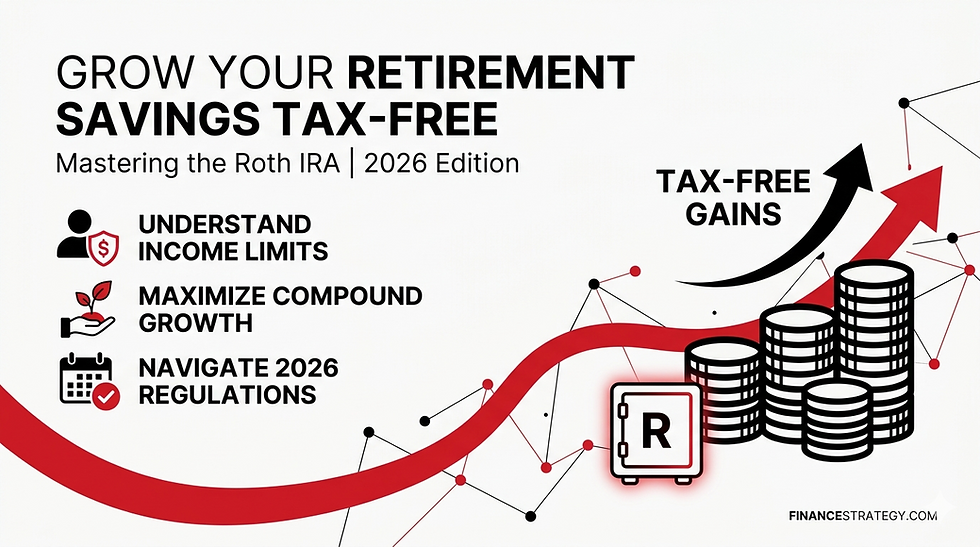
Imagine a retirement account where the tax collector has zero power over your growth. While inflation and shifting economic policies keep modern professionals awake at night, a specific legislative loophole offers absolute shelter for your wealth.
Fidelity Investments' recent national data reveals that Roth IRAs have officially become the vehicle of choice for Gen X, Millennial, and Gen Z savers trying to build security outside of employer plans. However, according to recent retirement trends, more than 40% of eligible professionals fail to maximize this account simply because they misunderstand how it operates.
In 2026, building long-term wealth requires a paradigm shift. If you want to grow your retirement savings tax-free, understanding the mechanics, updated rules, and compounding power of a Roth IRA is no longer optional—it is a foundational financial strategy.
Understanding the Roth IRA Architecture
A Roth IRA (Individual Retirement Account) is a tax-advantaged personal savings structure that turns traditional retirement planning on its head. Unlike a Traditional IRA or standard 401(k)—which grant an immediate tax deduction on contributions but tax your withdrawals later—the Roth IRA uses after-tax dollars. You pay income tax on the money today, but every dollar of growth and every future withdrawal is entirely tax-free.
This structural flip changes the math of long-term compounding. Consider how your savings build over a multi-decade timeline:
For corporate executives, independent founders, and ambitious professionals, this vehicle serves as a critical hedge against future tax hikes. By paying taxes at your current known rate, you shield your future self from potentially higher federal brackets decades down the line.
Crucial Updates: Roth IRA Guidelines 2026
The Internal Revenue Service (IRS) has officially implemented cost-of-living adjustments for the 2026 tax year under Notice 25-67. These shifts present new opportunities—and boundaries—for high-earning professionals looking to optimize their tax mitigation.
1. Higher Annual Contribution Benchmarks
For 2026, the baseline annual contribution limit has increased to $7,500 for individuals under age 50. Savers aged 50 and older can utilize a catch-up contribution of an additional $1,100, bringing their total annual limit to $8,600.
2. Adjusted Income Phase-Out Thresholds
The IRS restricts direct contributions based on your Modified Adjusted Gross Income (MAGI). For 2026, the income thresholds have expanded to account for inflation:
Filing Status | Full Contribution Range (MAGI) | Phase-Out Range (Partial) | Ineligible Threshold |
Single / Head of Household | Less than $153,000 | $153,000 to $168,000 | $168,000 or more |
Married Filing Jointly | Less than $242,000 | $242,000 to $252,000 | $252,000 or more |
3. The SECURE Act 2.0 High-Earner Mandate
A pivotal piece of the SECURE Act 2.0 legislation has officially taken operational effect. Beginning in 2026, if you are age 50 or older and your prior-year FICA (Social Security) wages exceeded $150,000, any catch-up contributions made to employer plans (like a 401(k) or 403(b)) must be made on an after-tax Roth basis. This regulatory shift highlights a clear legislative push toward Roth-style structures for high earners across all industries.
Benefits, Challenges, and Strategic Opportunities
Key Benefits
Total Tax Immunity on Growth: Your investments compound over time without capital gains taxes or dividend drag eroding your balance.
No Required Minimum Distributions (RMDs): Unlike traditional accounts that force you to withdraw money at age 73 or 75, a Roth IRA allows your money to stay in the market indefinitely.
Principal Liquidity: Because you already paid taxes on your initial contributions, you can withdraw your base principal at any time, for any reason, with zero taxes or penalties.
Estate Planning Advantages: A Roth IRA is an incredibly powerful wealth-transfer tool, allowing heirs to inherit a completely tax-free asset.
Major Challenges
Strict Income Ceilings: High-performing professionals can quickly find themselves locked out of direct contributions as their career trajectory scales past $153,000 (single) or $242,000 (joint).
The 5-Year Aging Rule: To withdraw investment earnings tax-free, the account must be open for at least five consecutive tax years, and you must have reached age 59½.
No Immediate Tax Break: You do not receive an upfront tax deduction, which can make it harder to lower your current year's adjusted gross income.
Strategic Opportunities
The Backdoor Roth Strategy: High earners who exceed the income limits can legally contribute to a Traditional IRA and immediately execute a Roth conversion, safely bypassing the income caps.
Macro Economic Hedging: Utilizing a Roth account protects your retirement distributions from future legislative tax increases, decoupling your security from shifting federal policy.
The Mathematics of Tax-Free Compounding
To understand why sophisticated financial minds prioritize this account, you have to look at the math behind long-term compounding interest. Let's compare a standard taxable brokerage account against a Roth IRA over a 30-year career window.
Assume an annual contribution of $7,500 ($625 per month) and an average annualized market return of 8%.
Wealth Accumulation Comparison
Total Principal Invested: $225,000
Total Balance (Before Taxes): ~$917,500
Total Investment Growth: ~$692,500
If this money sits in a standard taxable brokerage account, you will face annual tax drag on dividends and capital gains distributions. Assuming a modest 15% long-term capital gains tax rate upon withdrawal in retirement, your tax liability on the growth alone would exceed $103,800.
By choosing to grow your retirement savings tax-free in a Roth IRA, that entire $103,800 remains in your hands. That is six figures of pure purchasing power saved simply by using the correct tax wrapper.
Practical Recommendations & Execution Blueprint
Implementing an optimized Roth strategy requires careful execution. Follow this blueprint to maximize your wealth accumulation while avoiding costly regulatory pitfalls.
Step-by-Step Optimization Workflow
1.Verify Eligibility via MAGI:Step 1.
Review your projected 2026 adjusted gross income. Determine if you fall below the direct contribution caps ($153,000 single / $242,000 joint) or if you must prepare for an alternative strategy.
2.Establish and Automate:Step 2.
Open an account with an established, low-fee institutional custodian. Set up an automated monthly transfer of $625 to reliably hit the maximum $7,500 annual limit without manual effort.
3.Deploy Cash into Productive Assets:Step 3.
An IRA is simply a holding bucket, not an automatic investment. You must intentionally allocate your cash into broad-market index funds, low-cost ETFs, or target-date mutual funds to kickstart your compounding growth.
4.Execute Backdoor Pivot (If Required):Step 4.
If your income surpasses the IRS thresholds, make a non-deductible contribution to a Traditional IRA, wait for the funds to clear, and promptly execute a conversion to your Roth IRA through your custodian's portal.
Common Pitfalls to Avoid
Leaving Funds in Cash: Millions of savers open accounts but forget to select actual investments, leaving their capital to lose purchasing power to inflation in a default money market fund.
Violating the Pro-Rata Rule: When attempting a Backdoor Roth conversion, the IRS looks at all your traditional IRA balances combined. If you have pre-tax money sitting in an old Traditional IRA, a portion of your conversion will be triggered as a taxable event.
Over-contributing Across Accounts: The $7,500 limit is a combined cap across all IRAs. You cannot contribute $7,500 to a Traditional IRA and another $7,500 to a Roth IRA in the same calendar year.
Frequently Asked Questions
What happens if I accidentally contribute to a Roth IRA while making too much money?
If your income exceeds the 2026 limitations, you must remove the excess contributions and any earnings they generated before your tax filing deadline. Failure to do so will result in a 6% excise tax penalty from the IRS every year the excess remains in the account.
How can high-earning executives grow their retirement savings tax-free if they exceed the standard income limits?
High earners can seamlessly achieve this by executing a Backdoor Roth IRA conversion. By making a non-deductible contribution to a Traditional IRA and immediately converting it, you legally bypass the direct income caps to grow your retirement savings tax-free.
Can I run a Roth IRA alongside my company's employer-sponsored 401(k)?
Yes. Your participation in a workplace 401(k), 403(b), or TSP has no impact on your structural ability to open and fund a personal Roth IRA. Combining both options is an excellent way to balance pre-tax and after-tax retirement assets.
What is the 5-year rule for Roth IRA withdrawals?
The 5-year rule stipulates that you cannot withdraw the investment earnings tax-free until five consecutive tax years have passed since your very first contribution to any Roth IRA, regardless of your age.
Can I use my Roth savings for non-retirement needs?
You can withdraw your base contributions at any time without penalty or tax. Additionally, the IRS allows tax-and-penalty-free withdrawals of up to $10,000 in earnings for a qualified first-time home purchase, or penalty-free distributions for qualified higher education expenses.
Conclusion & Strategic Vision
The landscape of retirement planning is continuously shifting, but the mathematical certainty of tax-sheltered compounding remains unmatched. Transitioning your focus to tax-advantaged accounts protects your wealth from future economic volatility and legislative overreach.
By taking control of your financial architecture, aligning your portfolio with the updated 2026 limits, and automating your savings behavior, you build an ironclad foundation for decades to come.
Maximizing Your Wealth: Resources for Next Steps
To confidently navigate your wealth building journey and properly apply the Roth IRA guidelines 2026, leverage these verified institutional resources:
Internal Revenue Service (IRS): Review the official framework regarding Retirement Topics and Annual IRA Contribution Limits to verify compliance rules.
IRS Cost-of-Living Documentation: Read the full legal text on inflation adjustments via the IRS retirement plans publication gateway.
Financial Industry Regulatory Authority (FINRA): Use the consumer-protection tools and retirement calculators at FINRA's Investor Education Foundation.


Comments