What Kind of Jobs Can You Get After Scaler School of Technology? Your Complete 2026 Guide
- Jun 23
- 7 min read
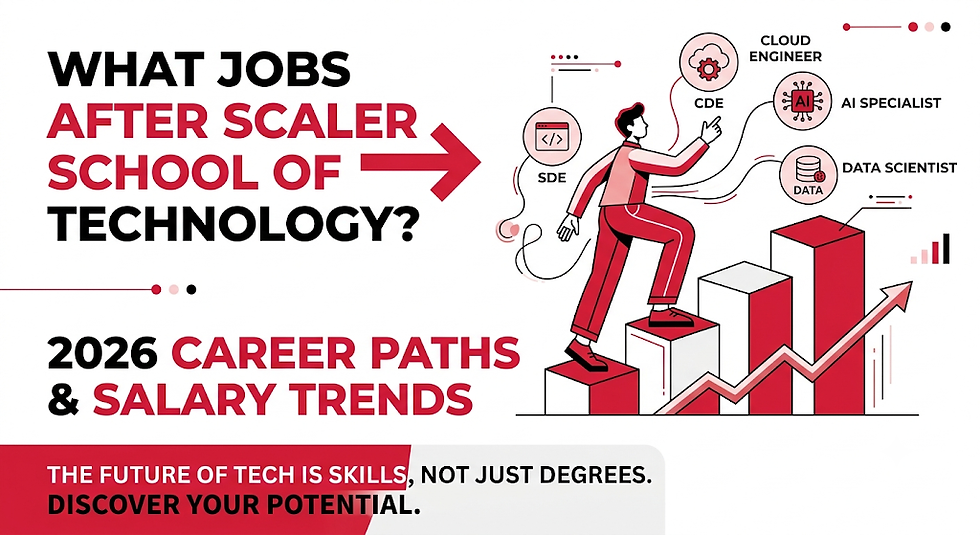
The landscape of Indian engineering education is undergoing an absolute shift. By 2026, the traditional corporate paradigm that favored degree certificates over practical capabilities has significantly cracked. Employers are actively filtering out candidates who lack hands-on deployment skills, seeking instead individuals who can design, build, and ship code directly into production environments. At the center of this transformation sits Bengaluru’s premier alternative tech ecosystem, producing an elite tier of computer science professionals. If you are exploring this career path, you are likely asking a pivotal question: What kind of Scaler School of Technology jobs can you actually secure upon graduation?
The reality is that students within this ecosystem are outperforming traditional four-year engineering cohorts across the country. Through a specialized, industry-integrated curriculum co-developed by tech leaders from Google, OpenAI, and PhonePe, graduates do not enter the job market as raw trainees—they join as functional, autonomous engineers. Backed by an extensive network of over 1200 hiring partners and a mandatory one-year industry immersion, the career trajectory here spans beyond standard entry-level software roles.
Let's dissect the specific high-paying engineering roles, industry domains, real-world salary structures, and career trajectories available to you in 2026.
High-Paying Roles and Career Paths After Scaler School of Technology
The undergraduate program in Computer Science & Artificial Intelligence here completely skips outdated academic theories to focus entirely on modern, production-grade architectures. Consequently, the specialized Scaler School of Technology jobs available to graduates span across elite tech domains.
1. Artificial Intelligence & Machine Learning (AI/ML) Engineer
The curriculum embeds advanced AI systems from day one, preparing you directly for the realities of the 2026 tech economy. Graduates are stepping straight into core AI infrastructure roles rather than simple data curation.
What You Will Do: Build, optimize, and deploy custom Large Language Models (LLMs), build full-duplex real-time voice speech engines, design computer vision pipelines for intelligent hardware, and construct production-level machine learning pipelines.
Key Skills Acquired: Deep Learning frameworks, neural network training, transformer optimization, vector databases, and real-time inference scaling.
2. Full-Stack Software Development Engineer (SDE)
Instead of building basic web forms, students are trained to construct complex, highly distributed systems capable of handling massive user traffic.
What You Will Do: Design enterprise-grade microservices architectures, architect low-latency backend systems, handle multi-tenant content management systems (CMS) databases, and build fluid, production-grade frontend interfaces.
Key Skills Acquired: Advanced data structures and algorithms (DSA), system design (HLD/LLD), asynchronous event handling, and database optimization.
3. Founding Engineer (Tech Startups)
With an active Innovation Lab on campus, a substantial portion of every cohort chooses to join high-growth tech startups at early stages, taking complete ownership of the technical stack.
What You Will Do: Code core application frameworks from absolute scratch, make critical technology stack decisions, scale early product architectures, and lead development sprints alongside founders.
Key Skills Acquired: Rapid prototyping, cloud infrastructure deployment, agile development cycles, and cross-functional product management.
4. DevOps & Cloud Infrastructure Engineer
High-traffic applications require robust automated deployment engines. Students learn to handle modern cloud clusters under production stress conditions.
What You Will Do: Architect automated Continuous Integration and Continuous Deployment (CI/CD) pipelines, orchestrate large-scale container environments, manage cloud-native databases, and minimize application downtime.
Key Skills Acquired: Kubernetes orchestration, Docker virtualization, AWS/GCP architecture, infrastructure as code, and site reliability metrics.
Scaler School of Technology Placement Statistics and 2026 Salary Packages
The structural design of the program treats career outcomes not as a final-year scramble, but as a deliberate, continuous development cycle. In 2026, the early data emerging from the founding cohorts confirms a dramatic competitive advantage over traditional regional engineering colleges.
Because students undergo a selective 3.3% acceptance filter to enter the institution, tier-one companies actively target the campus long before the official final placement season begins.
Metric | Real-World Placement Insights (2025-2026 Data) |
Pre-Placement Offer (PPO) Rate | 36% of the current batch secured PPOs via mandatory internships before final placement opened |
Average Placement Package (Overall) | ₹21 LPA (Lakhs Per Annum) average across tech ecosystems |
PPO Track Average CTC | ₹20 LPA average salary package for early PPO conversion tracks |
Highest CTC Package on PPO | ₹46 LPA achieved by top-tier early PPO candidates |
Highest International Stipend | ₹2 Lakhs per month during second-year industry immersion |
Total Global Internships | 12+ international positions secured across Singapore, Germany, and Bali |
Active Corporate Hiring Partners | Over 1200+ companies integrated into the recruitment network |
The continuous internship-to-PPO model serves as a direct validation of competency. Tech employers prefer evaluating an engineer over months of real production sprints rather than relying on standard two-hour algorithmic interviews. This unique pipeline ensures a highly predictable path to securing premium Scaler School of Technology jobs.
To secure your exclusive entry path into this industry-first tech program, you can register through the official tracking link: Apply to Scaler School of Technology. Don't forget to use the verified community code CS500 during your application sequence to claim your direct admission benefits.
Top Recruiting Companies and Sectors Hiring Grads
The corporate ecosystem hiring from this campus spans across multiple sectors, heavily favoring companies that demand intense technical execution rather than basic maintenance tasks.
1. Big Tech & Product Giants
Global tech firms recruit heavily from this pool because the students possess deep algorithmic foundations alongside real system design experience.
Primary Recruiters: Amazon, Google, Microsoft, Meta, and Apple.
Core Profiles: Core Software Development Engineer (SDE I), Systems Engineer, and Infrastructure Developer.
2. High-Growth Tech Scaleups & Fintech
Rapidly expanding platforms require engineers who can jump straight into shipping high-velocity code without requiring three months of basic corporate training bootcamps.
Primary Recruiters: Rippling, Slice, Swiggy, Zomato, PhonePe, and Uber.
Core Profiles: Product Engineer, Backend Developer, and Full-Stack Specialist.
3. AI-Native Labs & DeepTech Ventures
Emerging tech labs and funded artificial intelligence firms look specifically for engineers who have spent their undergraduate years working with high-performance computation models.
Primary Recruiters: Emergent AI, specialized robotics labs, and campus-incubated deep tech companies like Xspecies AI (building humanoid robotics systems) and Ninad AI (voice engines).
Core Profiles: AI Automation Specialist, NLP Engineer, and Machine Learning Systems Practitioner.
Real Student Success Stories and Innovations
The true validity of any tech ecosystem lies in the real things its students build and deploy. Scaler’s Electronic City campus in India’s Silicon Valley serves as a functional incubator for intense technical innovation.
Global Ecosystem Recognition: In 2026 alone, 14 SST students were selected for the prestigious Google Summer of Code (GSoC) out of more than 15,000 global applications, showing an elite competitive ratio across 140 countries.
The Apple Academy Breakthrough: Krishna, an active second-year student, bypassed traditional academic pathways to crack the highly competitive Apple Academy Programme in Bali, gaining immediate international tech exposure.
Shark Tank Funding & DeepTech: Student-led teams are not just writing practice applications—they are scaling operational companies. A startup incubated inside the campus Innovation Lab, NeoSapiens, successfully raised capital on Shark Tank India by developing an AI-native wearable lifestyle pendant.
National Hackathon Victories: Team AntarDrishti secured a victory at the Smart India Hackathon (SIH), claiming the top cash prize by creating a production-ready application deployed directly for national athletic frameworks.
Step-by-Step Career Progression: From Day 1 to Graduation
How does an individual transition from an applicant into someone capable of commanding a ₹21 LPA starting package? The four-year residential program breaks down into a methodical, step-by-step career acceleration engine:
Year 1: Core Fundamentals & System Architecture: Months 1 to 12.
Students immerse themselves instantly in advanced data structures, algorithmic tracking, and core software programming paradigms. There are no generic first-year non-tech subjects; learning is fully practical and project-driven from day one.
Year 2: AI Integration & First-Wave Internships: Months 13 to 24.
Focus shifts directly to advanced system design, artificial intelligence systems, and database clustering. By the end of this period, over 96% of students secure high-paying technical internships, with top stipends reaching up to ₹2 Lakhs per month.
Year 3: Mandatory One-Year Industry Immersion: Months 25 to 36.
Students step out of the standard classroom setting entirely to work as full-time software interns inside real tech companies or build operational products within the campus Innovation Lab. This phase drives the high 36% early PPO conversion rates.
Year 4: Specialization & Final Leadership Placement: Months 37 to 48.
Deep-dive specializations take place in advanced machine learning, cloud systems, or specialized product management. Students finalize their full-time transition into tier-one product firms, entering the global workforce as experienced engineering professionals.
To map your career trajectory and gain personalized entry into this rigorous ecosystem, apply directly using the verified tracking portal: Apply to Scaler School of Technology. Use the verified community code CS500 at registration to activate your application discount and priority interview processing.
FAQ: Your Pressing Career Questions Answered
Q1: What is the average salary package for Scaler School of Technology jobs in 2026?
A1: The overall average placement package across the ecosystem stands at an impressive ₹21 LPA. For students tracking along the early Pre-Placement Offer (PPO) conversion line during their industry immersion phase, the average starting salary is ₹20 LPA, with individual high-tier engineering offers peaking at ₹46 LPA.
Q2: Do companies accept Scaler students without a traditional B.Tech degree?
A2: Yes, absolutely. Modern technology firms have almost entirely shifted to skill-first hiring metrics, prioritizing what a candidate can build over degree certificates. Furthermore, Scaler structured its program efficiently—students have the structured option to independently pursue an accredited online BS degree from top institutions like IIT Madras or BITS Pilani alongside their practical residency, providing total educational alignment for higher studies or global visa paths.
Q3: How does the mandatory industry immersion phase work?
A3: Unlike standard engineering colleges that offer brief 2-month summer stints, Scaler mandates a full one-year structural tech integration during the third year. Students function inside product firms or tech startups as active developers, building real features, fixing infrastructure bugs, and managing live systems. This unique setup explains why 36% of the cohort transitions smoothly into full-time roles long before graduation day.
Join the Future of Tech Education
If your goal is to break away from outdated learning styles and position yourself at the forefront of the artificial intelligence and software engineering landscape, your next step starts right now.
Step 1: Access the prioritized 2026 registration framework directly at Apply to Scaler School of Technology.
Step 2: Fill out your background data and apply the community coupon code CS500 to secure direct application tracking, priority interview slots, and admission fee discounts.
Step 3: To connect directly with an active network of tech applicants, receive real-time admission updates, and gain access to peer preparation bootcamps, join the official community hub immediately: Join the Scaler SST WhatsApp Community.


Comments