Why 2026 Might Be the Most Unstable Year of the Decade (And What Comes Next)
- Mar 19
- 6 min read
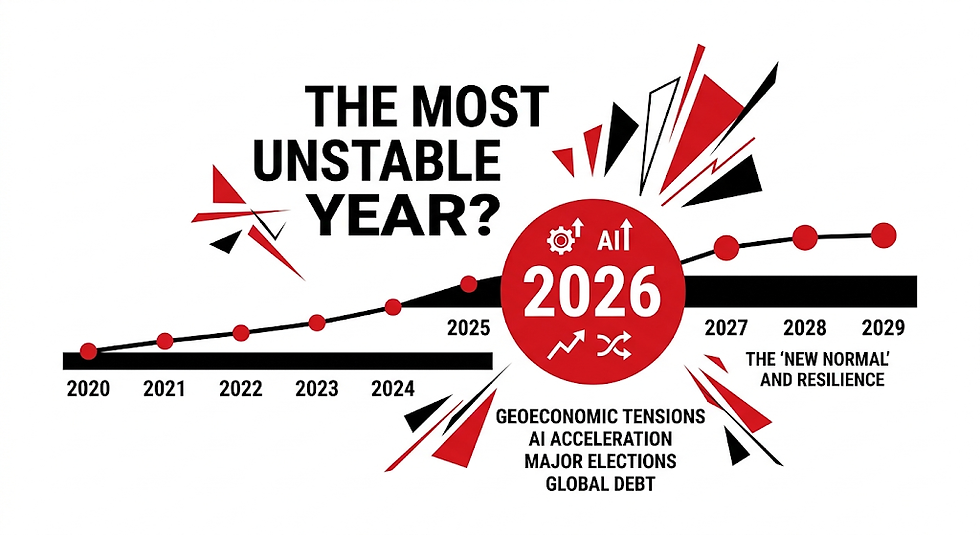
As we navigate the mid-2020s, the sense of "business as usual" has evaporated. We are no longer just recovering from past shocks; we are accelerating into a period of structural transformation. While 2024 and 2025 felt like a balancing act, 2026 is shaping up to be the most unstable year of the decade due to a perfect storm of geoeconomic confrontation, electoral volatility, and the "Year of Truth" for Artificial Intelligence.
From the high-stakes stadiums of the FIFA World Cup to the silent, high-speed calculations of autonomous AI agents, the world in 2026 is being rewired. This blog explores why 2026 is the year where old systems may finally fracture, and what the "new normal" looks like for the years that follow.
1. The Rise of "Geoeconomic Confrontation"
For decades, globalization was driven by cost. In 2026, it is driven by policy and "friendshoring." According to the World Economic Forum’s Global Risks Report 2026, geoeconomic confrontation has emerged as the number one global risk.
We are seeing a shift from a "laissez-faire" global economy to one defined by State Interventionism. Governments are no longer bystanders; they are active participants in the market through:
Aggressive Subsidies: Strategic sectors like semiconductors and green energy are receiving massive state backing.
Local Content Mandates: The EU and North America are increasingly requiring foreign investors to use local labor and transfer technology.
Export Controls: China and the West are tightening the screws on sensitive technologies, treating AI assets and critical minerals as national security priorities.
This transition isn't just about trade—it’s about the Geopolitics of Scarcity. With global debt standing at 235% of GDP, the competition for capital, lithium, and even fresh water is intensifying. In 2026, these tensions are moving from boardrooms to borderlines.
2. A Year of Political Earthquake: The 2026 Election Cycle
If you think politics has been divisive lately, 2026 will be the ultimate test of democratic resilience. Major elections are scheduled across five continents, many in highly sensitive environments.
Key Elections to Watch:
Bangladesh (February): The first competitive election in over a decade following the ousting of the Awami League. The nation faces high youth unemployment and a struggle for a "Second Republic."
United States Midterms: Historically a period of policy volatility, the 2026 midterms will determine the direction of US tariffs and trade deregulation, specifically impacting the USMCA renegotiations.
Hungary (April): A pivotal moment for Viktor Orbán’s Fidesz party, facing its strongest opposition in years from the Tisza Party amidst high inflation and energy costs.
Brazil & India: Regional and local elections in these powerhouses will signal the future of environmental policy and industrial growth.
With 50% of experts expecting a "turbulent or stormy" outlook, these elections are more than just local votes; they are indicators of whether the world will lean further into populism or return to multilateral cooperation.
3. The "Year of Truth" for AI and Tech Sovereignty
2026 is being hailed as the "Year of Truth for AI." We are moving past the "experimental" phase of 2023-2025 and into a phase of structural maturity.
In 2026, 2026 global instability trends are being heavily influenced by the transition to Agentic AI. Unlike previous models that just generated text, 2026-era AI consists of autonomous agents capable of performing complex, multi-step tasks without human oversight.
The Tech Shift:
AI Eating Software: We are moving from "writing code" to "expressing intent." Software is becoming self-assembling and self-healing.
Physical AI: Humanoid robots are no longer prototypes; they are entering factories and warehouses in significant numbers, particularly from companies like Tesla and Boston Dynamics.
Cloud 3.0: The need for data sovereignty and low-latency inference is pushing businesses away from pure public clouds toward hybrid, sovereign cloud models.
However, this brings a "borderless paradox." While technology connects us, the race for "tech sovereignty" is creating a fractured digital landscape where AI assets are treated as critical national infrastructure.
4. The Economic Reckoning: Inflation and Debt - The Most Unstable Year of the Decade
While some firms like Goldman Sachs forecast "sturdy" growth of around 2.9%, the underlying risks remain high. J.P. Morgan estimates a 35% probability of a global recession in 2026.
The instability is driven by three factors:
Sticky Inflation: Despite falling energy prices, goods price pressures related to trade wars keep inflation hovering around 3%, preventing central banks from aggressive rate cuts.
Labor Market Softening: While tech spending is booming, non-tech demand is sluggish, leading to a "shaky" labor market in developed economies.
Fiscal Stress: High interest rates are making it incredibly expensive for governments to service their record-high debt, forcing tough choices between defense spending and social safety nets.
5. The FIFA World Cup 2026: A Microcosm of Global Pressure
Amidst the instability, the FIFA World Cup 2026 stands as a massive logistical and economic event. Co-hosted by the US, Canada, and Mexico, it is expected to generate $80.1 billion in global gross output.
However, it also highlights the year's challenges:
Logistical Complexity: Navigating three different customs systems and regulatory frameworks.
Infrastructure Strain: Massive congestion at ports and airports in host cities like Los Angeles, Miami, and Vancouver.
Economic Impact: While it creates over 800,000 jobs, it also drives temporary inflation in the hospitality and transportation sectors, with hotel rates in some cities projected to rise by 90%.
6. Climate Change: The 1.5°C Overshoot
Environmentally, 2026 is a year of "changing realities." The World Meteorological Organization warns that global temperatures are likely to stay at record levels, with a high probability of breaching the 1.5°C threshold.
Key Environmental Risks for 2026:
Water Scarcity: Nearly 4 billion people face severe water stress, leading to potential "water wars" in arid regions.
Biodiversity Loss: The focus of COP 17 in Armenia will be the assessment of the "Kunming-Montreal Global Biodiversity Framework."
The Mineral Conundrum: The push for green energy is driving "cobalt mining" and lithium extraction into ecologically sensitive areas, creating a clash between climate goals and ecological preservation.
What Comes Next? The Post-2026 Landscape
If 2026 is the peak of instability, what follows? Experts suggest a move toward "Resilient Interdependence." By 2027 and beyond, we expect to see:
Matured AI Governance: The "Wild West" of AI will likely be replaced by international frameworks focused on safety and ethics.
Regionalized Supply Chains: The "chaos" of 2026 will force companies to finish their transition to regional hubs, reducing the impact of global trade wars.
Green Industrialization: The heavy state investments of 2026 will begin to pay off in the form of cheaper, more accessible renewable energy infrastructure.
FAQ: Understanding the 2026 Shift
Q: Why is 2026 considered a year of high global instability?
A: 2026 global instability trends suggest that the combination of major global elections, the transition to autonomous AI agents, and a peak in geoeconomic confrontation between major powers creates a highly volatile environment.
Q: Will there be a global recession in 2026?
A: While there is no consensus, major analysts put the risk of a recession at roughly 35%. Growth is expected to be "sturdy" but uneven, with technology sectors booming while traditional labor markets soften.
Q: How will AI change the workplace in 2026?
A: 2026 marks the "Year of Truth" where AI moves from being a tool to a "baseline expectation." We will see the rise of autonomous agents and humanoid robots in logistics and manufacturing, shifting the focus from manual coding to "intent-driven" development.
Q: What is the economic impact of the 2026 World Cup?
A: It is projected to be a massive economic driver, contributing approximately $80 billion to the global economy and creating over 824,000 jobs, though it will cause temporary logistical strain in North America.
Conclusion
2026 is not just another year on the calendar; it is a crossroads. The convergence of tech leaps, political shifts, and economic restructuring makes it a period of high risk but also high opportunity. Those who understand these 2026 global instability trends today will be the ones best positioned to thrive in the "new normal" that follows.
Stay Ahead of the Curve
Track Global Markets: Stay updated on real-time economic shifts and debt levels via the IMF World Economic Outlook.
Prepare for the Tech Shift: Explore the latest in autonomous systems and AI governance at MIT Technology Review.
Follow the 2026 World Cup: Get the official updates on logistics, venues, and economic impact from FIFA.com.


Comments