Why Many IIT Graduates Choose Startups Over High-Paying Jobs in 2026
- Jun 17
- 4 min read
For decades, securing a high-paying job after graduating from an IIT was considered the ultimate career goal. With attractive salary packages, global opportunities, and prestigious employers, many IIT students aspired to work for top multinational corporations. However, a noticeable shift has emerged in recent years. Increasingly, IIT graduates are choosing startups over high-paying corporate jobs.
This trend reflects changing career priorities, evolving work cultures, and a growing entrepreneurial mindset among India's brightest engineering talent.
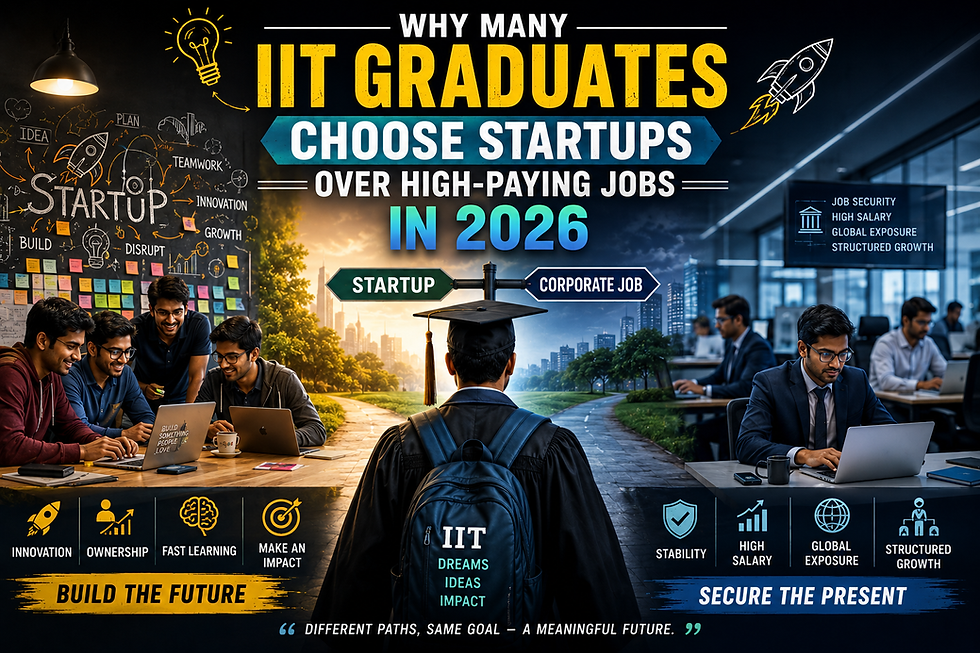
The Traditional Appeal of High-Paying Jobs
High-paying corporate jobs offer several advantages:
Financial stability
Brand recognition
Structured career growth
Global exposure
Employee benefits
Companies in technology, consulting, finance, and product development continue to attract top IIT talent with competitive compensation packages.
Yet, despite these advantages, many graduates are exploring alternative paths.
The Rise of India's Startup Ecosystem
India has become one of the world's fastest-growing startup ecosystems. The success of companies like Flipkart, Zomato, Ola, Razorpay, and CRED has inspired a new generation of engineers to think beyond traditional careers.
IIT campuses have played a significant role in this transformation by fostering innovation, entrepreneurship, and problem-solving.
Today, many students view startups as opportunities to create impact rather than simply earn a salary.
Ownership and Greater Impact
One major reason IIT graduates prefer startups is the ability to make meaningful contributions.
In large corporations, employees often work on specific components of large projects. In startups, however, individuals frequently take ownership of products, features, and strategic decisions.
This sense of responsibility allows young professionals to:
Learn faster
Influence business decisions
Develop leadership skills
See the direct impact of their work
For ambitious graduates, this can be far more rewarding than a traditional corporate role.
Faster Learning and Career Growth
Startups operate in dynamic environments where employees often wear multiple hats.
An engineer may contribute to product development, customer interactions, project management, and business strategy simultaneously.
This exposure accelerates learning and helps professionals develop a broader skill set.
Many IIT graduates view startups as an opportunity to gain years of experience in a much shorter period.
Entrepreneurial Mindset at IITs
IITs are not just engineering institutions; they are innovation hubs.
Students regularly participate in:
Hackathons
Startup competitions
Entrepreneurship cells
Incubation programs
Innovation challenges
These experiences encourage students to identify real-world problems and build solutions.
By the time they graduate, many already have startup ideas or entrepreneurial ambitions.
Equity Can Be More Valuable Than Salary
Another attractive aspect of startups is equity ownership.
Instead of focusing solely on monthly compensation, some graduates prefer receiving shares in a growing company.
If the startup succeeds, the value of these shares can significantly exceed traditional salary packages.
Although startup success is never guaranteed, the potential rewards can be substantial.
Freedom and Work Culture
Modern professionals increasingly value flexibility, creativity, and autonomy.
Many startups offer:
Flexible work environments
Faster decision-making
Less bureaucracy
Greater innovation opportunities
For graduates seeking exciting challenges rather than routine tasks, startups can be highly appealing.
Risks of Choosing a Startup
Despite the advantages, startup careers are not without risks.
Challenges may include:
Job uncertainty
Long working hours
Financial instability
Business failure
Unlike established corporations, startups operate in highly competitive environments where success is never guaranteed.
Students should carefully evaluate both opportunities and risks before making career decisions.
Startup vs High-Paying Job Comparison
Factor | Startup | High-Paying Corporate Job |
Learning Speed | Very High | Moderate |
Job Stability | Lower | Higher |
Ownership | High | Limited |
Innovation | Very High | Moderate |
Salary (Initially) | Moderate | High |
Career Growth | Fast | Structured |
Risk Level | High | Lower |
Work Flexibility | Higher | Varies |
The Future of Engineering Careers
As technology continues to evolve, engineering careers are becoming increasingly entrepreneurial.
Fields such as Artificial Intelligence, Robotics, FinTech, ClimateTech, Cybersecurity, and Space Technology are creating new opportunities for innovation-driven startups.
Many IIT graduates recognize that building solutions to emerging challenges can be just as rewarding as securing a high-paying corporate job.
Conclusion
The growing preference for startups among IIT graduates reflects a broader shift in career aspirations. While high-paying corporate jobs continue to offer security and prestige, startups provide opportunities for ownership, innovation, rapid learning, and meaningful impact.
Today's IIT graduates are increasingly prioritizing growth, creativity, and entrepreneurship over salary alone.
As India's startup ecosystem continues to expand and technology reshapes industries, more graduates are likely to choose paths that allow them to build, innovate, and lead rather than simply work within established systems.
The future of engineering careers may not belong solely to those who earn the highest salaries, but to those who create the next generation of solutions and companies.
FAQs
1. Why do IIT graduates prefer startups over high-paying jobs?
Many IIT graduates are attracted to startups because they offer ownership, faster learning, innovation opportunities, and the chance to create real-world impact.
2. Do startups offer lower salaries than corporate companies?
Generally, startups may offer lower initial salaries, but they often provide equity and faster career growth opportunities.
3. Is joining a startup after IIT risky?
Yes, startups involve higher risk due to uncertainty and competition, but they can also provide significant learning and wealth-creation opportunities.
4. Can startup experience help in future careers?
Absolutely. Startup employees often gain leadership, communication, technical, and business skills that are highly valued across industries.
5. Do IITs support entrepreneurship?
Yes. Most IITs have entrepreneurship cells, incubation centers, startup accelerators, and innovation programs that encourage students to launch ventures.
6. What are the benefits of working at a startup?
Benefits include ownership, innovation, faster learning, flexible work culture, broader responsibilities, and potential equity gains.
7. Can startup equity become more valuable than a salary package?
Yes. If a startup grows successfully, equity can generate returns that significantly exceed traditional salary earnings.
8. Will more IIT graduates choose startups in the future?
With India's growing startup ecosystem and emerging technologies like AI, Robotics, and FinTech, this trend is expected to continue.
9. Which IIT graduates became successful entrepreneurs?
Several IIT alumni have founded successful companies across sectors such as e-commerce, fintech, food delivery, education technology, and software services.
10. Are startups better than corporate jobs?
Neither is universally better. The right choice depends on individual career goals, risk tolerance, financial priorities, and personal interests.



Comments