Why Traditional B.Tech is Obsolete in 2026: The NIAT Advantage
- 2 days ago
- 4 min read
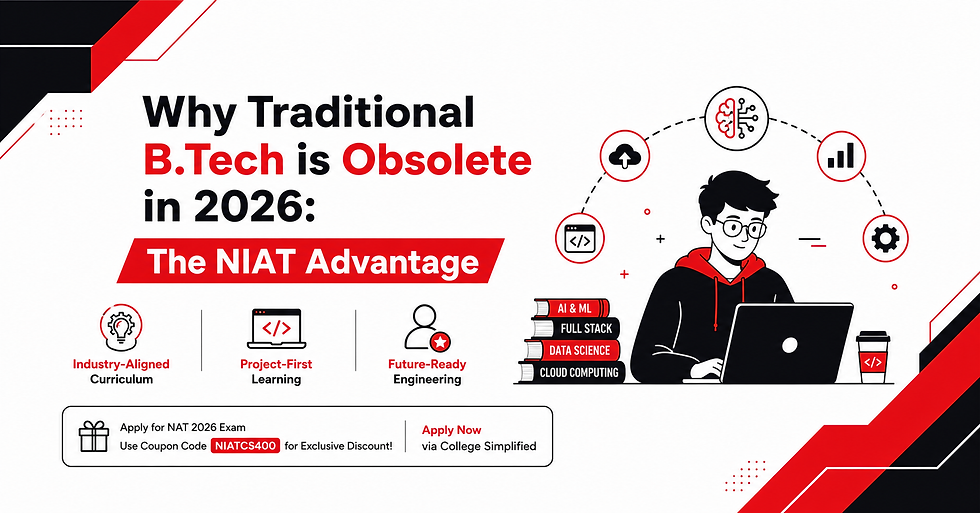
The landscape of engineering in India has hit a critical turning point. As we navigate through 2026, the gap between what is taught in a classroom and what is required in a high-growth tech environment has never been wider. While thousands of graduates emerge every year with a degree in hand, the industry is increasingly vocal about one harsh truth: a traditional B.Tech is becoming obsolete.
For students and parents planning for the future, the choice is no longer just about the "college brand" but about the "curriculum relevance." This is where the NIAT vs Traditional B.Tech 2026 debate becomes essential for anyone looking to stay ahead of the curve.
The Reality Check: Why Traditional B.Tech is Fading in 2026
In most traditional engineering colleges, the syllabus is still rooted in theories established decades ago. While fundamentals are important, the speed of technological evolution—specifically in Generative AI, LLMs, and Cloud Native development—has outpaced the standard university update cycle.
Current data shows that nearly 80% of engineering graduates in 2026 require additional 6-12 months of training before they can contribute to real-world projects. The traditional B.Tech model often prioritizes rote learning and clearing semester exams over building functional software or hardware.
Apply for the NAT 2026 Exam today! Use Coupon Code NIATCS400 to get an exclusive discount on your application. Apply Now via College Simplified
NIAT Nextwave Institute: A Curriculum Built for the Future
NIAT (NxtWave Institute of Advanced Technologies) has flipped the script. Instead of following a rigid, outdated syllabus, NIAT offers an industry-aligned curriculum developed in collaboration with over 3,000 tech companies.
1. Project-First Learning vs. Theory-Heavy Modules
In a traditional setup, you might learn the "history of operating systems." At NIAT, you start by building. The curriculum is mapped to 12-dimensional thinking, ensuring students understand the "why" and "how" of technology by creating clones of platforms like Netflix, Swiggy, and WhatsApp.
2. Specialized Streams for 2026
Traditional B.Tech often offers generic "Computer Science" degrees. NIAT provides specialized pathways that are in high demand right now:
Full Stack Development: Mastering the MERN stack and DevOps.
AI & Machine Learning: Moving beyond basic algorithms to building with Generative AI and Large Language Models.
Data Science & Analytics: Using real-world datasets to drive business intelligence.
Key Comparison: NIAT vs Traditional B.Tech 2026
Feature | Traditional B.Tech (2026) | NIAT Nextwave Institute |
Curriculum Update | Once every 4–5 years | Real-time updates based on industry feedback |
Learning Focus | Theoretical exams & marks | Project-based mastery & skill maps |
Mentorship | Academic faculty | 1:1 mentorship from top software engineers |
Tech Exposure | Basic C++/Java and theory | AI, ML, Cloud Computing, & Advanced DSA |
Eligibility | Entrance based on rote memory | NAT (NxtWave Assessment Test) |
The NIAT vs Traditional B.Tech 2026 comparison highlights a fundamental shift: NIAT treats engineering as a craft, while traditional colleges treat it as a subject.
Deep Dive into the NIAT Course Structure
The NIAT program is divided into phases that ensure a student evolves from a novice to a pro:
Foundation Phase (Year 1-2): Focuses on programming fundamentals, UI/UX, and building full-stack applications.
Specialization Phase (Year 3): This is where you pick your lane—Software Engineering or AI/ML tracks.
Go-Pro Phase (Year 4): Dedicated to capstone projects and advanced problem-solving (DSA) to crack global tech interviews.
Don't miss out on the 2026 intake! Secure your seat by applying for the NAT exam. Use code NIATCS400 for a special discount. Register Here
Why Students are Choosing NIAT via College Simplified
Choosing the right path in 2026 can be overwhelming. College Simplified provides the necessary clarity by breaking down complex admission processes. When you look at the NIAT vs Traditional B.Tech 2026 landscape, it’s clear that the support system at NIAT—including 1:1 doubt resolution and career coaching—is what sets it apart.
For more detailed insights on college selections and 2026 entrance trends, visit College Simplified.
High-Demand Skills in the 2026 Market
To succeed this year, having "B.Tech" on your resume isn't enough. Recruiters are looking for:
AI Fluency: Can you integrate AI into existing workflows?
Adaptive Problem Solving: Can you solve a problem you haven't seen in a textbook?
Collaborative Coding: Experience with Git, CI/CD pipelines, and agile methodologies.
Traditional colleges rarely touch upon these, whereas NIAT integrates them into the daily routine.
Ready to join the elite 1% of engineers? Apply for NIAT using Coupon Code NIATCS400. Start Your Application
Frequently Asked Questions (FAQs)
Q1: What is the main difference in NIAT vs Traditional B.Tech 2026?
The main difference lies in the curriculum; NIAT focuses on real-world projects and the latest AI/ML technologies, while traditional B.Tech remains largely theoretical and outdated.
Q2: Is the NAT (NxtWave Assessment Test) difficult?
The NAT assesses logical reasoning, critical thinking, and basic math. It is designed to find potential, not just reward rote memorization.
Q3: Can I get a scholarship for NIAT?
Yes, based on your NAT performance and 1:1 counselling sessions, various concessions are available. Use code NIATCS400 when applying for the exam for immediate savings on the registration fee.
Q4: Does NIAT provide a degree?
NIAT partners with 20+ recognized universities to provide a formal B.Tech degree alongside its intensive skill-mapping program.
Conclusion: Making the Right Move
As we look at the tech horizon of 2026, the "safe" path of a traditional degree is now the riskiest. The NIAT vs Traditional B.Tech 2026 debate concludes with one winner for those who want to be creators and innovators: NIAT. By focusing on course depth and industry-relevant streams, NIAT ensures you don't just graduate; you excel.
Take the first step towards a future-proof career. Use Coupon Code NIATCS400 and apply for the NAT 2026 exam now. Apply Today
For personalized guidance on admissions, check out College Simplified to connect with expert mentors who can help you navigate the 2026 engineering landscape.


Comments