Can CBSE Marks Increase After Revaluation? The Ultimate 2026 Guide
- May 19
- 7 min read
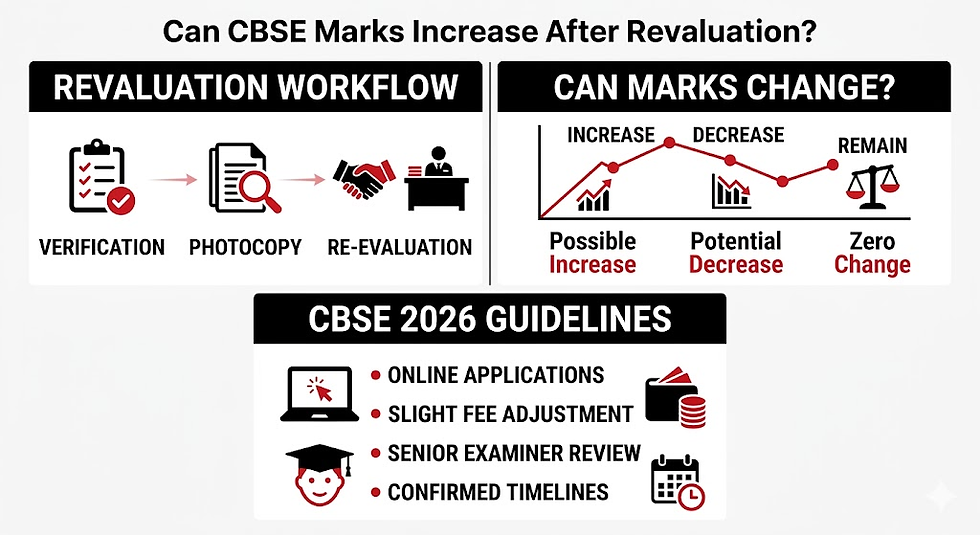
The declaration of the Central Board of Secondary Education (CBSE) Class 10 and Class 12 board results is always a high-stakes, emotional moment for millions of students across India. While many celebrate their hard work, a substantial number of students face sheer disbelief when they open their digital report cards. If you scored much lower than what you projected based on official answer keys, you are likely asking yourself a critical question: Can CBSE marks increase after revaluation?
The short and encouraging answer is yes, CBSE marks can definitely increase after revaluation. In fact, given the unprecedented structural changes introduced by the board for the 2026 evaluation cycle, understanding how this process works—and how it can benefit you—is more critical than ever before.
This comprehensive guide breaks down everything you need to know about the CBSE marks increase process in 2026, including the latest policy changes, a massive fee reduction, the impact of digital evaluation, and a step-by-step strategy to successfully appeal your scores.
The 2026 CBSE Evaluation Crisis: Why Revaluation is Crucial This Year
To understand your chances of a score revision, it helps to understand the macro picture of how your papers were checked.
In May 2026, CBSE declared the Class 12 board results with an overall pass percentage of 85.20%. This represents a sharp drop of 3.19 percentage points compared to 2025’s pass percentage of 88.39%. Furthermore, schools across the country reported a staggering 16% decline in the number of students scoring 90% or above.
This noticeable dip in scores has been heavily linked to the nationwide rollout of the On-Screen Marking (OSM) system, a digital evaluation framework where nearly 98.6 lakh answer scripts were scanned, converted into PDFs, and evaluated digitally by teachers on computer screens.
Initial Glitches in the Digital Framework
While the Ministry of Education has defended OSM as a foolproof method that ensures "zero totaling errors," officials have openly acknowledged human and technical limitations during its execution:
Legibility Issues: Over 68,018 answer books had to be completely re-scanned mid-process due to exceptionally poor initial scan quality.
Ink Discrepancies: Exactly 13,583 answer books could not be digitally evaluated at all because students used light-colored inks that rendered poorly on-screen. These had to be pulled out and checked manually.
The Human Factor: CBSE Controller of Examinations, Sanyam Bhardwaj, openly stated in a media briefing that because the board evaluates a massive volume of approximately 1.25 crore answer scripts annually, "there is a possibility that an error may occur somewhere."
Because digital evaluation was new to thousands of examiners, instances of accidental skipping of pages, strict digital navigation issues, or missing inline structural credits have surfaced. If you feel your hard work was compromised by these technical shifts, the CBSE marks increase process is your formal mechanism for justice.
Historic Student-Friendly Policy Shifts in 2026
Responding to widespread anxiety among parents and students regarding unusually low marks, the Ministry of Education and CBSE Secretary Sanjay Kumar announced a historic, highly lenient post-result relief package.
If you are hesitating to apply due to financial constraints or rigid rules from previous years, take a look at how student-friendly the system has become in 2026:
Massive Fee Reductions (Up to 85% Cut): Historically, applying for post-result evaluation was an expensive affair. For 2026, the fees have been slashed drastically to make the process accessible to everyone.
100% Full Refunds on Upward Revisions: In a groundbreaking structural update, CBSE has announced that if a student’s marks increase or are revised upward during the scrutiny process, the entire fee paid for re-evaluation will be fully refunded to the student’s account.
2026 CBSE Revaluation Fee Comparison Matrix
Post-Result Service Stage | Old Fee Structure (2025) | New Slashed Fee Structure (2026) | Price Reduction (%) | Refundable? |
Stage 1: Accessing Scanned Answer Sheet | ₹700 per subject | ₹100 per subject | 85.7% Drop | No |
Stage 2: Verification of Marks | ₹500 per subject | ₹100 per subject | 80% Drop | No |
Stage 3: Re-evaluation of Specific Answers | ₹100 per question | ₹25 per question | 75% Drop | Yes (If marks increase) |
The Non-Negotiable 3-Stage CBSE Marks Increase Process
You cannot simply jump online and demand that an examiner re-read your whole paper. CBSE enforces a strict, chronological three-stage sequence. Missing Stage 1 disqualifies you from Stage 2 and Stage 3.
Let’s explore each stage in depth so you can maximize your chances of a successful mark jump.
Stage 1: Applying for a Photocopy of the Evaluated Answer Book
Timeline: May 19, 2026, to May 22, 2026 (A strict 3-day window)
Cost: ₹100 per subject
What Happens: You log onto the official portal and request your paper. CBSE uploads a digital, scanned copy of your evaluated answer script to your candidate dashboard. To maintain examiner security, all credentials and signatures identifying the original evaluator are completely blocked out. You will see your exact handwriting alongside the marks allocated to each section.
Stage 2: Verification of Marks
Timeline: May 26, 2026, to May 29, 2026
Cost: ₹100 per subject
What Happens: Once you have your scanned copy, you apply for verification. In this stage, senior board checkers pull up your records to look for administrative discrepancies. They check for:
Computational or totaling errors across the whole sheet.
Any completely un-evaluated answers (where an examiner missed a page).
Data entry issues (e.g., you scored 8 marks on paper, but the system typed it as 3 marks on the final online portal).
Note: The OSM framework has minimized totaling errors significantly, so while errors here are rare, this stage serves as the mandatory bridge to Stage 3.
Stage 3: Re-evaluation of Specific Questions
Timeline: May 31, 2026, to June 5, 2026
Cost: ₹25 per question (Fully refundable if your score goes up)
What Happens: This is where the magic happens for an actual CBSE marks increase process. If you review your scanned sheet against the official CBSE marking scheme (which is published alongside the question papers on the portal) and realize that a perfectly correct 5-mark answer was given only 2 marks, you can explicitly challenge that exact question.
A specialized independent committee of senior subject experts will review your answer dynamically. CBSE allows a maximum of 10 questions per subject to be challenged under this window.
The Multi-Sided Risk: Can Marks Decrease or Remain the Same?
While a mark hike is highly possible, you must enter this process with an analytical and realistic mindset. When a senior subject expert looks at your challenged answers, three things can happen:
1. Marks Increase (The Best Case Scenario)
If the original examiner was overly harsh, overlooked key steps in a derivation, missed structural keywords in a long answer, or made an outright error, your score is revised upwards. Your old marksheet is declared null and void, and a brand-new updated marksheet is issued. This also triggers your fee refund.
2. Marks Remain the Same (The Most Common Case)
If the independent expert feels that the marks awarded by the first examiner match the latitude provided in the official marking schema, your scores will remain static. You lose the processing fee, but you gain complete peace of mind that your result was fair.
3. Marks Decrease (The Risk Factor)
Yes, CBSE can reduce your marks during re-evaluation. If a senior examiner looks at your paper and finds that the original teacher mistakenly awarded you extra marks for an incomplete answer, or broke marking guidelines in your favor, they have the full authority to deduct those marks.
Crucial Rule: Whatever the final outcome of the re-evaluation is—whether it goes up by 5 marks or down by 3 marks—the new score is absolute and binding. You cannot request your old marks back, and no further legal or board appeals are entertained.
Step-by-Step Guide to Applying Online
CBSE does not accept any offline applications, letters, or school-route representations. The entire process must be completed independently by the student online.
Head directly to the official CBSE post-result services web portal: cbseit.in or cbse.gov.in.
Click on the active link labeled "Apply – Class 12 / Class 10 (AnswerBook)".
Enter your authentic board credentials: Your Roll Number, 5-digit School Number, and Admit Card ID (exactly as printed on your hall ticket).
Select the subjects you wish to review. The portal will automatically calculate your total fee based on the 2026 revised rates.
Generate your online undertaking and proceed to the payment gateway.
Pay online using Net Banking, Debit/Credit Cards, or any standard UPI application. Download and save the application receipt containing your unique Application Number for future tracking.
Dedicated FAQ Section
Q1: Is it worth applying for the CBSE marks increase process if I'm short by just 2 or 3 marks for college cut-offs?
Answer: Absolutely. In 2026, with competitive university admissions and strict cut-offs, even a single mark can drastically alter your ranking. Given that the re-evaluation fee has been slashed to just ₹25 per question and is fully refundable upon a score increase, the financial risk is incredibly low. If you have matched your answer script with the official marking scheme and noticed a genuine discrepancy, you should definitely apply.
Q2: Can my school apply for rechecking on my behalf?
Answer: No. CBSE mandates that the student must apply individually through the online student portal (cbseit.in). Schools cannot mass-apply or submit physical applications for their students. However, you should definitely seek guidance from your school teachers to analyze your scanned answer sheet before choosing which questions to challenge.
Q3: How long does it take for the revised re-evaluation results to come out?
Answer: Typically, CBSE processes and uploads the revised outcomes within 15 to 20 days after the respective stage application window closes. The updated status will appear directly on the website under the "Application Status" tab, and an official updated digital marksheet will be pushed to your DigiLocker account.
Q4: If my marks decrease after re-evaluation, can I choose to keep my original marks?
Answer: No. As per official board guidelines, the marks obtained after the final re-evaluation are completely binding. If your score decreases, your original marksheet becomes invalid, and the lower score will be updated as your final official result. It is highly recommended to only challenge answers where you are completely certain that you deserved more points.
Conclusion & The Verdict
The introduction of On-Screen Marking (OSM) in 2026 has undoubtedly caused unexpected fluctuations in student scores across the country. However, CBSE has balanced this transition by giving students an incredibly affordable, transparent, and financially risk-free method to challenge their results.
If your gut feeling and your calculations match the official CBSE marking criteria, do not let your hard work go to waste. Keep a close eye on the active windows, download your scanned copies, and confidently use the system to claim the marks you truly earned!
Need Official Help? Useful Resources & Action Links
Do not fall prey to fraudulent third-party websites claiming to expedite your marks review. Use only the official government portals listed below to complete your process securely:
Apply for Post-Result Services: Initiate your application directly on the Official CBSE Re-evaluation Portal.
Check Academic Guidelines: Read detailed circulars and download subject-wise marking keys at the CBSE Academic Official Website.
Main Corporate Portal: Find immediate national announcements, press releases, and notifications on the primary Central Board of Secondary Education (CBSE) Home Page.
Get Professional Student Support: If you are facing severe post-result stress or require operational clarity, you can utilize the official board helplines available through the CBSE Results Portal which remains active with dedicated counselors until June 1, 2026.


Comments