Complete Guide to CBSE Revaluation Process 2026: Steps, Slashed Fees, and Dates
- May 19
- 6 min read
The declaration of the Central Board of Secondary Education (CBSE) Class 12 results marks a massive milestone in a student’s academic journey. However, receiving a scorecard that does not align with your expectations can be incredibly disheartening. If you are confident that your hard work deserved a higher score, you do not have to settle.
Following the release of the Class 12 board results, which saw a dip in the overall pass percentage to 85.20% compared to last year's 88.39%, CBSE acknowledged the potential for evaluation errors across its massive operation of checking 1.25 crore answer scripts. To ensure absolute transparency, the board has officially activated the CBSE revaluation process 2026 portal.
In an unprecedented, highly student-friendly move, CBSE has completely overhauled its fee structure this year, slashing application costs by up to 85% and introducing full refunds for successful appeals.
This comprehensive guide covers everything you need to know about navigating the three-stage post-result review pathway, including the exact timeline, updated fee structure, and step-by-step application instructions.
Understanding the New 2026 Evaluation Framework
Before diving into the steps, it is essential to understand why this year's review process looks different. In 2026, CBSE fully implemented On-Screen Marking (OSM) for evaluating Class 12 answer scripts nationwide. While this digital transition aims to eliminate manual totaling slip-ups and missing page evaluations, technical transitions can occasionally introduce unforeseen discrepancies.
Recognizing this, CBSE Controller of Examinations Sanyam Bhardwaj highlighted that when evaluating such an enormous volume of scripts, minor anomalies can occur. To cushion students against the financial burden of seeking corrections, the board drastically reduced its fees, making the review mechanism highly accessible to everyone.
The 3-Stage CBSE Revaluation Process 2026 Explained
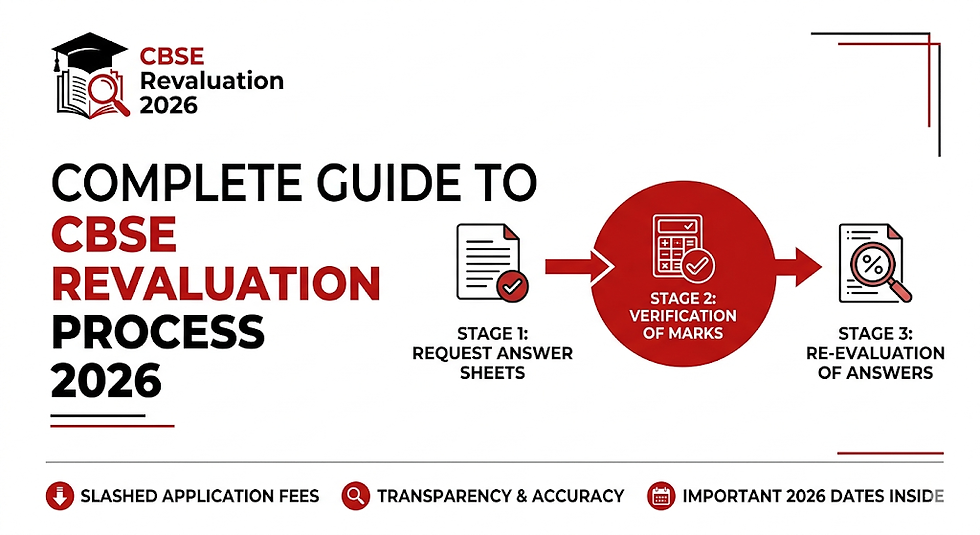
The post-result review system is a strict, sequential, three-stage pipeline. You cannot skip stages. If you want your specific answers re-evaluated, you must first apply for a photocopy of your answer book. If you do not apply for Stage 1, you automatically forfeit your eligibility for Stage 2 and Stage 3.
Let's break down each phase in detail, updated with the definitive 2026 schedule and newly restructured fee guidelines.
Stage 1: Application for Scanned Copy of Evaluated Answer Sheet
This mandatory first step allows you to download a digital, scanned copy of your checked answer book. To protect privacy and ensure objectivity, CBSE completely blocks out all identifying information regarding the examiner and evaluation team. You will only see your written responses and the marks assigned to them.
Application Window: May 19, 2026, to May 22, 2026
Revised 2026 Fee: ₹100 per subject (Massively reduced from the historical fee of ₹700—an 85% price cut!)
How it Works: Once you apply, your scanned booklet will be populated into your unique student login portal between May 26 and May 29, 2026.
Stage 2: Verification of Marks
Once you have your digital answer sheet in hand, you must cross-reference your answers against the official CBSE marking schemes provided inside the application portal. Stage 2 specifically deals with clerical, technical, and mathematical errors on the examiner’s part.
Application Window: May 26, 2026, to May 29, 2026
Revised 2026 Fee: ₹100 per subject
What is Checked:
Whether totaling errors exist across sections.
Whether any written response or sub-question was accidentally left completely unchecked or un-awarded.
Whether marks from internal pages were correctly transferred to the cover sheet.
Stage 3: Re-evaluation of Specific Answers
If you notice that a specific question was checked but marked unfairly or strictly outside the parameters of the marking scheme, you move to the final stage: CBSE revaluation process 2026. Here, subject matter experts evaluate targeted answers individually.
Application Window: May 31, 2026, to June 5, 2026
Revised 2026 Fee: ₹25 per question
The 2026 Refund Bonus: In a highly progressive move for 2026, CBSE announced that if your marks increase during this re-evaluation phase, the ₹25-per-question fee will be fully refunded to your account.
CBSE Revaluation Process 2026: Official Timeline & Fee Structure
To make sure you do not miss any hard deadlines, keep this summary reference table bookmarked. CBSE has firmly stated that no late applications will be accepted under any circumstances.
Stage | Activity / Process | Start Date | Last Date (Deadline) | Fees (Per Subject / Question) |
Pre-Stage | Class 12 Board Results Declared | May 13, 2026 | — | Free via DigiLocker / Results Portal |
Stage 1 | Request Photocopy of Answer Script | May 19, 2026 | May 22, 2026 | ₹100 per subject |
Stage 1B | Access & Download Scanned Booklet | May 26, 2026 | May 29, 2026 | Included in Stage 1 fee |
Stage 2 | Apply for Verification of Marks | May 26, 2026 | May 29, 2026 | ₹100 per subject |
Stage 3 | CBSE Revaluation Process 2026 | May 31, 2026 | June 5, 2026 | ₹25 per question (Refunded if marks increase) |
Post-Stage | Final Updated Marksheet on DigiLocker | Late June 2026 | — | Free |
Step-by-Step Guide: How to Apply Online
The entire framework is hosted digitally. Avoid fraudulent third-party websites and follow these precise steps to submit your application securely:
Visit the Official Portal: Go directly to the official CBSE application portal at cbseit.in or navigate through the main landing tab on cbse.gov.in.
Authenticate Credentials: Click on the active link labeled "Apply for Answer Book / Verification / Re-eval". Select Class 12, and input your Roll Number, School Number, and Center Number exactly as printed on your 2026 Board Admit Card.
Select Your Subjects: Choose the specific subjects for which you want to request a scanned copy. Double-check your selections, as modifying your application later is impossible.
Generate & Upload Undertaking: The portal will prompt you to generate a student undertaking form. Print it, sign it, scan it, and upload it back to the platform.
Online Fee Payment: Proceed to the payment gateway. Pay the required fee (e.g., ₹100 per subject for Stage 1) using net banking, debit/credit cards, or UPI.
Track Status: Save your automatically generated Application Number securely. You will need it to track your approval status and download your scanned scripts.
Crucial Risk Factors Every Student Must Consider
While the massive 85% price drop makes it tempting to apply for every subject, you should exercise analytical caution. Keep these fundamental board rules in mind:
1. Marks Can Decrease: When you opt for verification or re-evaluation, your marks can go up, stay exactly the same, or even decrease. If a fresh reviewer discovers that a previous examiner marked you too leniently, your score will drop.
2. The Revised Result is Final: You must accept the final calculated tally after the review process. You cannot choose to retain your older, higher score if your marks drop during rechecking. Your original marksheet will become legally invalid, and a fresh version will be generated on DigiLocker.
3. Limited Correction Scope: Stage 3 re-evaluation is strictly evaluated on a question-by-question framework. You cannot ask for a global "re-checking of the whole paper" based on general dissatisfaction; you must point out precise discrepancies using the official marking scheme guidelines.
Frequently Asked Questions (FAQs)
Q1: Is it possible to directly apply for the CBSE revaluation process 2026 without buying a photocopy?
Ans: No, it is absolutely impossible. The board enforces a strict, multi-tier sequence. To become eligible for the final CBSE revaluation process 2026, you must first register and pay for the Stage 1 scanned answer booklet photocopy from May 19 to May 22, followed by the Stage 2 verification process.
Q2: What happens if my marks change after the review?
Ans: If there is a change in your marks (increase or decrease), your old marksheet stands revoked. CBSE will update your digital credentials, and you will be able to download your official, updated marksheet directly from DigiLocker within 2 to 3 weeks following the conclusion of the final June deadlines.
Q3: Why did CBSE lower the application fees so drastically for 2026?
Ans: Following the nationwide rollout of full-scale On-Screen Marking (OSM) for Class 12 scripts, the board acknowledged that processing over 1.25 crore answers digitally leaves room for marginal errors. Slashing fees by up to 85% ensures that no student is financially blocked from reviewing their own answer sheets due to high costs.
Q4: Will I get a refund if my marks increase during re-evaluation?
Ans: Yes! Under the revised rules for 2026, if you apply for Stage 3 re-evaluation at ₹25 per question, and your claim is proven valid resulting in a score increase, CBSE will issue a complete refund of that specific question's re-evaluation fee back to your source account.
Action Plan & Official Links
Do not leave your future to chance or wait until the final hour. Because the Stage 1 window remains open for only a brief three-day period, server bottlenecks and payment gateway timeouts are common close to the deadline. Gather your admit card credentials, analyze your performance objectively against your expectations, and apply today.
Use these official, validated institutional resources to begin your review:
Main Regulatory Website: Central Board of Secondary Education (CBSE)
Direct Rechecking & Revaluation Link: CBSE Online Re-evaluation Portal
Status Tracking Dashboard: CBSE Re-evaluation Application Status
For a step-by-step visual walkthrough of how the portal interface looks and how to fill out the form fields correctly without making errors, check out this CBSE Class 12 Revaluation Process Walkthrough. This video is helpful because it shows the exact layout of the application pages, helping you avoid errors during submission.


Comments