Complete List of Questions Asked in Census 2026 India (All 33 Questions Explained)
- Apr 18
- 3 min read
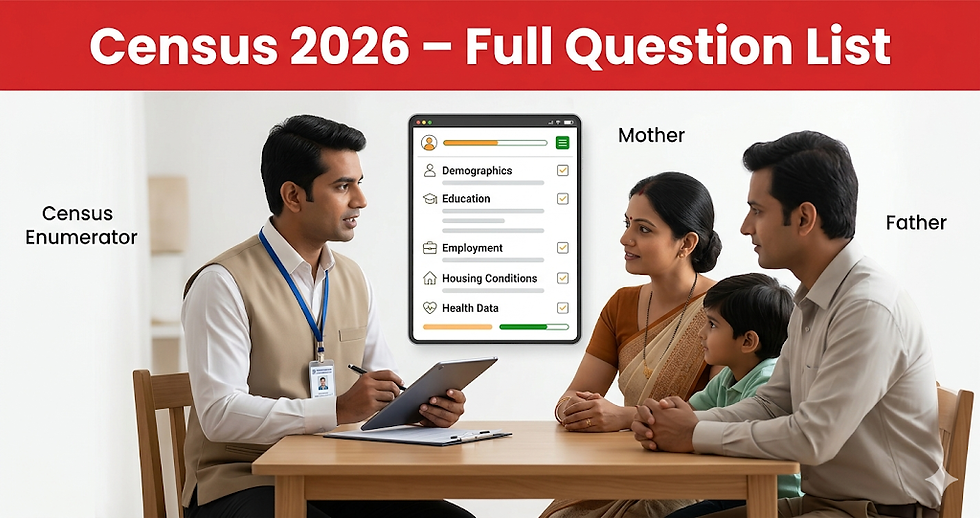
Census 2026 is one of the largest data collection exercises in India, and many people want to know exactly what information will be collected during home visits.
The Government of India has officially notified a structured questionnaire consisting of 33 questions in the first phase (House Listing & Housing Census).
This guide provides the complete list of questions, explained in simple terms so you know exactly what to expect.
Official Source for Census Questions
You can verify official information here:
Census India Official Websitehttps://censusindia.gov.in/census.website/en
The Census is conducted by theOffice of the Registrar General & Census Commissioner, India
Total Number of Questions in Census 2026
Phase 1 (House Listing): 33 questions
Phase 2 (Population Enumeration): Individual-level questions
The first phase focuses mainly on household, housing, and amenities data.
Complete List of 33 Questions (Phase 1)
Below is the full official list of questions asked during Census home visits.
A. Identification Details
Building number (municipal/local authority/census number)
Census house number
B. Housing Structure Details
Material of floor
Material of wall
Material of roof
Use of the house (residential/commercial/mixed)
Condition of the house
C. Household Information
Household number
Total number of persons living in the household
Name of the head of household
Sex of the head of household
Social category (SC/ST/Other)
D. Ownership & Living Conditions
Ownership status of the house
Number of rooms in the house
Number of married couples in the household
E. Basic Amenities
Main source of drinking water
Availability of drinking water
Main source of lighting
Access to toilet
Type of toilet
Wastewater outlet
Availability of bathing facility
Availability of kitchen and LPG/PNG connection
Main cooking fuel used
F. Household Assets & Facilities
Radio or transistor
Television
Internet access
Laptop or computer
Telephone/mobile/smartphone
G. Transport & Assets
Bicycle/scooter/motorcycle/moped
Car/jeep/van
H. Additional Questions (New Additions)
Main cereal consumed in the household
Mobile number
These questions focus on housing conditions, access to facilities, and basic assets, helping the government understand living standards across India.
Questions Asked in Phase 2 (Population Enumeration)
In the second phase, individual-level data is collected, such as:
Age
Gender
Marital status
Religion
Education
Occupation
Language
Migration details
Disability status
This phase focuses on demographic and social data of each person.
Why These Questions Are Asked
The purpose of collecting this information is to:
Plan infrastructure (roads, housing, water supply)
Design welfare schemes
Allocate government resources
Understand population trends
Important Things to Remember
You do not need to provide documents in most cases
Answers are based on your responses
Data is confidential and protected by law
Census officers will not ask for financial or sensitive details
What Census Officers Will Not Ask
To avoid confusion, they will not ask for:
Bank account details
OTPs or passwords
Income tax information
Any payment
Final Verdict
Census 2026 includes a well-structured list of 33 questions in the first phase, focusing on household and living conditions.
Conducted by theOffice of the Registrar General & Census Commissioner, India
this data helps shape India’s development and policy decisions.
The key takeaway is simple:
Understand the questions, provide accurate answers, and rely only on official sources.
FAQs
How many questions are asked in Census 2026?
There are 33 questions in the first phase (house listing).
What type of questions are asked?
Questions focus on housing, household details, amenities, and assets.
Are personal questions asked?
Yes, in the second phase, basic demographic details are collected.
Do I need documents?
No, usually answers are recorded based on your responses.
Is Census data safe?
Yes, it is confidential and protected by law.


Comments