Demystifying CBSE Revaluation Fees: A Complete Guide for Class 10 and 12 Students
- May 19
- 6 min read
The declaration of the Central Board of Secondary Education (CBSE) Class 10 and Class 12 board results is always a high-stakes moment for millions of students across India. While many celebrate their hard-earned scores, it is entirely common for some students to feel that their performance on the exam sheet is not accurately reflected in their final scorecard. Whether you missed a crucial cutoff by a few marks or firmly believe an examiner overlooked a brilliantly written answer, CBSE provides a structured, multi-stage mechanism to review your answer sheets.
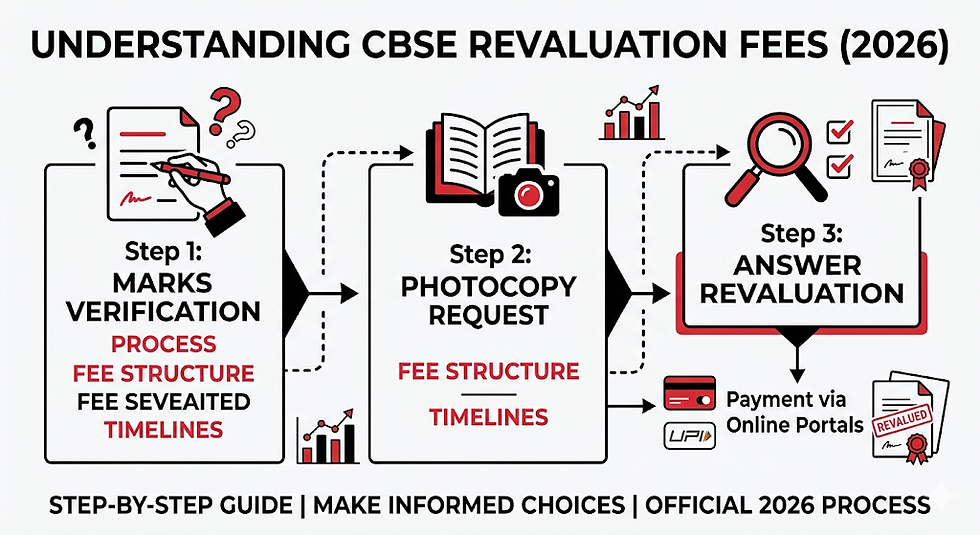
However, navigating this post-result framework requires a clear understanding of the timelines, strict procedural rules, and financial implications. Applying for an answer sheet review is not a single-step action; it is a progressive journey consisting of three distinct phases, each carrying its own independent cost.
This comprehensive guide breaks down the entire CBSE revaluation fees structure for the year 2026, details the step-by-step application pipeline, and offers critical strategic advice to help you make informed choices without burning a hole in your pocket.
The Three-Stage CBSE Post-Result Verification Framework
To ensure maximum transparency and minimize human error, the CBSE does not permit students to jump straight to rechecking a specific answer. Instead, the board mandates a sequential process. To reach the final stage of revaluation, you must successfully clear and pay for the preceding stages.
If you do not apply for Stage 1, you lose eligibility for Stage 2 and Stage 3. Let's look closely at how this framework operates and analyze the associated costs.
Detailed Breakdown of the CBSE Revaluation Fees Structure
To manage your budget and expectations, it is essential to understand that fees are charged on a per-subject or per-question basis, rather than a flat rate per student. Below is the precise financial breakdown for both Class 10 and Class 12 students in 2026.
Stage of Application | Eligible Candidates | Class 10 Fees (INR) | Class 12 Fees (INR) | Scope of Work |
Stage 1: Verification of Marks | Any student dissatisfied with results | ₹500 per subject | ₹500 per subject | Totalling check, unchecked answer scan, data entry verification |
Stage 2: Photocopy of Answer Book | Only those who completed Stage 1 | ₹500 per answer book | ₹700 per answer book | Digital access to the evaluated answer script (PDF format) |
Stage 3: Revaluation of Specific Answers | Only those who completed Stage 2 | ₹100 per question | ₹100 per question | Detailed reassessment of specific disputed questions by an expert |
Phase 1: Verification of Marks (The Gateway Stage)
The first step is a macro-level review of your marks. When you pay the required fee for this phase, an official evaluator pulls your answer script to ensure that:
All answers have been assigned a mark.
There are no computational errors or mistakes in totaling the marks across sections.
The marks on the inside pages match the final tally on the cover sheet of the answer booklet.
Crucial Note: No actual re-grading or re-assessment of the quality of your answers occurs during this stage. If an examiner gave you 2 out of 5 marks for an answer, Stage 1 will not change that score unless the 2 marks were accidentally omitted from the final sum.
Phase 2: Obtaining a Photocopy of the Answer Book
If your Stage 1 results reveal no calculation errors, but you remain confident that your written answers deserved higher marks, you must progress to Stage 2.
Upon paying the fee—which stands at ₹500 per script for Class 10 and ₹700 per script for Class 12—CBSE uploads a scanned PDF copy of your evaluated answer sheet to your candidate login portal. This file displays the specific marks awarded by the examiner for each question, along with any official markings or comments.
Reviewing this document allows you to compare your responses against the official CBSE marking scheme to identify valid grounds for a challenge.
Phase 3: Revaluation of Specific Questions
This final phase is where actual re-grading takes place. If you discover that a correct response was marked completely wrong, or if the marks awarded fall well short of the criteria listed in the official marking scheme, you can challenge those specific answers.
The fee for this stage is ₹100 per individual question. Because this cost can accumulate quickly if you challenge multiple items, you must choose your targets carefully based on clear evidence from the marking scheme.
Step-by-Step Guide: How to Apply and Pay Online
The entire application process is hosted online through the official CBSE portals. The board does not accept offline applications, physical demand drafts, or cash payments under any circumstances.
Step 1: Monitor the Core Schedule
Immediately after the results are declared, CBSE publishes an official circular detailing the precise dates for each phase. The window for each stage is brief—frequently lasting only 2 to 3 days. Mark these dates clearly, as missed deadlines cannot be extended.
Step 2: Access the Application Portal
Visit the primary website of the board: cbse.gov.in.
Click on the Main Website link and look for the Pariksha Sangam or Scholarships/CBSE Portal section.
Click the link labeled "Apply for Verification/Photocopy/Revaluation 2026."
Step 3: Enter Your Credentials and Select Subjects
Log into the system using your Roll Number, School Number, and Center Number exactly as printed on your original CBSE admit card. Once logged in, select the specific subjects you want to submit for verification. Double-check your choices, as you cannot edit your selections after submitting the form.
Step 4: Complete the Online Payment
After finalizing your application form, the portal routes you to an integrated secure payment gateway. You can settle the CBSE revaluation fees structure using any of the following digital payment channels:
Net Banking
Debit Card / Credit Card
UPI (Unified Payments Interface)
Your application remains incomplete until the payment clears successfully. Always download and save the transaction receipt and the generated confirmation page for future reference.
Important Rules, Risks, and Hidden Realities
Before committing your financial resources to this process, it is critical to familiarize yourself with the strict rules governing CBSE mark reviews:
Scores Can Decrease: When you request a review, your marks can go up, stay the same, or decrease. If an evaluator discovers that a previous examiner gave you unearned marks, your score will be lowered, and you must accept the new, lower result.
Fees Are Non-Refundable: All processing fees are entirely non-refundable. Even if your marks remain unchanged or decrease after review, the board will not return your money.
Surrendering Your Old Marksheet: If your score changes by even a single mark, your original marksheet becomes invalid. You must mail or surrender your old physical marksheet to your regional CBSE office to receive an updated certificate.
Mandatory Sequential Steps: You cannot bypass the initial stages. For example, you cannot buy a copy of your answer sheet without first paying for the initial marks verification phase.
Dedicated FAQ Section
Q1. Can I apply directly for the revaluation phase without going through the marks verification process?
Ans: No, you cannot bypass any part of the sequence. To access the final revaluation phase, you must step through the complete CBSE revaluation fees structure in order. You must first apply for Phase 1 (Verification of Marks). Only candidates who complete Phase 1 can apply for Phase 2 (Photocopy of Answer Book). Finally, only those who receive their photocopy can log an application for Phase 3 (Revaluation of specific questions).
Q2. What happens if my marks decrease after the verification or revaluation process?
Ans: Any change in marks—whether an increase or a decrease—is final and binding. If your score drops during the review, your original score is erased, and your official record updates to the lower mark. You must return your old physical marksheet to CBSE to obtain your revised document.
Q3. How can I pay the application fees, and are offline methods accepted?
Ans: CBSE accepts fee payments exclusively through online channels. You can pay via Net Banking, Credit cards, Debit cards, or UPI. The board does not accept cash, postal orders, checks, or physical demand drafts.
Q4. Are CBSE revaluation fees refunded if my marks increase significantly?
Ans: No. All processing fees across the verification, photocopy retrieval, and individual question revaluation phases are entirely non-refundable, regardless of the final outcome of the review.
Conclusion and Next Steps
The decision to challenge your CBSE board exam evaluation should be driven by strategy and objective evidence rather than emotion. If you notice a substantial discrepancy between your school pre-board performance and your final board results, starting with Phase 1 (Verification of Marks) is an excellent, low-risk way to rule out basic computational or clerical errors.
If you decide to request a full photocopy of your answer booklet, make sure to review it alongside a trusted school subject teacher. Comparing your written answers directly to the official CBSE marking scheme helps ensure you spend money only on challenges with a high probability of success. Keep a close eye on the official portal schedules, stay organized, and approach the process step by step.
Need Official Updates or Career Guidance?
To read official circulars or launch your application, visit the Official CBSE Portal.
To check your initial or revised scores online, navigate directly to the CBSE Exam Results Page.
Uncertain about your academic path while waiting for your review results? Browse the Shiksha Career Counseling Guide to explore professional paths, college cutoffs, and admissions strategies.


Comments