France vs Sweden Tactical Analysis: Winning Strategies For 2026
- 15 hours ago
- 7 min read
In the modern land scape of international football, few matchups present as fascinating a chess match as a clash between Western European giants France and Scandinavian powerhouses Sweden. As we move through the 2026 international calendar—with teams neck-deep in high-stakes qualification campaigns and structural rebuilds—understanding the tactical nuances between these two distinct footballing cultures is more critical than ever.
Whether analyzing the men's senior squads or looking at the highly competitive women's setups currently battling through the UEFA qualifiers, games between these nations are rarely won by individual brilliance alone. Instead, they are decided by structural discipline, transitional speed, and systemic adjustments.
This comprehensive France vs Sweden tactical analysis breaks down the core formations, defensive blocks, transition mechanics, and winning strategies required for either side to claim dominance on the pitch in 2026.
The Core Formations: Structural Layouts in 2026
To understand how these two teams interact, we must first look at their preferred baseline structures. Both managers have evolved their philosophies to match the physical and technical demands of the 2026 modern game.
France’s Fluid 4-3-3 / 4-2-3-1 Hybrid
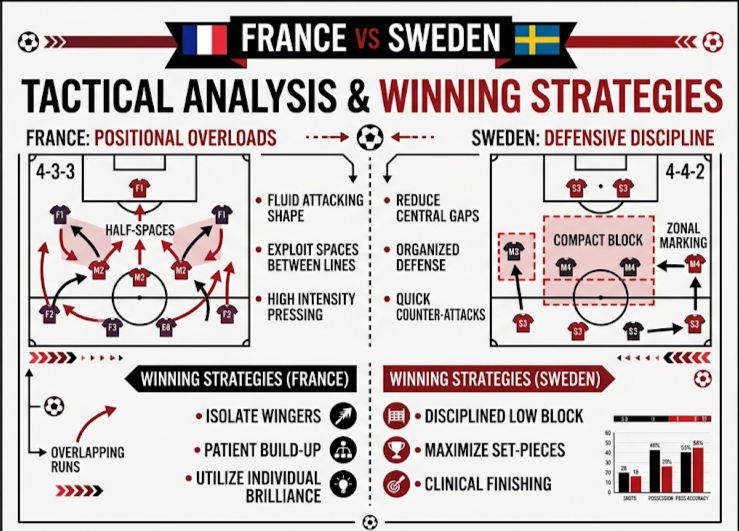
France has long favored a system that balances immense individual athletic capability with tactical flexibility. Under possession, their shape frequently shifts from a rigid 4-3-3 into an asymmetrical 4-2-3-1 or even a 3-2-4-1 during sustained attacking phases.
The Defensive Line: Operating with highly progressive full-backs who can tuck inside to form a back three or push high to provide natural width.
The Engine Room: A double-pivot or midfield trio designed to dictate tempo, win second balls, and break up play before distributing to creative outlets.
The Attacking Trident: Exceptionally fluid. In modern setups, French wingers rarely hug the touchline permanently; they look to isolate defenders in 1v1 situations or cut inside to leave space for overlapping full-backs.
Sweden’s Disciplined 4-4-2 / 4-2-3-1 Pragmatism
Sweden’s identity is built on a foundation of collective organization, spatial control, and high physical endurance. While historically famous for a rigid, deep-lying 4-4-2, recent tactical overhauls in 2026 show a willingness to adapt to a modern 4-2-3-1, allowing their creative midfield sparkplugs to operate between the lines.
The Defensive Unit: Extremely compact. Sweden relies on tight horizontal and vertical spacing, minimizing the gap between the defensive line and the midfield block.
The Midfield Screen: Two dynamic central midfielders who excel in lateral shifting, shielding the central defenders from progressive vertical passes.
The Direct Outlets: Sweden utilizes a combination of technically gifted wingers who can cross early, alongside physical center-forwards capable of pinning central defenders and acting as focal points for long sequences or direct aerial long-balls.
In-Possession Dynamics: Breaking the Lines
When France and Sweden square off, the battle for possession reveals two completely contrasting philosophies on how to manipulate space and break the opposition’s structure.
France: Positional Overloads and Half-Space Exploitation
France’s primary objective when carrying the ball into the attacking third is to create situational overloads ($2v1$ or $3v2$ scenarios), particularly in the half-spaces—the vertical corridors between the opponent's center-backs and full-backs.
France In-Possession Mechanics:
[Left-Wing] ---------> (Cuts Inside to Half-Space) <--------- [Attacking Midfielder]
                                     |
                                     V
                     [Creates Overload / Isolates Full-back]
                                     ^
                                     |
[Overlapping Full-back] -------------+
By instructing their central midfielders to make late runs into these zones, France forces Sweden’s compact block to stretch horizontally. This positional manipulation opens up passing lanes for visionary playmakers to slide through-balls into the box or shift the point of attack rapidly to the opposite flank.
Sweden: Controlled Directness and Set-Piece Dominance
Sweden does not seek possession merely for the sake of statistics. Their in-possession phase is deliberate, safe, and inherently vertical. They excel at utilizing their central strikers to hold up the ball, allowing the rest of the team to advance up the pitch in an organized wave.
Furthermore, Sweden relies heavily on maximizing wide overloads to win corner kicks and deep free-kicks. In modern international football, set-pieces remain Sweden's great equalizer against technically superior opposition, using complex blocking structures and targeted near-post runs to exploit any zonal marking lapses in the French box.
Out-of-Possession and Defensive Strategy
The definitive foundation of any France vs Sweden tactical analysis rests on how each team sets up without the ball. Defensive resilience in international football is often the thin line between a tournament run and a premature exit.
Sweden's Mid-to-Low Compact Block
Against a highly explosive team like France, Sweden almost always deploys a disciplined mid-to-low defensive block. The priority here is simple: deny central space. France vs Sweden tactical analysis
Sweden's Compact Defensive Structure:
       [Forward 1]      [Forward 2]
------------------------------------------- (Mid-Block Line)
   [LM]     [CM]          [CM]     [RM]
------------------------------------------- (Low-Block Line)
  [LB]     [CB]          [CB]     [RB]
By keeping the distance between their defensive and midfield lines under 10–12 meters, Sweden makes it incredibly difficult for France’s creative players to receive the ball on the half-turn. Sweden willingly surrenders the wide areas, banking on their center-backs' aerial superiority to clear away incoming crosses.
France's Aggressive Counter-Pressing and Rest Defense
France approaches defense through proactive territorial control. When they lose the ball high up the pitch, they apply an intense 5-to-6-second counter-press designed to trap the opponent near the touchline and win the ball back instantly while the opposition is transitionally disorganized.
If the initial press is bypassed, France relies on an immaculate "rest defense"—ensuring that at least three defenders and one holding midfielder remain strictly positioned behind the ball to stifle any direct Swedish counter-attacks before they materialize.
Transition Phases: The Battleground of Speed vs Structure
Matches between these two teams are frequently decided during transition phases—the volatile seconds when a team switches from defense to attack or vice versa.
France’s Lightning-Fast Counter-Attacks
France possesses some of the most devastating transitional athletes in world football. If Sweden commits too many players forward during a set-piece or an attacking sequence, France can transition from their own box to the opponent's penalty area in a matter of clicks.
The strategy is direct: win the ball, feed it immediately into the path of an explosive winger, and let them exploit the massive green spaces behind Sweden’s backtracking full-backs.
Sweden’s Structured Defensive Transition
Knowing the inherent dangers of France’s speed, Sweden’s defensive transition is highly risk-averse. When Sweden loses possession, their nearest players commit tactical fouls or engage in a delaying press. The goal isn’t necessarily to win the ball back immediately, but rather to delay France’s forward momentum long enough to allow the Swedish defensive block to drop back and reshape themselves into their rigid 4-4-2 framework.
2026 Winning Strategies Analysis
For either side to emerge victorious in a modern 2026 encounter, managers must execute specific, targeted strategic adjustments.
How France Can Defeat Sweden
To unlock a stubborn Swedish defense, France must avoid falling into the trap of slow, predictable U-shaped passing around the perimeter of the block.
Vary the Tempo: France must deliberately slow down possession to lure Sweden's block higher up the pitch, before suddenly accelerating the play with one-touch vertical combinations.
Isolate the Full-Backs: Creating isolated 1v1 situations on the flanks will allow France's dynamic wingers to beat their markers to the redline, forcing Sweden's center-backs to pull out of the box and leave gaps in front of goal.
Substitutions as Tactical Weapons: Utilizing dynamic, high-energy substitutes around the 60th minute can exploit the physical fatigue built up by Sweden's heavy lateral shifting.
How Sweden Can Defeat France
Sweden's path to victory relies on flawless execution, emotional discipline, and clinical efficiency in front of goal.
Flawless Low-Block Discipline: Maintaining structural integrity for 90+ minutes without committing cheap fouls on the edge of the penalty area.
Target the Space Behind French Full-backs: When French full-backs push exceptionally high during attacking phases, Sweden must immediately target those vacated wide channels on the counter-attack.
Set-Piece Efficiency: Treating every corner and wide free-kick like a golden scoring opportunity, using physical size to unsettle the French goalkeeper and zonal markers.
Comparative Data Overview
To contextualize the tactical metrics of these two European giants throughout the recent 2025/2026 competitive cycles, consider the structural performance trends below:
Tactical Performance Metric | France National Team | Sweden National Team |
Average Possession % | 58.4% | 46.2% |
PPDA (Passes Per Defensive Action) | 8.8 (High Pressing) | 13.5 (Mid-to-Low Block) |
Expected Goals from Set-Pieces (per 90) | 0.28 | 0.54 |
Deep Completions into Penalty Box (per 90) | 12.4 | 6.8 |
Average Defensive Line Height (Meters) | 52.5m | 38.0m |
FAQ Section
What is the most common score line in France vs Sweden matches?
Historically, matches between France and Sweden are tightly contested affairs. While France holds the upper hand in overall historical victories, the most frequent score lines are narrow 2-1 or 1-0 results, showcasing just how difficult it is to break down Sweden's organized structure.
How does France's tactical flexibility impact Sweden's defensive setup?
France's fluid shifting between a 4-3-3 and a 3-2-4-1 in possession makes it difficult for Sweden to employ strict man-marking. Sweden is forced to rely heavily on zonal defending, ensuring their players pass off structural marking responsibilities seamlessly as French attackers rotate through the half-spaces.
Why is a France vs Sweden tactical analysis crucial for predicting international match outcomes?
A comprehensive France vs Sweden tactical analysis highlights the classic clash of styles between proactive, possession-based flair and organized, transition-oriented pragmatism. Understanding these systemic interactions allows analysts to predict where overloads will occur, how defensive lines will hold up under pressure, and which team possesses the structural advantage under specific match conditions.
Which team is more effective at set-pieces in 2026?
Statistically, Sweden remains significantly more efficient and dangerous from set-piece situations. Their tactical routines, coupled with the natural physical profile of their squad, make dead-ball scenarios one of their primary offensive strategies against top-tier nations like France.
Conclusion & Strategic Outlook
As the tactical evolution of international football accelerates through 2026, the rivalry between France and Sweden remains a pristine example of systemic chess. France relies on technical supremacy, fluid positional overloads, and terrifying transitional speed to break opponents down. Conversely, Sweden relies on pristine spatial discipline, an unshakeable mid-to-low block, and clinical execution on set-pieces and direct counters.
Ultimately, the team that manages to dictate the tempo of the transition phases and enforce their preferred spatial restrictions will always hold the key to victory in this classic European showdown.

Comments