Why Belgium Defeated USA: Tactical Analysis of the Round of 16 Clash
- Jul 7
- 6 min read
The global stage was set in Seattle for a highly anticipated heavyweight rematch. Twelve years after their legendary 2014 duel in Salvador—the night Tim Howard made a record-breaking 16 saves—the United States Men's National Team (USMNT) and Belgium squared off yet again in the Round of 16. Armed with a tactical blueprint masterminded by head coach Mauricio Pochettino and fueled by home-turf advantage, the United States entered the stadium aiming to rewrite history.
Instead, what unfolded on July 6, 2026, was a masterclass in modern European game-management. Rudi Garcia’s tactical adjustments completely dismantled the American structural engine, culminating in a resounding 4-1 victory for the Red Devils.
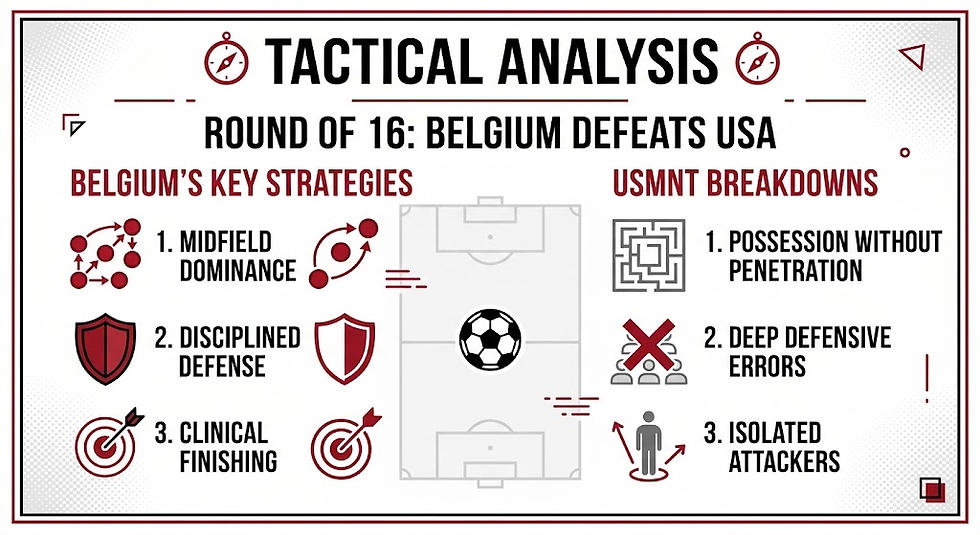
While public narratives often zero in on final scores, football matches are decided in the half-spaces and transitional phases. This in-depth tactical analysis explores the exact strategic breakdowns, systemic alterations, and high-pressing mechanisms that determined why Belgium defeated the USA.
Belgium Defeated USA The Pre-Match Shock: Rudi Garcia's Bold Lineup Deception
Before a single ball was kicked, Rudi Garcia gained a psychological edge. In a move that shocked pundits worldwide, Belgium dropped generation-defining icons Kevin De Bruyne and Jérémy Doku to the substitute bench.
Rather than sticking to a predictable blueprint, Garcia shifted Belgium into a fluid 4-2-3-1 base structure that easily collapsed into a compact 4-4-1-1 defensive shape. The omission of De Bruyne and Doku allowed Belgium to field a younger, more intense midfield block capable of sustaining a high operational workload. Charles De Ketelaere was handed the starting central role, flanked by Leandro Trossard on the left and Dodi Lukébakio on the right.
This brave tactical tweak explicitly targeted the build-up tendencies of Pochettino’s team. USA preferred a complex 3-1-6 attacking shape during possession phases, utilizing deep rotations where Tyler Adams anchored the single pivot and full-backs pushed extremely high. By packing the midfield lines and modifying their attacking verticality, Belgium ensured the USA could never establish early structural rhythm.
Stifling the Spine: The Total Isolation of Folarin Balogun
The foundational layer of Belgium's defensive masterpiece was the total neutralization of Folarin Balogun. The American center-forward is the main target man for Pochettino's fluid system, relying on quick countermovements to drop deep, turn, and bring wide wingers like Christian Pulisic into central channels.
Garcia deployed 23-year-old center-back Nathan Ngoy with a singular, strict mandate: shadow Balogun across every blade of grass.
Ngoy executed this game plan flawlessly. By physicalizing the duel and stepping up early to intercept progressive passes, he denied Balogun the space needed to anchor or link up play. The visual data was stark: Balogun did not record a single attempt on goal until the 82nd minute, a weak effort easily gathered by Thibaut Courtois.
Because the United States lacked a focal point to hold up the ball, their 56% possession rate devolved into sterile horizontal circulation between center-backs Chris Richards and Tim Ream. Belgium’s backline remained tightly compacted, completely relaxed in the knowledge that no vertical threat existed to exploit the gaps behind them.
Overloading the Right: How Trossard and De Cuyper Exposed Sergiño Dest
While the defensive unit closed central access, Belgium’s attacking structure aggressively funneled its offensive sequences down the left flank. This brought the tactical analysis of the Round of 16 straight to Sergiño Dest’s doorstep.
Leandro Trossard was given tactical freedom to drift inside from the left wing, dragging Dest out of position and creating massive gaps behind the American right-back. Maxim De Cuyper, overlapping with relentless engine power from left-back, turned this flank into a constant 2-on-1 overload.
The 9th-Minute Opener: Trossard easily bypassed a hesitant challenge, drove into the penalty area, and forced a poor clearance from Alex Freeman. The loose ball dropped perfectly to Nicolas Raskin, who spotted Charles De Ketelaere unmarked to slot home the opening goal.
The 33rd-Minute Retaliation: Shortly after Malik Tillman’s deflected free-kick briefly leveled the match at 1-1, Belgium exposed the exact same weakness. Youri Tielemans picked out Trossard on the left wing, whose perfectly clipped cross found De Ketelaere rising highest to nod home a powerful header.
The systemic imbalance was so severe that Pochettino pulled Dest at half-time, replacing him with Giovanni Reyna in a desperate attempt to regain control of the midfield. However, the damage was already done.
High-Pressing Traps: Turning Deflection into Disaster
In the second half, the USA attempted to modify their shape. They adjusted into a temporary +1 build-up structure to match the Belgian press, pushing Alex Freeman slightly higher while keeping midfield lines tightly packed. For a brief 10-minute stretch, rotations between Tillman, Weston McKennie, and Pulisic threatened to find vertical space.
However, Belgium's pressing intensity completely suffocated this tactical adjustment. Garcia's front four did not merely mark zones; they actively hunted the ball based on specific triggers, such as backward passes or body-shape hesitations.
The Vanaken Masterclass
Introduced in the 21st minute following an unfortunate early injury to Amadou Onana, Hans Vanaken delivered an extraordinary substitute performance. Rather than dropping deep, Vanaken pushed high alongside De Ketelaere to spearhead the pressing traps.
In the 57th minute, De Ketelaere aggressively closed down goalkeeper Matt Freese outside his own penalty area. Freese hesitated, turned directly into the pressing angle, and coughed up possession. De Ketelaere quickly collected the ball and picked out Vanaken, who calmly finished into an open net to make it 3-1.
Stoppage-Time Exclamation
The final nail in the coffin arrived in the 92nd minute via the exact same high-press mechanism. Vanaken harassed Alex Freeman on the right edge of the penalty area, continuing his tracking run as the ball was pushed back toward Chris Richards. Vanaken picked Richards' pocket, drove toward the box, and unselfishly squared the ball to Romelu Lukaku for a textbook finish.
Statistical Overview: A Match Controlled in the Half-Spaces
While traditional scorelines can sometimes be misleading, the underlying match data confirms that Belgium entirely dictated where, when, and how this fixture was played.
Tactical Metric | United States (USMNT) | Belgium (Red Devils) |
Final Score | 1 | 4 |
Possession % | 56% | 44% |
Total Shots | 7 | 15 |
Shots on Target | 3 | 8 |
Successful Take-ons | 3 / 9 | 9 / 14 |
PPDA (Passes per Defensive Action) | 14.2 | 8.6 |
The metrics underscore the core theme of this tactical analysis of the Round of 16: possession without penetration is completely useless against a disciplined European low-block. Belgium’s PPDA of 8.6 highlights their aggressive defensive posture, while Dodi Lukébakio's 6 completed take-ons from 8 attempts provided the direct vertical transitions that kept the USA pinning backward all night.
Tactical Analysis of the Round of 16: Key Takeaways
Ultimately, this tactical battle was won by the manager who was willing to adapt. Mauricio Pochettino relied heavily on the technical symmetry and central combinations that had carried the USMNT through the group stages. However, when those passing lanes were aggressively cut off by Belgium's compact 4-4-1-1 shape, the USMNT lacked a viable structural backup plan.
Rudi Garcia’s willingness to bench world-class talents like De Bruyne and Doku in favor of tactical discipline and high-energy pressing completely unbalancing the hosts. By shutting down Balogun, isolating Dest, and executing ruthless pressing traps on the American backline, Belgium proved that structural adaptability remains the ultimate currency in knockout international football.
Frequently Asked Questions (FAQs)
Why did Belgium bench Kevin De Bruyne and Jérémy Doku against the USA?
Manager Rudi Garcia made a calculated tactical decision to bench De Bruyne and Doku to implement a high-energy pressing scheme. He preferred a fluid 4-2-3-1/4-4-1-1 shape that prioritized defensive work-rate and intense pressing traps to disrupt the USA's building phases from deep midfield positions.
How did Nathan Ngoy neutralize Folarin Balogun?
Ngoy shadowed Balogun across all attacking zones, tightly marking him to prevent him from receiving, turning, or linking up play with Christian Pulisic. This intense physical marking completely cut off central passing avenues, limiting Balogun to zero shots on goal until late in the 82nd minute.
What was the turning point in this tactical analysis of the Round of 16 match?
The structural turning point was Belgium’s relentless tactical exploitation of the left flank against Sergiño Dest, which created both of Charles De Ketelaere’s first-half goals. The psychological turning point was Hans Vanaken’s 57th-minute goal, which punished an error by goalkeeper Matt Freese during an aggressive Belgian high-press.
Why did the USA struggle despite having 56% possession?
The USA's possession was largely sterile because Belgium closed down all central access channels. Without a reliable central reference point to anchor play, the USMNT circulated the ball sideways across their backline, unable to penetrate Belgium's deep, disciplined defensive block.
Stay Ahead of the Pitch!
Football tactics evolve at lightning speed, and analyzing the world's greatest games requires a deep understanding of the numbers behind the magic. Don't miss a single breaking tactical breakdown, statistical analysis, or tournament update.
Get official match reports and tournament schedules directly on the Official FIFA World Cup Platform.
Watch tactical game breakdowns and comprehensive post-match reviews on DAZN Soccer News.
Dive deep into real-time statistics, player heat maps, and structural metrics on Squawka Football Features.


Comments