FSSAI Old Monk Rum Ban Explained: Truth, 2026 Rules & Fact Check
- 10 hours ago
- 7 min read
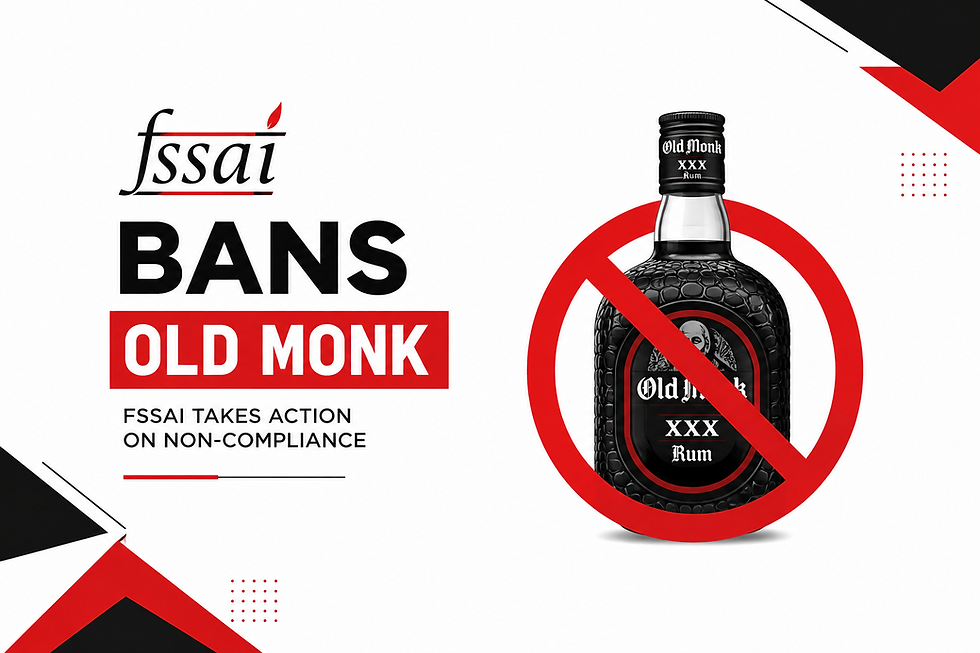
FSSAI Old Monk Rum Ban: The Full Story Behind India's 2026 Liquor Crackdown
In August 2026, news sent shockwaves through India’s liquor industry and among millions of loyal consumers: the Food Safety and Standards Authority of India (FSSAI) ordered a sales ban targeting select variants of Old Monk rum along with several iconic Indian whisky and rum brands. For decades, Old Monk has enjoyed legendary status as a staple at gatherings, prized for its dark vanilla-caramel profile and distinctive ribbed bottle. Naturally, headlines claiming an "Old Monk ban" triggered panic across social media, leading many to wonder if India's favorite dark rum had been taken off the shelves for good.
The truth behind the regulatory order is far more nuanced than social media posts suggest. The regulatory enforcement was not a blanket ban on the brand itself, nor did it stem from chemical toxicity or acute health hazards. Instead, the FSSAI cracked down on specific manufacturing units over severe misbranding, deceptive age claims, and the improper use of artificial flavorings designed to bypass natural maturation processes.
This detailed analysis breaks down the mechanics of the enforcement action, the specific variants involved, the regulatory framework governing Indian spirits, and what this landmark decision means for the future of alcoholic beverages in India.
Background: What Triggered the August 2026 Enforcement Action?
The controversy began when FSSAI food safety inspectors conducted routine checks and collected laboratory samples from multiple distillery operations across Maharashtra, Madhya Pradesh, and Goa. Following extensive chemical analysis, the central regulator published an official release confirming that prohibition orders had been issued against several leading alcohol manufacturers.
Laboratory reports revealed that several high-volume commercial liquor products—including specific batches of Old Monk, Royal Challenge, McDowell’s No. 1, Bagpiper, and Antiquity Blue—were "substandard" under the Food Safety and Standards (Alcoholic Beverages) Regulations. Testing confirmed that manufacturers were adding external artificial or nature-identical flavorings to mimic the inherent aroma and taste that should naturally develop through traditional fermentation, distillation, and barrel maturation.
In an official statement addressing the crackdown, the FSSAI stated unequivocally:
"There is no internationally recognised manufacturing practice whereby rum flavour is added to rum or whisky flavour is added to whisky. A few manufacturers are found to add flavour externally, which mimics the product's inherent aroma and taste, and sell the same as a standard product, thereby misleading consumers."
By masking unaged, inexpensive neutral alcohol with industrial flavor compounds, manufacturers were effectively short-circuiting the traditional aging process while marketing their products as premium matured spirits.
Understanding the FSSAI Old Monk Rum Ban: Key Reasons Explained
To understand why the regulator took such stringent action, it is helpful to look closely at the regulatory violations cited in the official order regarding Old Monk and competing brands. The core issues fall into two main categories: illegal flavoring practices and deceptive product labeling.
1. Artificial Flavoring to Fake Maturity
Under Indian food safety standards, spirits sold simply as "Rum" or "Whisky" must derive their signature flavor profiles organically. For rum, that taste comes from sugarcane molasses or fermented sugarcane juice, yeast activity, distillation, and time spent aging in oak barrels.
The regulatory body discovered that certain production units took neutral spirit—a cheap, highly rectified alcohol lacking any distinct flavor or aroma—and blended in synthetic "rum flavor". The regulator likened this practice to adding synthetic tea flavor to tea leaves or synthetic coffee flavor to coffee beans. While adding distinct external flavors like vanilla, coffee, or spices is legally permissible under designated "Flavoured Spirit" or "Premix" categories, using synthetic rum essence to fake the taste of authentic rum violates standard identity regulations.
2. Misleading Age Statements ("7 Years Old Blended")
The second major violation specifically involved Old Monk’s famous "7 Years Old Blended" claim on its XXX Rum variant. According to FSSAI investigations into the Khopoli manufacturing facility in Maharashtra, the product's primary ingredient was unaged, neutral spirit. Actual matured rum spirit accounted for less than 5% of the final blend.
Under the Food Safety and Standards (Alcoholic Beverages) Regulations, strict rules govern age declarations on blended spirits. The regulations stipulate that any age statement printed on a bottle must strictly reflect the age of the youngest spirit included in that blend. Labelling a bottle as "7 Years Old" when more than 95% of its volume consists of fresh, unaged neutral alcohol directly misleads buyers regarding the quality and heritage of what they are purchasing.
Affected Variants and Distilleries: The Full 2026 List
The regulatory action was targeted rather than a blanket ban on entire companies. Prohibition orders applied specifically to designated manufacturing plants where non-compliant samples were collected.
The table below summarizes the key brands, affected variants, and responsible manufacturing facilities named in the FSSAI enforcement action:
Brand Name | Affected Variants | Manufacturer / Production Unit | Primary Compliance Violation |
Old Monk | The Legend, Gold Reserve, XXX Matured Rum | Mohan Rocky Springwater (Khopoli, Maharashtra) | Artificial rum flavoring; misleading age claims (<5% aged spirit) |
McDowell's No. 1 | McDowell's No. 1 Rum | United Spirits / Diageo (Baramati, Maharashtra) | External flavor additives masking natural profile |
Bagpiper & Old Cask | Bagpiper Deluxe Whisky, Old Cask Deluxe XXX Rum | Inbrew Beverages (Madhya Pradesh) | Artificial nature-identical flavorings in standard spirits |
McDowell's Celebration | McDowell's Celebration Matured XXX Rum, Central Province Whisky | Associated Alcohol & Breweries (Madhya Pradesh) | Non-compliant flavor masking; misbranding |
Royal Challenge & Antiquity | Royal Challenge Whisky, Antiquity Blue Whisky | United Spirits / Diageo (Madhya Pradesh) | Artificial whisky flavoring in neutral spirit base |
In addition to these prohibition orders, the FSSAI initiated inspections at Mandexi Distilleries & Breweries in Goa and dispatched formal show-cause notices to six additional liquor manufacturers across Maharashtra.
The Legal Framework: Standard Spirits vs. Flavoured Spirits
To appreciate the regulatory logic, one must understand how Indian food safety law distinguishes between different categories of alcoholic beverages.
│ FSSAI Alcoholic Beverage Regulations │
│
┌───────────────────────┴───────────────────────┐
▼ ▼
│ Standard Spirits │ │ Flavoured / Premix Spirits │
│ (e.g., Rum, Whisky, Vodka) │ │ (e.g., Mango Vodka, Spiced) │
│ │
• Natural fermentation & aging • Base neutral spirit permitted
• No synthetic "same-category" • External natural/artificial
flavorings allowed flavorings explicitly allowed
• Strict age claim rules • Must clearly state flavor type
• Standard label mandatory • Front label must declare
"Flavoured Spirit"
Under the Food Safety and Standards (Alcoholic Beverages) Regulations:
Standard Rum: Defined as an alcoholic distillate obtained from fermented sugarcane juice, sugarcane molasses, or sugarcane products. It must possess the characteristic natural taste and aroma derived from its raw materials and aging. No coloring matter other than plain caramel is permitted. Adding artificial rum flavor is illegal.
Standard Whisky: Defined as an alcoholic beverage produced by distilling fermented grain mash (malt, corn, barley, or rye). Its character must come from grain materials and wood maturation. Adding artificial whisky flavor is illegal.
Flavoured Spirits & Premixes: Flavors such as mango, chilli, coffee, or mint are fully permitted when added to a neutral spirit base. However, the front label must explicitly state what the product is—such as "Coffee-Flavoured Rum" or "Mango-Flavoured Vodka"—so consumers know they are buying a flavored concoction rather than a traditionally aged spirit.
Because Old Monk and the other penalized brands marketed their products under standard "Rum" or "Whisky" descriptors without transparent disclosures, the FSSAI flagged them for misbranding and consumer deception.
Market Impact and Industry Response in 2026
India represents one of the largest alcohol markets in the world, generating roughly $40 billion in annual revenue. Domestically produced spirits—often referred to as Indian Made Foreign Liquor (IMFL)—account for the vast majority of consumer sales due to their accessible price point compared to imported Scotches and rums.
The crackdown sends a strong regulatory signal across the industry:
Relabeling and Compliance Pathways: The regulator emphasized that the order does not mean these products must disappear forever. Manufacturers have two practical compliance choices: reformulate their recipes to rely on genuine barrel aging and natural base ingredients, or relabel their packaging as "Rum-Flavoured Spirit" while removing misleading age claims.
Industry Pushback: Major spirits conglomerates, including Diageo India (United Spirits), expressed concern over the enforcement action, with some approaching judicial bodies like the Bombay High Court to challenge specific aspects of the orders. Industry representatives argue that certain flavoring practices are standard across mass-market production to maintain consistency across batches.
Consumer Protection Trends: The action against liquor manufacturers coincides with a broader 2026 campaign by the FSSAI to eliminate deceptive practices across food and beverage sectors. Recent parallel actions include restricting non-compliant "energy drink" claims on high-caffeine beverages and clamping down on misleading health claims in nutraceuticals.
Frequently Asked Questions (FAQs)
Is Old Monk rum completely banned across all of India?
No, Old Monk is not banned nationwide. The FSSAI prohibition order specifically targets three variants—Old Monk The Legend, Gold Reserve, and XXX Matured Rum—produced at the Mohan Rocky Springwater facility in Khopoli, Maharashtra. Bottles produced at compliant facilities operating under proper recipes remain available.
What caused the recent FSSAI Old Monk rum ban in 2026?
The FSSAI Old Monk rum ban was triggered by laboratory tests showing the use of artificial "rum flavor" added to unaged neutral spirit to fake maturation. Additionally, the regulator cited deceptive age claims on the XXX Matured Rum variant, which claimed to be "7 Years Old Blended" despite containing over 95% unaged neutral spirit.
Is it toxic or dangerous to drink the affected Old Monk bottles?
No, the regulator did not find toxic or poisonous substances in the tested samples. The enforcement action is based on misbranding, substandard quality classifications, and consumer deception rather than chemical toxicity.
Can companies sell these products again after the FSSAI Old Monk rum ban?
Yes, manufacturers can resume sales once they achieve full compliance with FSSAI regulations. This can be accomplished either by removing artificial flavorings and aging the spirit naturally, or by relabeling the product accurately as a "rum-flavoured spirit" with all misleading age claims removed.
Conclusion & Stay Updated on Food Safety Laws
The 2026 FSSAI action against Old Monk and other popular Indian spirits represents a crucial turning point for transparency in India's consumer beverage market. By enforcing strict distinctions between naturally aged spirits and artificially flavored neutral alcohol, the regulatory body is ensuring that consumers get exactly what is printed on the label. While the headline of a favorite brand facing regulatory action may startle fans, the ultimate outcome is a cleaner, more honest marketplace for everyone.
To stay informed about official food safety notices, regulatory updates, and consumer advisories in India, visit the official portals below:
Check official regulatory advisories at the Food Safety and Standards Authority of India (FSSAI).
Read public health notices and food safety policies from the Ministry of Health and Family Welfare (MoHFW).


Comments