How El Nino-driven weaker monsoon rains could impact India.
- Apr 17
- 3 min read
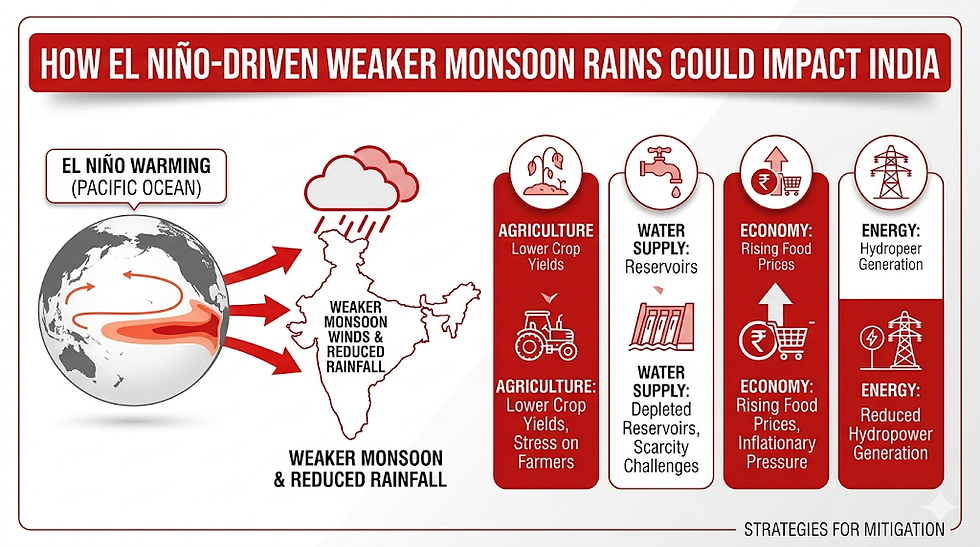
India is likely to face a below-normal monsoon in 2026, largely due to the development of El Niño conditions in the Pacific Ocean. Since the monsoon contributes nearly 70% of India’s annual rainfall, any weakness can have wide-ranging impacts on agriculture, economy, and daily life.
Here’s a complete and accurate breakdown of how a weaker monsoon could affect India.
El Niño & Monsoon 2026: Key Highlights
Particulars | Details |
Phenomenon | El Niño |
Expected Impact | Weaker monsoon rains |
Forecast Rainfall | ~92% of long-period average |
Key Risk Areas | Agriculture, inflation, water supply |
Timeline | June–September 2026 |
Probability | High chance of below-normal rainfall |
El Niño typically weakens monsoon winds and reduces rainfall across India.
El Nino-driven weaker monsoon rains : What Is El Niño and Why It Matters
El Nino-driven weaker monsoon rains : El Niño is a climate pattern where:
Pacific Ocean temperatures rise
atmospheric circulation changes
monsoon winds weaken
This disrupts India’s rainfall system, often leading to:
less rain
delayed monsoon
long dry spells
1. Impact on Agriculture
Lower Crop Production
A weaker monsoon can:
reduce yields of rice, wheat, cotton, soybeans
delay sowing of Kharif crops
affect crop growth cycles
India’s agriculture depends heavily on rainfall, and poor monsoon can hurt farm output significantly.
Farmer Income Decline
reduced harvest → lower income
rural spending may decrease
This can impact the entire rural economy.
2. Food Inflation Risk
Rising Prices
Lower crop production may lead to:
higher prices of vegetables and grains
increase in edible oil imports
possible export restrictions
Food makes up a large part of inflation, so prices may rise sharply.
3. Impact on Economy & GDP
Slower Economic Growth
agriculture contributes ~18% to GDP
employs nearly half of India’s population
A weak monsoon can:
reduce GDP growth
affect demand in rural markets
Growth estimates could face downward pressure.
4. Water Shortage & Reservoir Stress
Reduced Water Availability
lower rainfall → reduced reservoir levels
pressure on drinking water supply
irrigation challenges
Authorities may need to manage water resources carefully.
5. Power & Energy Impact
Hydropower Generation Falls
less rainfall → lower water in dams
reduced hydropower output
At the same time:
higher temperatures → more electricity demand
This creates energy supply pressure.
6. Heatwaves and Weather Extremes
El Niño often brings:
hotter summers
more frequent heatwaves
erratic rainfall patterns
Some regions may even face:
drought-like conditions
uneven rainfall distribution
7. Financial & Market Impact
Pressure on RBI and Markets
rising inflation → possible interest rate changes
currency pressure (rupee volatility)
stock market sectoral impact (agriculture, FMCG, power)
The central bank may need to adjust monetary policy.
8. Political and Social Impact
inflation can affect public sentiment
rural distress may increase
policy decisions may be influenced
This makes monsoon performance politically significant.
Regional Impact Variations
central & western India: higher deficit risk
southern states: mixed rainfall
northeast: may see normal or excess rain
Monsoon impact is not uniform across India.
Can There Be Any Relief?
Some factors may help:
Indian Ocean Dipole (IOD) turning positive
late-season rainfall recovery
However, overall outlook still suggests risk of weaker monsoon.
Frequently Asked Questions ( FAQs )
Why does El Niño weaken monsoon?
It disrupts atmospheric circulation and weakens monsoon winds.
How much rainfall is expected in 2026?
Around 92% of normal, which is below average.
Which sector is most affected?
Agriculture is the most impacted sector.
Will food prices rise?
Yes, weaker monsoon can push food inflation higher.
Can the situation improve later?
Some improvement is possible, but risk remains.
Final Takeaway
The El Niño-driven weaker monsoon in 2026 could have far-reaching consequences for India, from agriculture and food prices to economic growth and water availability.
While some regional relief may occur, the overall outlook points to below-normal rainfall, higher inflation risks, and increased pressure on resources, making this monsoon season a critical factor for the country’s economy and daily life.



Comments