How the Israel–Iran War Is Affecting Indian Stock Markets.
- Mar 4
- 4 min read

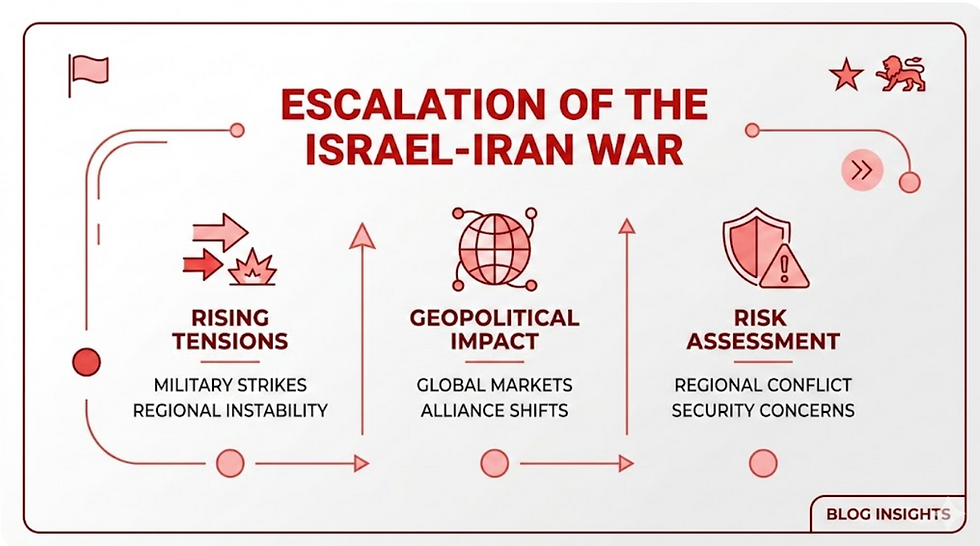
The ongoing escalation of the Israel–Iran conflict in 2026 has rippled well beyond geopolitics into financial markets worldwide and India’s markets have not been immune. With oil prices surging, investor sentiment weakening, and global risk aversion rising, Dalal Street is showing clear signs of stress.
This analysis breaks down:
How equity markets reacted
Why crude oil is the key transmission channel
Sectoral winners and losers
Currency and bond market linkages
What analysts and investors are watching next
The situation is trending and continues to evolve rapidly.
Indian Stock Market Impact (2026)
Market Indicator | Recent Movement | Main Reason |
Sensex & Nifty | Sharp declines, multi-day selloffs | Global risk aversion, oil worries |
Oil Prices | Brent crude up sharply | Conflict risk & supply fears |
Rupee | Weaker against USD | Safe-haven flows & trade risk |
Bond Yields | Higher yields | Inflation expectations & risk premium |
Volatility Index | Surge in fear index | Uncertainty spike |
Defence Stocks | Up amid geopolitical risk | Safe-haven and strategic demand |
1. Equity Markets in Red: Fear & Volatility Dominate
Indian benchmark indices saw significant declines as geopolitical risk intensified:
The Sensex plunged over 1,000 points in a single session, wiping out substantial investor wealth.
The Nifty 50 also slipped sharply, reflecting broad market weakness and risk-off sentiment.
Recent media reports estimate over ₹11 lakh crore wiped out from Indian market capitalisation amid escalating tensions.
Markets have reacted not only to actual conflict escalation but also to the fear of prolonged disruption, which investors dislike.
2. Crude Oil: The Key Transmission Channel
Unlike conflicts limited to a single region, the Israel–Iran war directly threatens oil supply channels — particularly through the Strait of Hormuz, a chokepoint for global energy flows.
Brent crude surged significantly amid fears of supply disruptions and higher risk premiums.
Higher global oil prices translate into a higher import bill for India, which relies on imported crude for about 80–85 % of its oil needs.
Every $1 rise in crude oil can cost India roughly $2 billion annually in import expenditure, pressuring corporate margins and trade balances.
As a result, markets are pricing in not just geopolitical risk but also macro headwinds triggered by higher energy costs.
3. Sectoral Winners and Losers
Losers in the Short Term
Aviation & Travel Stocks: With fuel costs rising and travel fears up, airline shares were among the hardest hit.
Consumer-Sensitive Sectors: FMCG and consumer goods faced pressure due to weaker sentiment and input cost concerns tied to crude. See broader risk analysis.
Banking & Financials: Risk assets underperform in a risk-off environment as investors seek safer instruments.
Potential Winners / Defensive Plays
Defence Stocks: Shares of defence companies such as Hindustan Aeronautics Ltd (HAL), Bharat Electronics Ltd (BEL) and others saw notable upticks amid expectations of increased geopolitical defence spending.
Safe-Haven Assets: Traditionally gold and other defensive assets see inflows as traders reduce exposure to equities.
4. Rupee Weakness and Rising Bond Yields
The India equity sell-off has not been isolated from currency and debt markets:
Rupee Depreciation: Global risk aversion has strengthened the U.S. dollar and pressured the Indian rupee, making imports costlier.
Bond Yields Rise: With inflation expectations higher due to rising oil prices, bond yields climbed — reflecting a risk premium on medium- and long-term debt.
These movements reinforce equity weakness, as higher yields and a weaker rupee make risk assets less attractive.
5. Foreign Investor Sentiment and Capital Flows
Global risk-off episodes often trigger portfolio rebalancing by Foreign Institutional Investors (FIIs):
FIIs tend to withdraw from emerging markets during heightened geopolitical stress, directing capital toward safe-haven instruments like U.S. Treasuries or gold.
This can accentuate downward pressure on Indian equities, especially mid-caps and small-caps, which are more sensitive to liquidity changes.
Sharp sell-offs can reflect both fundamental concerns and technical flows driven by risk-averse trading models.
6. Analyst Views: Volatility and Near-Term Risks
Market analysts and brokerage reports are highlighting key risk factors:
Short-Term Corrections: Indian indices could test lower levels (e.g., Nifty 50 near 24,500–25,000) if tensions persist beyond one to two weeks.
Temporary vs Prolonged Impact: Some experts view the sell-off as a short-term panic reaction, with medium-term recovery likely if conflict remains contained.
Oil Price as Macro Risk: Sustained crude price increases could widen trade deficits, delay interest rate cuts, and increase inflationary pressures.
7. Investor Mindset and Behaviour
Investor psychology plays a role:
Fear and uncertainty drive swift market reactions even before fundamentals change materially.
Safe-haven moves — including allocation to gold and defence sectors — reflect risk-off positioning rather than permanent loss of confidence.
Short-term traders may react more violently than long-term investors, amplifying volatility.
Understanding market behaviour context can help investors differentiate between strategic repositioning and panic selling.
Frequently Asked Questions ( FAQs )
Why did the Indian stock market fall after the Israel–Iran conflict escalated?
The escalation triggered a risk-off environment, driven by rising crude oil prices, investor fear, and expectations of macro headwinds.
Which sectors are most affected?
Aviation, consumer goods and financials were weak, while defence and safe-haven sectors saw relative strength.
How does oil price impact Indian markets?
As India imports most of its crude, higher oil prices widen the import bill, increase inflation risk and put foreign exchange pressure on the rupee.
Are markets expected to recover soon?
If the conflict remains contained and crude prices stabilise, markets may recover, but prolonged escalation poses extended volatility.
What should investors focus on now?
Monitoring crude price trends, geopolitical developments, and risk sentiment is key, alongside diversifying
exposure to defensive sectors.
Final Takeaway
The Israel–Iran war of 2026 has reignited geopolitical risk premium in global financial markets and Indian equities have felt it sharply. With crude oil prices surging, the rupee weakening, bond yields rising, and investor sentiment turning cautious, markets are pricing in uncertainty.
However, this is not necessarily a structural collapse but a risk-off repricing reflecting heightened geopolitical tension.
Understanding the transmission channels oil, currency, and risk sentiment can help investors navigate volatility and distinguish between panic selling and long-term repositioning.
As the situation evolves, markets will continue to reflect both geopolitical developments and macroeconomic fundamentals. Keeping a balanced view with a focus on core valuation drivers remains crucial for investors.


Comments