India-EU Trade and Technology Council: Supply Chain De-risking (2026)
- Jul 17
- 5 min read
The global geopolitical architecture of 2026 is defined by a singular, collective imperative: economic security through diversification. For decades, global manufacturing, technology assembly, and critical raw material processing remained heavily centralized. However, recent black swan events—ranging from geopolitical friction points to unilateral export controls on vital minerals—have transformed supply chain concentration into an unacceptable vulnerability.
At the center of this structural realignment sits the India-EU Trade and Technology Council (TTC). Originally conceptualized to foster closer economic ties, the alliance has matured into a highly strategic instrument. Following the landmark 16th India-EU Summit in New Delhi, the framework received an aggressive, outcome-oriented upgrade. Both powers are explicitly leveraging the partnership to decouple vital sectors from Beijing, establishing a trusted corridor for advanced technology and manufacturing.
Why the India-EU Partnership is Crucial Now
The European Union’s "de-risking" doctrine and India’s "Atmanirbhar Bharat" (Self-Reliant India) initiative have found total convergence within the TTC. The reliance on a single dominant source for electronic components, Active Pharmaceutical Ingredients (APIs), and green technology inputs is no longer viewed as an efficiency, but as a critical single point of failure.
By combining the EU's massive capital reserves, advanced research infrastructure, and high-end engineering capabilities with India's scale, software prowess, and expanding manufacturing base, the alliance offers a viable alternative to Chinese supply chains. It presents a structural counterweight designed to protect the economic sovereignty of both democratic powers.
The Strategic Pillars of the India-EU Trade and Technology Council
The upgraded TTC framework operates through three highly targeted working groups. Each focuses on neutralizing vulnerabilities where reliance on external, non-trusted entities poses the greatest risk.
1. Rebuilding the Semiconductor Ecosystem
Semiconductors are the bedrock of the modern economy, and their supply concentration has long been an Achilles' heel for global industry. The TTC has established direct bridges between the India Semiconductor Mission (ISM) and the EU Chips Act.
Rather than working in isolation, Indian semiconductor design facilities are now directly integrated with European pilot manufacturing lines. This grants Indian engineers access to advanced Process Design Kits (PDKs) and affordable silicon prototyping. Crucially, the joint India-EU Semiconductor Roundtable at Semicon India 2026 formalized co-investment strategies, laying down a roadmap for multi-billion-dollar trusted assembly and test facilities that bypass traditional East Asian hubs.
2. Diversifying Critical Green and Clean Energy Technologies
Dominance over the green transition—specifically solar wafers, rare earth magnets, and lithium-ion batteries—has given China significant leverage over Western climate goals. The India-EU Trade and Technology Council is systematically building alternative industrial clusters to break this monopoly.
The EV Innovation Hub: The joint Automotive Research Association of India (ARAI) and European Commission initiative has built an operational platform standardizing electric vehicle charging infrastructure and battery testing protocols.
The €60 Million Clean-Tech R&D Fund: Active co-investments are flowing directly into waste-to-hydrogen engineering, circular battery recycling, and sovereign supply chains for critical raw materials.
Hydrogen Valleys: Cooperative frameworks established for late 2026 are setting common safety and transport standards for green hydrogen, ensuring the infrastructure remains entirely free of non-trusted components.
3. Securing Digital Sovereignty: AI, 6G, and Digital Public Infrastructure (DPI)
Beyond physical factories, the battlefield for supply chain security extends to data, trust networks, and telecom routing. The council has taken massive strides to align the two regions' technology stacks:
DPI Cross-Pollination: Technical teams are actively working on linking India’s DigiLocker with the EU Digital Identity Wallet. This enables highly secure, cross-border digital signatures and trusted administrative transactions.
6G and Frontier AI: By forming standard-setting coalitions for 6G architecture and signing the AI Code of Practice, both regions are building a structural firewall against non-transparent, state-subsidized software platforms.
Moving from Policy to Action: The Execution Blueprint
Strategic intent is meaningless without execution. To prevent the council from devolving into another bureaucratic talking shop, the ministerial updates have shifted the TTC from a high-level dialogue to an active industrial coordinator.
Here is the information structured into standard, easy-to-read bullet points:
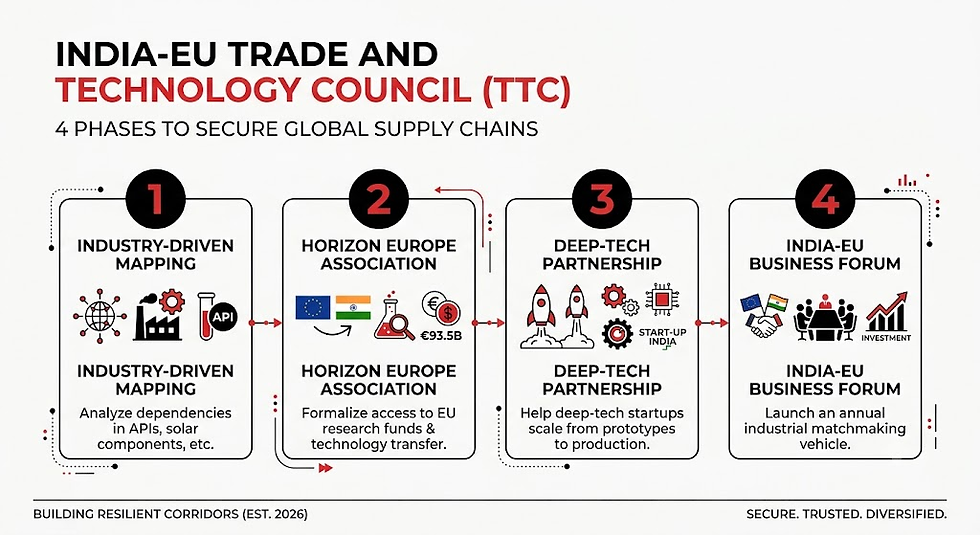
Phase 1: Industry-Driven Value Chain Mapping – Moving away from broad bilateral statements, specific industry task forces map precise vulnerabilities in Active Pharmaceutical Ingredients (APIs) and solar sub-components to identify immediate alternative sourcing targets.
Phase 2: Formalizing Horizon Europe Association – Bilateral teams are finalizing India’s access to the EU’s €93.5 billion Horizon Europe research fund by the end of 2026. This allows direct, subsidized technology transfers between European research labs and Indian commercial entities.
Phase 3: Launching the Deep-Tech Startup Partnership – Led by the European Innovation Council and Start-Up India, this initiative assists deep-tech companies in scaling from laboratory prototypes directly into commercial factory production, bypassing Chinese venture capital.
Phase 4: Institutionalizing the India-EU Business Forum – Converting the dialogue into an annual, sector-specific industrial matchmaking vehicle ensuring private capital deploys efficiently into these newly secure corridors.
Key Challenges Confronting the Strategic Corridor
While the momentum behind the council is historic, several structural bottlenecks require ongoing diplomatic negotiation:
The Carbon Border Adjustment Mechanism (CBAM): The EU’s carbon border tax remains a complex compliance point for Indian exporters. A primary focus of the council is providing Indian firms with access to accredited, trusted verification services to prevent trade disruption.
Regulatory Alignment: Reconciling the EU's strict General Data Protection Regulation (GDPR) frameworks with India’s evolving Digital Personal Data Protection (DPDP) landscape requires continuous fine-tuning to keep data flowing seamlessly.
Talent Mobility: While the launch of the European Legal Gateway Office pilot in India has streamlined the movement of high-skilled ICT professionals, broader migration paths for manufacturing engineers remain vital for operationalizing these value chains.
The 2026 Outlook: A More Resilient Global Economy
The work being done via the council demonstrates that supply chain de-risking is no longer a theoretical concept—it is a tangible reality driven by commercial investments and shared strategic anxieties. As the council enters its next formal upgrade cycle, the corridor between Brussels and New Delhi is proving to be a highly effective defense against industrial coercion. By building trusted, redundant, and transparent supply chains, India and the EU are creating an economic ecosystem anchored in shared democratic values, shared technology standards, and genuine mutual resilience.
Frequently Asked Questions
What is the primary objective of the India-EU Trade and Technology Council?
The primary goal of the India-EU Trade and Technology Council is to serve as a high-level strategic platform where both powers align their trade policies, security frameworks, and technological ecosystems. A major modern focus of this initiative is building resilient supply chains and minimizing systemic economic dependence on China.
How does the council help reduce supply chain reliance on China?
The council targets critical sectors currently dominated by Chinese manufacturing—such as semiconductors, active pharmaceutical ingredients (APIs), and clean energy components. By facilitating technology transfers, cross-border investments, and harmonizing industrial regulations, it helps businesses seamlessly transition production to trusted hubs within India and the European Union.
What major milestones have been achieved by the council recently?
Key achievements include linking India’s semiconductor initiatives with the EU Chips Act, launching formal entry negotiations for India into the €93.5 billion Horizon Europe research fund, and establishing an EV Innovation Hub to co-develop electric vehicle infrastructure.
Act for a Secure Business Future
As supply chains continue to realign globally, staying informed about evolving trade corridors, new industrial compliance laws, and bilateral funding avenues is essential for maintaining a competitive edge.
Monitor the latest industrial co-investments and policy adjustments directly via the European Commission India Portal.
Review active strategic declarations and foreign policy coordination efforts at the Ministry of External Affairs, Government of India.
Discover collaborative technology funding programs and cross-border innovation grants hosted on the Horizon Europe Funding Platform.
To understand the macro economic perspectives guiding these decisions, you can watch this insightful breakdown of the India-EU Trade, Technology & Clean Energy Cooperation, which details how these working groups translate high-level diplomacy into active, localized industrial projects.



Comments