iPhone Ultra Release Delay Rumors: Is Apple Facing Production Issues?
- 1 day ago
- 6 min read

The tech landscape is buzzing with speculation, and the spotlight is fixed entirely on Cupertino. For months, tech enthusiasts have been tracking every whisper surrounding Apple’s highly anticipated first foray into foldable smartphones—the rumored iPhone Ultra. Intended to go head-to-head with Samsung's upcoming Galaxy Z Fold 8 Wide, the Ultra represents Apple’s biggest design risk in a decade.
However, recent supply chain leaks have sent shockwaves through the community, suggesting the groundbreaking device might be delayed. Are these rumors a sign of deep trouble in the supply chain, or is it just business as usual for a perfectionist tech giant? Let's dive into an in-depth analysis of the current situation.
The Core of the Rumors: What’s Happening in the Supply Chain?
Historically, Apple has followed a highly predictable annual release cadence. However, 2026 is shaping up to be an entirely different beast. Reports from top industry insiders—including DigiTimes, Nikkei Asia, and Bloomberg’s Mark Gurman—indicate that Apple is drastically altering its launch playbook by splitting its smartphone roadmap across late 2026 and early 2027.
Under this new split-launch strategy, Apple plans to announce its premium tier—the iPhone 18 Pro, iPhone 18 Pro Max, and the foldable iPhone Ultra—in September 2026. Meanwhile, the baseline iPhone 18, iPhone 18e, and the second-generation iPhone Air are being pushed to a Spring 2027 window.
But while the announcement timeline remains fixed for September, it is the shipping date of the Ultra that has triggered intense debate. Rumors of a production timeline delay started circulating heavily when prominent supply chain analysts noted major bottlenecks at the Engineering Verification Testing (EVT) stage.
Initially, mass production was slated to begin in June. However, technical friction reportedly forced Apple to push the mass assembly window back to the tail end of July or early August. This sudden compression of the production calendar sparked wild theories: Was the iPhone Ultra facing a fatal design flaw, or would it be delayed entirely until 2027?
Deconstructing the Bottlenecks: Hinge Durability vs. PCB Assembly
When building a $2,000 first-generation foldable device, engineering margins are razor-thin. Industry leaks point to two distinct production hurdles that Apple has been fighting behind closed doors.
1. The Hinge Mechanism and Screen Crease Noise
Earlier in the spring, tipsters leaked that Apple’s initial mechanical prototypes were failing strict quality control inspections. Specifically, after being subjected to millions of rigorous automated folds, the intricate hinge mechanism—reportedly supplied by Taiwan's Shin Zu Shing and U.S.-based Amphenol—began producing a slight, audible "rattling" noise.
Furthermore, Apple's extreme demands for a completely crease-free experience using Ultra-Thin Flexible Glass (UFG) meant that any microscopic deviation in manufacturing tolerances resulted in unacceptable defect rates.
2. Upstream Surface Mount Technology (SMT) Yield Failures
While the internet focused heavily on the physical hinge, a separate, more complex issue emerged in the upstream manufacturing process. Well-known Chinese insider Fixed Focus Digital reported that Apple was experiencing catastrophic pre-assembly yield failures during the Surface Mount Technology (SMT) process on the printed circuit boards (PCBs).
Rather than relying on legacy wiring, Apple's advanced internal architecture places ultra-dense component layers directly onto connection pads using thermal curing. Apple’s hyper-strict quality standards caused a significant portion of early circuit board batches to be rejected, drastically slowing down the components needed to start full-scale device assembly.
[EVT Stage Failures] ──> [SMT Board Yield Issues] ──> [Hinge Noise Under Stress]
                                 │
                                 ▼
               [Mass Production Squeezed to Late July]
                                 │
                                 ▼
           [Expected Result: Severe Launch-Week Shortages]
Is the iPhone Ultra Actually Delayed?
Despite the initial panic, the latest data directly from the supply chain tells a much more nuanced story. The rumor of a total postponement into 2027 has been thoroughly debunked by recent activity.
According to reports from The Elec and the China Securities Journal, Apple has officially moved past the final verification stages. The upstream SMT circuit board issues have been mostly resolved, and Samsung Display has received formal approval to begin volume shipping of the massive 7.8-inch internal foldable OLED panels.
So, what does this mean for the production timeline delay?
The Reality: While the phone isn't canceled or pushed to next year, the two-month delay in starting mass production means Apple has lost precious time to build up launch-week inventory.
Instead of a catastrophic delay, consumers are looking at a staggered retail rollout. Apple is highly likely to unveil the iPhone Ultra alongside the iPhone 18 Pro series during its traditional September keynote. However, while the Pro models will hit store shelves a couple of weeks later, the Ultra will likely operate on a delayed shipping schedule—potentially landing in the hands of consumers in late October or November.
What to Expect From the iPhone Ultra (Specs & Pricing)
When the iPhone Ultra finally breaks cover, it promises to be an absolute powerhouse of next-generation hardware. By shifting the baseline iPhones to 2027, Apple is ensuring that its fall showcase focuses entirely on elite, boundary-pushing technology.
Feature | Spec / Rumored Detail |
Main Display | 7.8-inch Foldable OLED (Samsung M14 material, integrated color-filter layer) |
Cover Display | 5.5-inch OLED |
Processor | Next-Gen A20 Pro (Advanced 2nm node process) |
Memory | 12GB RAM (Optimized heavily for local Apple Intelligence) |
Connectivity | In-house C2 Apple Modem (Featuring advanced location privacy) |
Biometrics | Touch ID embedded in the power button (No Face ID due to thin chassis) |
Thermal Design | Dedicated Vapor Chamber cooling system |
Base Price | Starting at $2,000 (Premium variant climbing to $2,200) |
By integrating the color-filtering layer directly into the display stack and removing traditional structural screen layers, Apple is aiming for the thinnest foldable profile on the market. Additionally, the transition to the 2nm A20 Pro chip alongside an in-house C2 modem signifies Apple’s complete independence from Qualcomm, delivering massive battery efficiency gains despite the dual-screen form factor.
The Strategic Play: Why Apple Won’t Blink
Apple is entering a mature foldable market where Samsung has already had several generations to iron out the kinks. Moving carefully isn't just an accident caused by supply chain friction—it's an intentional strategy.
If Apple were to rush production to ensure millions of units were available on day one, they would risk a PR nightmare if the hinges or screens failed in real-world scenarios. By enforcing uncompromising quality control standards at the EVT stage—even at the cost of compressing their production window—Apple protects its premium brand identity.
A staggered release that results in immediate sell-outs and multi-week shipping delays only serves to heighten the device's exclusivity. For a luxury $2,000 product, artificial or production-induced scarcity can actually drive consumer desire even higher.
Frequently Asked Questions (FAQs)
Q1.What is causing the rumored production timeline delay for the iPhone Ultra?
The production timeline delay stems from two primary supply chain challenges: early yield failures during the Surface Mount Technology (SMT) circuit board assembly phase, and minor acoustic anomalies ("rattling") discovered in the liquid metal hinge mechanism during extreme durability testing. Most of these engineering hurdles have now been successfully resolved.
Q2.Will the iPhone Ultra launch in 2026 or be pushed to 2027?
Apple is still firmly on track to announce the iPhone Ultra in September 2026 alongside the iPhone 18 Pro lineup. However, due to the shifted production schedule, actual product shipments may be staggered, meaning the device might not reach customers until October or November 2026.
Q3.How much will the first foldable iPhone cost?
According to supply chain pricing leaks, the iPhone Ultra is expected to start at a premium price point of $2,000, with top-tier storage configurations reaching up to $2,200.
Q4.Why is Apple splitting its iPhone release schedule?
By moving the standard iPhone 18 and iPhone Air models to Spring 2027, Apple can alleviate supply chain pressure, manage the choked 2nm chip allocation from TSMC, and maintain a steady stream of high-profile hardware releases throughout the fiscal year.
The Bottom Line
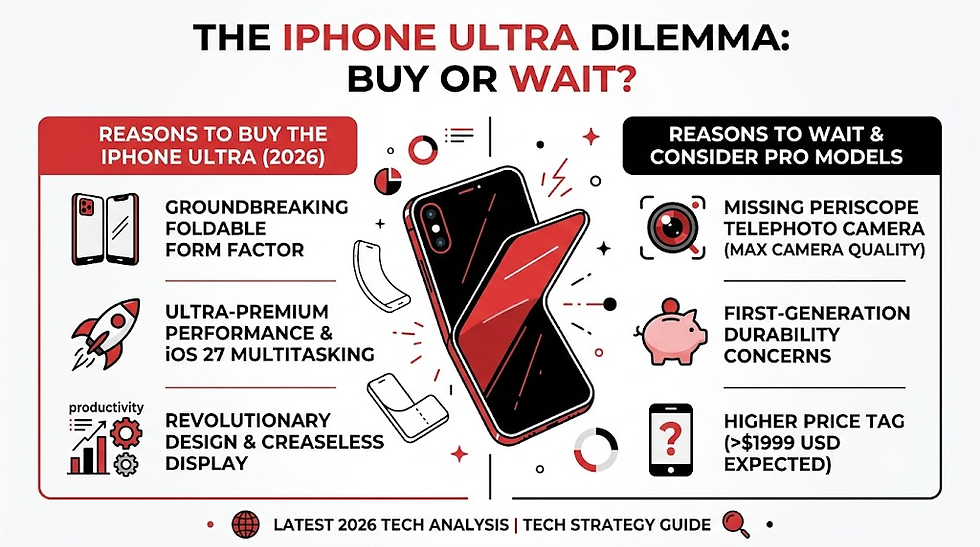
The rumors of an iPhone Ultra delay aren't a sign of a failing project, but rather a testament to Apple’s brutal, uncompromising approach to hardware validation. While the compressed production schedule means you will likely have to fight through severe shipping delays and instant pre-order sell-outs this fall, the wait promises to deliver a highly polished, incredibly thin, and benchmark-setting device.
Stay tuned as we closely follow more updates from the supply chain as the September keynote approaches!
Stay Ahead of the Tech Curve
Want to make sure you don't miss the pre-order window when the iPhone Ultra finally drops? Bookmark our tech hub and stay informed with real-time updates.
Check out the latest hardware breakdowns on the Apple Official Newsroom.
Track deep structural supply chain analysis and expert commentary via MacRumors.
Compare how Apple's foldable strategy stacks up against the competition over at Android Authority.


Comments