Should You Buy the iPhone Ultra or Wait? 2026 Market Analysis
- 3 hours ago
- 7 min read
The smartphone landscape is on the verge of its most monumental shift in a decade. For years, premium smartphone upgrades have felt incremental—a slightly faster processor, a marginally brighter display, or an extra camera sensor. However, as we approach the final quarters of 2026, Apple is reportedly planning to break its traditional mold completely. Industry leaks, supply chain tracking, and developer betas all point to a singular, groundbreaking release this September: Apple’s first-ever foldable device, universally dubbed the iPhone Ultra.
Positioned as an ultra-premium tier sitting comfortably above the iPhone 18 Pro Max, this device represents Apple’s definitive response to years of Android dominance in the foldable market. But with a rumored retail price that could shatter industry records, consumers face a massive dilemma: Should you prepare to purchase this first-generation piece of engineering luxury, or is it wiser to hold off?
This comprehensive analysis breaks down the leaked specifications, structural changes, pricing realities, and software overhauls to help you decide if you should buy the device or wait for future iterations.
What is the iPhone Ultra? The 2026 Paradigm Shift
For the past several generations, tech enthusiasts speculated whether Apple would introduce a ultra-premium "Ultra" phone resembling a rugged titanium slab, akin to the Apple Watch Ultra. Instead, 2026 supply chain data reveals that Apple has repurposed the "Ultra" moniker for its ultimate hardware frontier: a book-style folding smartphone.
Rather than merely extending the screen real estate of a standard handset, the iPhone Ultra is designed to be an iPhone-iPad hybrid. It addresses a growing consumer demographic: professionals, creators, and power users who want a pocketable phone that transforms seamlessly into a high-productivity canvas.
According to reports from major tech outlets like Macworld and The Elec, mass production of the device's specialized components began tracking heavily in late July. While the upcoming iPhone 18 Pro lineup is moving smoothly through assembly, the iPhone Ultra's radically complex form factor means it may follow a split-release schedule—unveiled in September but arriving on shelves a few weeks later, reminiscent of the iPhone X rollout in 2017.
Rumored Specifications and Hardware Innovations
Apple has historically avoided entering new product categories until it feels the underlying technology has matured. With foldables, the company has reportedly focused its research and development on eliminating the two biggest pain points of existing folding devices: the prominent screen crease and structural fragility.
1. The Screen and Hinge Engineering
The iPhone Ultra is tipped to feature an internal 7.7 to 7.8-inch foldable LTPO OLED display boasting a 120Hz refresh rate. When unfolded, it adopts a squarish 4:3 aspect ratio, nearly identical to an iPad mini. On the outside, users will interact with a 5.3 to 5.5-inch cover display, making it slightly more compact and wider than a standard smartphone when closed, mirroring a passport shape.
To achieve perfection, Apple has reportedly collaborated with Samsung Display to source a near-creaseless panel. The hinge architecture relies on high-end titanium alloys and LiquidMetal matrix composites to guarantee structural integrity while minimizing the internal gap. Furthermore, an advanced, optically clear stress-reducing adhesive layer is utilized to distribute tension evenly during daily folding cycles.
2. Form Factor and Dimensions
The physical footprint of the Ultra highlights Apple’s fixation on extreme thinness:
Unfolded Thickness: An astonishing 4.5mm to 4.8mm, making it exceptionally sleek when held open.
Folded Thickness: Approximately 9.2mm to 9.5mm, meaning it won't feel overly bulky or cumbersome in a standard pocket.
3. Processing Power: The A20 Pro Silicon
Under the hood, the device will be powered by Apple’s upcoming A20 Pro chipset. Built on a cutting-edge next-generation manufacturing process, this chip is engineered specifically to handle the thermal challenges of an ultra-thin split chassis while driving localized generative artificial intelligence tasks via Apple Intelligence. It is expected to be paired with 12GB of RAM to facilitate aggressive, desktop-class multitasking.
The Big Compromises: What You Give Up
No first-generation product is without its structural compromises. If you plan to buy the device, you must prepare to accept several functional trade-offs that might feel jarring given the astronomical price point.
The Omission of Face ID
Because the display assembly and chassis are engineered to be so incredibly thin when opened (4.5mm), there is simply not enough physical depth to house Apple's complex TrueDepth camera system required for Face ID. Consequently, the iPhone Ultra is widely rumored to drop Face ID entirely. Instead, Apple will pivot to a side-mounted Touch ID sensor integrated directly into the power button—a mechanism currently used on the iPad Air.
Camera System Constraints
If you are an elite mobile photographer who relies heavily on long-range optical zoom, the Ultra may disappoint you. Due to the lack of internal depth within a folding half-chassis, periscope telephoto lenses cannot fit without creating a massive, unbalanced camera bump. Rumors suggest the Ultra will feature a simplified dual-camera setup on the rear—consisting of a 48MP primary lens and a 48MP ultrawide lens—completely omitting the dedicated optical telephoto zoom found on the iPhone 18 Pro Max.
MagSafe Real Estate
Maintaining a lightweight build across a folding hinge has also impacted wireless charging. Reports indicate that the back layout may lack a traditional heavy glass plate, which could limit or entirely alter standard magnetic MagSafe alignments and charging speeds.
iOS 27 and the Software Multitasking Revolution
Hardware is only half the story. Industry insiders report that Apple intentionally delayed its entry into foldables until its software ecosystem was mature enough to redefine mobile productivity. The upcoming rollout of iOS 27 is set to be the true catalyst for this device.
Developer betas for iOS 27 have revealed specialized APIs designated as foldState and angle Degrees. Rather than simply stretching standard iPhone apps into an awkward aspect ratio, iOS 27 implements an active continuity framework:
Flex-Mode Layouts: When the device is bent halfway (like a laptop), apps dynamically shift their interfaces. For instance, a video call will sit on the top panel while controls, text inputs, or note-taking fields occupy the bottom panel.
Desktop-Class Windowing: iOS 27 brings a hybrid window management system inspired by macOS and iPadOS, enabling users to run multiple apps side-by-side with genuine drag-and-drop mechanics.
Smarter Apple Intelligence: The upgraded Siri AI system will natively understand split-screen context, allowing you to ask the assistant to analyze an image open on the left side of your screen and draft an email about it on the right side.
The Financial Reality: Premium Pricing Breakdown
There is no sugarcoating it: the iPhone Ultra will be the most expensive commercial phone Apple has ever brought to market. Because the manufacturing yields of flexible OLEDs and micro-engineered hinges are inherently low, component costs are drastically higher than standard flagship components.
Current global price projections indicate:
United States: Expected to start between $1,999 and $2,500 depending on the base storage layout (likely starting at 256GB or 512GB with up to 12GB of RAM).
India: Anticipated to land between ₹1,90,000 and ₹2,00,000 before standard local taxes, meaning final store pricing could easily exceed ₹2,10,000.
This puts the phone squarely in the luxury tech bracket, targeting tech executives, enterprise power-users, and affluent early adopters rather than the mainstream consumer base.
Strategic Decision: Should You Buy the iPhone Ultra or Wait?
To simplify your buying strategy, we have weighed the essential pros and cons into a straightforward checklist.
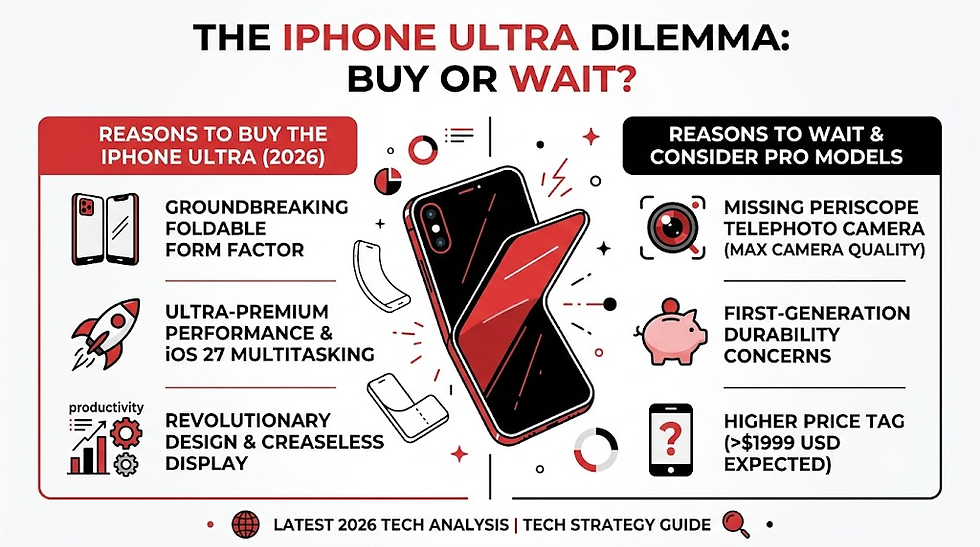
Reasons to Buy the iPhone Ultra in 2026
Ultimate Multi-Tasking: You want a pocketable tool that eliminates the need to carry both a smartphone and an iPad mini throughout your workday.
Cutting-Edge Design: You want to experience Apple's most radical hardware engineering project in a decade, featuring an ultra-thin 4.5mm profile and a near-creaseless display.
Next-Gen Software Experience: You want immediate access to the full potential of iOS 27’s split-screen layout and advanced contextual AI utilities.
Reasons to Wait for the iPhone 19 Ultra or Pro Models
Camera Quality is a Priority: If you cannot live without long-range optical telephoto lenses, the iPhone 18 Pro Max remains the undisputed camera king.
First-Generation Skepticism: Historically, first-generation Apple products (like the original Apple Watch or the initial MacBook 12-inch) serve as public beta tests. Version two almost always brings better durability and optimized pricing.
Price and Value Logistics: Spending over $2,000 on a smartphone is a massive financial commitment. If you prefer established biometric security like Face ID, waiting or opting for the standard Pro tier is highly logical.
Frequently Asked Questions (FAQs)
Q1: Is it worth it to buy the iPhone Ultra if I already have an iPad?
If you frequently use your iPad at a desk or for heavy illustration with an Apple Pencil, keeping your current ecosystem is recommended. However, if you primarily use your iPad mini or base iPad for reading, editing documents, and emails on the move, choosing to buy the iPhone Ultra allows you to consolidate those two separate devices into a single, highly streamlined pocket companion.
Q2: Why does the iPhone Ultra use Touch ID instead of Face ID?
The decision comes down to physical space limitations. To maintain an ultra-thin opened profile of roughly 4.5mm, the chassis cannot accommodate the depth required for the infrared cameras and dot projectors that power Face ID. To circumvent this, Apple integrated a highly responsive Touch ID sensor into the side power button.
Q3: Will the iPhone Ultra support standard MagSafe accessories?
Due to structural weight reductions and the complex internal hinge layout, traditional circular MagSafe magnet arrays may be absent or significantly limited. While wireless charging via Qi2 protocols will still be supported, specialized, ultra-thin magnetic accessories may be required to secure a proper alignment without damaging the folding mechanism.
Q4: When is the official release date for the foldable iPhone?
Apple is expected to officially unveil the iPhone Ultra during its highly anticipated September 2026 hardware keynote event, alongside the refined iPhone 18 Pro lineup. However, because of the complex manufacturing validations associated with the folding display, store shipments may begin a few weeks after the standard Pro models hit the market.
Keep Your Tech Strategy Ahead of the Curve
Navigating first-generation tech rollouts requires accurate information directly from verified industry sources. To ensure your purchase decisions align with official hardware drops, check out the resources below:
Official Keynote Trackers: Stay up to date on upcoming hardware rollouts and launch timelines via the Official Apple Newsroom.
Developer Beta Documentation: Explore how the new multitasking environments operate ahead of the consumer launch through the Apple Developer Portal.


Comments