Navigating Indian Fuel Price Trends: A Comprehensive Guide to Monthly Petrol and Diesel Fluctuations

Every morning at 6:00 AM, the retail selling prices of petrol and diesel across India are updated by state-run Oil Marketing Companies (OMCs) like Indian Oil Corporation Limited (IOCL), Bharat Petroleum Corporation Limited (BPCL), and Hindustan Petroleum Corporation Limited (HPCL). For the average commuter, logistics business owner, or policymaker, these variations can seem erratic. However, the costs we pay at the fuel pump are governed by a sophisticated framework of global macroeconomic indicators, bilateral trade logistics, and domestic fiscal structural mechanics.
Understanding the systematic forces behind Indian fuel price trends requires evaluating how global crude oil benchmarks integrate with domestic taxation and exchange rate parameters to determine local commercial pricing.
The Core Mechanisms Behind Monthly Indian Fuel Price Trends
The fundamental landscape of fuel cost architecture in India relies heavily on structural import conditions. India operates as the world’s third-largest consumer of crude oil, fulfilling over 85% of its entire domestic oil demand through foreign imports (Reddy, 2026). Consequently, retail fuel pricing cannot exist in isolation from global volatile disruptions.
Historically, India utilized an Administrative Price Mechanism (APM), where the Union Government directly regulated and heavily subsidized retail fuel prices. To optimize resource allocation and limit fiscal deficits, the government transitioned to a deregulated regime:
Petrol Deregulation: Implemented in June 2010.
Diesel Deregulation: Implemented in October 2014.
Dynamic Fuel Pricing: Introduced in June 2017, moving the sector from fortnightly updates to daily price resets based on a rolling 15-day average of international benchmark costs.
Macroeconomic Factors Dictating Retail Fuel Prices
Understanding how a shift in global commodity spaces converts to an exact price per liter at an Indian filling station requires identifying four core pillars.
1. International Crude Oil Benchmarks
Indian refineries procure a combination of sweet (low-sulfur) and sour (high-sulfur) crude oils, known structurally as the Indian Crude Basket. This blend is heavily influenced by two primary global indices:
Brent Crude: The premier benchmark for Atlantic basin crude stocks, widely utilized to price global options.
Oman-Dubai Crude: The primary pricing baseline for Middle Eastern oil fields exporting heavily into Asian refining corridors.
When supply disruptions scale up or OPEC+ institutes production limits, these underlying benchmark assets rally, generating immediate upward pricing pressure on Indian import logistics (Mirzabaev, 2026).
2. The US Dollar to Indian Rupee (USD/INR) Exchange Rate
Because global crude oil transactions are settled universally in United States Dollars ($USD$), the currency conversion path acts as a major variable. Even if Brent crude trading values flatten, a depreciation of the Indian Rupee ($INR$) against the $USD$ elevates the net cost of acquisition for domestic OMCs. This currency risk is pushed downstream onto local retail consumers during periodic daily assessments.
3. Trade Parity Pricing (TPP) Methodology
Indian OMCs determine the underlying factory-gate base cost of petrol and diesel using Trade Parity Pricing (TPP). TPP calculates a weighted combination of:
Import Parity Price (IPP): The theoretical cost incurred if refined petroleum products were directly imported into Indian ports (accounting for FOB asset cost, insurance, freight, and custom levies).
Export Parity Price (EPP): The theoretical revenue realized if domestic refineries exported their inventory to global markets.
In India's current operating matrix, TPP is heavily weighted at an 80:20 ratio in favor of Import Parity Pricing. This formula ensures that domestic factory-gate costs mirror international refined product valuations rather than raw crude prices alone.
4. Domestic Taxation Infrastructure
The actual cost of refining and delivering raw fuel accounts for only a portion of the final retail price. The remaining amount consists of layered government taxes.
Central Excise Duty: A fixed tax levied by the Union Government per liter of fuel sold. It applies uniformly across all states and does not change based on shifts in underlying crude costs.
State Value Added Tax (VAT): An ad valorem tax implemented individually by state governments. Because it is calculated as a percentage of the base cost plus central excise, its absolute value changes alongside fluctuations in underlying oil costs. This explains why retail fuel prices vary significantly between different locations, such as New Delhi, Mumbai, and Bengaluru.
Tracking the Current 2026 Energy Landscape
The year 2026 has introduced deep structural transformations and unexpected volatility to global energy corridors, reflecting clearly across Indian fuel price trends.
The Strait of Hormuz Supply Crisis
The dominant macroeconomic event of early 2026 has been the acute maritime shipping disruption across the Strait of Hormuz due to heightened geopolitical friction (Reddy, 2026). Given that approximately 20% of global liquefied natural gas and crude supplies traverse this maritime choke point, the initial shock caused Brent crude values to spike past $100 per barrel in March 2026 (Mirzabaev, 2026).
While India's energy ecosystem experienced vulnerabilities—particularly regarding the direct supply and subsequent rationing of Liquefied Petroleum Gas (LPG) for household utilities—the state-run OMCs managed to protect domestic vehicle owners from catastrophic pump price spikes (Reddy, 2026). This price stabilization was largely achieved through targeted adjustments to central excise buffers and strategic utilization of bilateral refining discounts, ensuring that domestic petrol and diesel prices remained stable relative to the high volatility seen in international commodity markets (Reddy, 2026).
Downstream Impact on Commercial Logistics
While consumer retail rates have been insulated by government intervention, broader industrial energy volatility continues to affect the transport sector. Fluctuations in refined oil valuations affect fleet operating costs, supply chain continuity, and transportation freight pricing (Różyński, 2026). Road transport networks depend heavily on steady diesel pricing to keep consumer goods affordable (Różyński, 2026).
Concurrently, these long-term macro variations are accelerating corporate interest in alternative energy infrastructure, driving investment toward electric commercial fleets, clean alternative fuels, and strict compliance with vehicle fuel efficiency targets (Roychowdhury & Chattopadhyaya, 2021).
Step-by-Step Breakdown: How a Change in Global Crude Reaches the Pump
To understand the delays and structural limits of dynamic pricing, consider the following lifecycle of a crude shipment arriving in India:
Phase 1: Procurement and Maritime Transit
Indian OMCs purchase crude futures or spot contracts on global markets. The oil is loaded onto oil tankers in regions like the Middle East, West Africa, or Latin America and travels across maritime routes to reach Indian coastal terminals. This journey can take anywhere from 4 to 25 days.
Phase 2: Domestic Refining and Processing
Upon arrival at ports like Jamnagar, Mundra, or Paradip, the crude is transferred via pipelines to domestic refineries. Here, it undergoes fractional distillation to separate it into consumer products, including petrol, diesel, aviation turbine fuel (ATF), and petrochemical bases.
Phase 3: The 15-Day Pricing Window
Because OMCs determine the factory-gate base cost using a moving 15-day rolling average of international benchmarks, today’s retail price does not reflect today's spot price for Brent crude. Instead, it reflects the average procurement costs incurred over the previous two weeks. This smoothing mechanism helps protect consumers from sudden, single-day price spikes on global commodity exchanges.
Future Outlook: Fuel Pricing in a Modernizing Economy
As India targets its long-term sustainable development and net-zero emissions goals, the economic role of fossil fuel pricing is evolving (BHARAT, 2026). Revenue collected from fuel taxes remains a key contributor to both central and state budgets, funding large-scale public infrastructure, highway construction, and renewable energy projects (BHARAT, 2026).
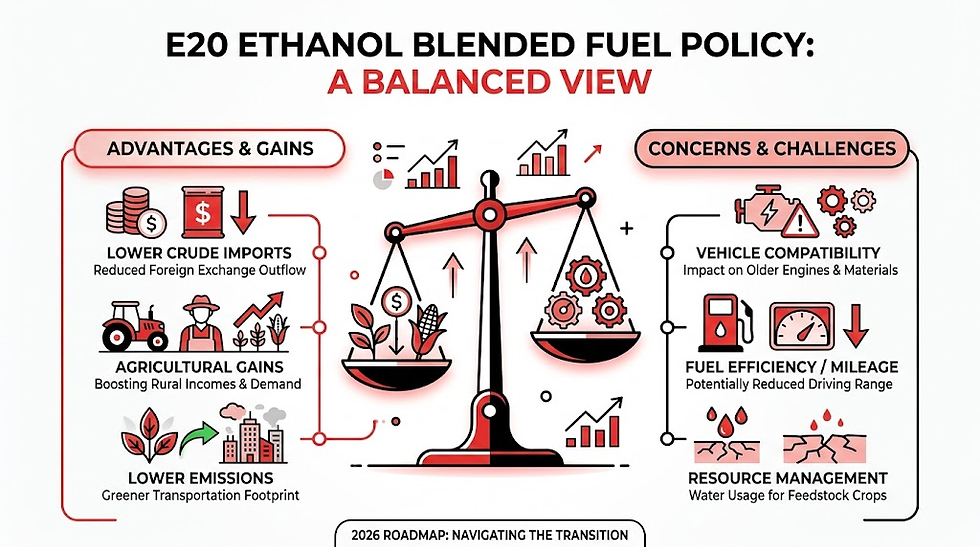
However, structural shifts are underway. The wider adoption of compressed natural gas (CNG), ethanol-blended petrol (aiming for E20 standards), and expanding electric vehicle charging networks are gradually altering traditional fuel demand patterns. Over time, this diversification will help reduce India’s vulnerability to international supply disruptions and provide a more stable outlook for domestic energy consumers.
Frequently Asked Questions (FAQs)
Why do fuel prices vary across different states in India?
While the base cost of refined fuel and the Central Excise Duty remain uniform across the country, individual state governments apply their own Value Added Tax (VAT) or Sales Taxes. Because state VAT is an ad valorem percentage that varies by region, the final price at the pump differs between cities. Local freight costs from refineries to regional distribution centers also contribute to these price variations.
How does a weak Indian Rupee impact Indian fuel price trends?
Because international crude oil is traded globally in US Dollars ($USD$), Indian OMCs must convert Indian Rupees ($INR$) to dollars to complete transactions. If the Rupee depreciates against the Dollar, it requires more Rupees to purchase the same barrel of oil. This increases the net import bill, creating upward pressure on Indian fuel price trends even if global oil prices remain flat.
What is the Trade Parity Pricing model used for petrol and diesel?
Trade Parity Pricing (TPP) is the pricing formula used to calculate the base value of petrol and diesel in India. It consists of a weighted average of the Import Parity Price (IPP) and the Export Parity Price (EPP) in an 80:20 ratio. This ensures that domestic retail fuel costs stay aligned with international market values for refined petroleum products.
Why don't retail petrol prices drop immediately when global crude prices crash?
Retail pricing in India relies on a 15-day rolling average of international benchmarks rather than immediate spot prices. Additionally, when global oil prices decline, the central or state governments may adjust excise duties or VAT to stabilize revenue for public infrastructure projects. OMCs may also use these windows to recoup losses from periods when they absorbed high import costs without raising consumer prices.
Stay Ahead of Changing Energy Markets
Managing fleet operations or planning daily transportation budgets requires access to reliable, real-time energy insights. Keeping track of shifting retail costs, policy updates, and international market drivers helps businesses and consumers adapt to changing economic conditions.
For official updates and historical data on retail fuel adjustments across India, consult the latest sector analyses from the Ministry of Petroleum and Natural Gas (MoPNG) or review detailed price mapping through the PPAC Pricing Data Portal.


Comments