Scaler School of Technology vs Taking a Gap Year: Apply Before June 26
- 6 hours ago
- 7 min read

The period following the release of Class 12 board results and national competitive exams like JEE Main is often filled with critical decisions. For many students aiming for elite careers in software engineering, artificial intelligence, and data science, the choices can feel limited. If your test scores didn't align with your expectations, or if you missed out on top-tier Indian Institutes of Technology (IITs) or National Institutes of Technology (NITs), you likely find yourself standing at a major career crossroads: should you spend the next twelve months repeating the grueling cycle of entrance coaching, or should you embrace an industry-disrupting model of modern education?
This comprehensive guide presents an in-depth analysis of Scaler School of Technology vs Taking a Gap Year to help you make an informed choice for the academic year 2026. With the crucial June 26, 2026 application deadline fast approaching, understanding the structural differences between these two paths is essential.
Before diving into the detailed breakdown, you can secure your path directly by using the Scaler SST Official Application Portal and entering the exclusive Coupon Code CS500 to fast-track your registration.
The 2026 Tech Landscape: Skills vs. Credentials
The global technology ecosystem is experiencing an unprecedented transformation driven by generative AI, large language models, and automation. Traditional tech employers are rapidly shifting away from conventional, rote-learning engineering degrees. Instead, they increasingly favor practical builders—candidates who can directly ship code, build scalable data pipelines, and solve production-level problems.
When evaluating Scaler School of Technology vs Taking a Gap Year, it is important to understand what a gap year actually entails in 2026. Historically, a gap year meant locking yourself in a room, solving thousands of multiple-choice physics and chemistry problems, and betting an entire year on a single three-hour examination window. While this path can lead to a legacy college seat, it delays your actual engagement with computer science by another full year.
In contrast, alternative modern education systems focus heavily on real-world application from day one. To help you visualize how these two routes affect your timeline, structural skill acquisition, and financial career trajectory over a four-year horizon, consider the direct comparison below.
Structural Comparison Matrix
Parameters | Scaler School of Technology (SST) | Taking a Conventional Gap Year |
Primary Focus | Software Engineering, AI/ML, and system architecture from Day 1. | Rote-memorization of Physics, Chemistry, and Math for entrance exams. |
Time Investment | Immediate entry into a 4-year undergraduate track (Batch starts August 2026). | 1 full year spent away from core tech learning, risking exam-day performance. |
Industry Exposure | Mandatory 1-year industry immersion (internships & startup incubation). | Zero professional exposure; limited entirely to academic test preparation. |
Degree Outcome | 4-Year UG Program in CS & AI integrated with an online BITS Pilani degree. | Delayed enrollment; heavily dependent on securing a future college seat. |
Average Placement Track | Early indicators show a ₹20 LPA average salary package for PPO-track students. | Unpredictable; heavily reliant on the final placement cell of whichever college is joined later. |
Scaler School of Technology vs Taking a Gap Year: Deconstructing the Dilemma
To truly understand the trade-offs of this decision, let's break down the core pillars of both options: time optimization, curriculum relevance, and real-world placement risk.
1. The Cost of Time and the Risk of "Exam Day" Noise
Taking a drop year means risking 12 months on the assumption that a second attempt at traditional entrance exams will yield a radically different outcome. While some students successfully boost their percentiles, thousands find themselves facing identical or marginal improvements due to escalating competition and shifting examination patterns.
Choosing Scaler School of Technology allows you to skip the uncertainty of another preparation cycle. Instead of delaying your journey, you enter an intensive, residential computer science program based in Bengaluru—the tech capital of India. The cohort commencing in August 2026 will dive straight into algorithmic thinking, product development, and machine learning architectures, putting them a full calendar year ahead of peers who opted for a gap year.
2. Curriculum Freshness vs. Outdated Syllabi
Even if a gap year successfully lands you a seat in a conventional tier-2 or tier-3 engineering college, what does the destination actually look like? Most traditional engineering programs operate on rigid university syllabi that take years to update. Students frequently spend their first two years studying irrelevant subjects like engineering drawing, workshop practices, and basic chemistry before writing code.
The curriculum at Scaler School of Technology is co-developed and continuously updated by over 100 tech leaders and founders from companies like Google, OpenAI, and PhonePe. The material is fundamentally designed for an AI-first world. Rather than prioritizing memorized theory, your academic performance is evaluated through deployed features, working software applications, and system designs.
To explore this practical curriculum in depth and begin your registration process before the intake closes, apply via the Scaler SST Registration Link and use code CS500 for your enrollment benefits.
Placement Realities and Industry Immersion
The ultimate benchmark for any educational path is its career outcome. When assessing the professional impact of Scaler School of Technology vs Taking a Gap Year, the difference in industry integration is stark.
Traditional Path:  [Gap Year] ---> [4 Years Rote Theory] ---> [Optional 2-Month Internship] ---> [Placement]
Scaler SST Path:   [Year 1-2: Intensive Coding & AI] ---> [Year 3: 1-Year Full Industry Immersion] ---> [PPO/Placement]
Traditional engineering programs relegate internships to an optional two-month window during the third-year summer break. This brief period rarely provides enough time to work on deep, production-grade systems.
Scaler structurally integrates a mandatory one year of industry immersion directly into its four-year framework. This immersion consists of real-world internships or hands-on startup building within SST’s dedicated Innovation Lab. Because tech employers evaluate candidates on what they can build rather than their degree pedigree, this extensive real-world experience provides a distinct competitive advantage.
Real-World Career Metrics
Recent audited data highlights the effectiveness of this hands-on model:
Pre-Placement Offers (PPOs): Early placement indicators reveal that 36% of the current batch has already secured internships with PPO tracks at elite firms like Amazon, Rippling, and Slice.
Compensation Metrics: The average salary package for these PPO-track students stands at an impressive ₹20 LPA, with top-tier packages reaching up to ₹46 LPA.
Global Exposure: Students have secured over 12 international internships across major tech hubs like Singapore, Germany, and Bali, working directly within fast-scaling global ecosystems.
Critical Admission Timeline for the June-2 Intake (2026 Batch)
If you decide that building real-world skills outweighs the uncertainty of a gap year, you must act quickly. The current June-2 Intake for the 2026 foundational batch is operating on a strict timeline.
Online Application Submission:Deadline: June 26, 2026 (11:59 PM).
Complete your personal, academic, and tech achievement profiles online. Ensure you submit before the midnight cutoff.
Scaler NSET Examination:Date: June 28, 2026.
Sit for the 120-minute Scaler National Scholarship and Entrance Test (NSET), which comprehensively evaluates Mathematics and Logical Reasoning.
Result Declaration & Shortlisting:Date: June 30, 2026 onwards.
Receive your NSET scorecard and interview shortlists via email and registered communication channels.
Personal Interview Rounds:Date: July 1, 2026 onwards.
Participate in a two-round online technical and behavioral interview process conducted by industry experts.
Final Admission Offers:Date: July 9, 2026 onwards.
Successful candidates receive final admission decisions and scholarship allocations, ahead of the August 2026 batch launch.
Important Admissions Note: To be eligible for the 2026 intake, applicants must be 20 years of age or younger as of July 1, 2026, and must have secured at least a 60% aggregate score in Class 12 Mathematics from a recognized board.
To lock in your application ahead of the upcoming deadline, navigate directly to the Scaler SST Application Form. Remember to apply the coupon code CS500 on the payment page to receive a waiver on your registration fees.
Final Verdict: Which Path Should You Choose?
The decision between Scaler School of Technology vs Taking a Gap Year ultimately depends on your learning style and long-term career objectives.
Choose a Gap Year if:
Your primary goal is securing a traditional campus experience at an IIT, NIT, or top-tier legacy university, and you are fully prepared to spend 12 months mastering competitive physics and chemistry patterns.
You prefer a standard, heavily theoretical academic framework over a fast-paced, product-driven coding ecosystem.
Choose Scaler School of Technology if:
You want to start building software, launching applications, and learning artificial intelligence immediately without losing a year.
You value direct mentorship from silicon-valley veterans and tech practitioners over standard classroom lectures.
You want to leverage a built-in network of over 1,200 hiring partners and secure intensive, long-term internship opportunities well before graduation.
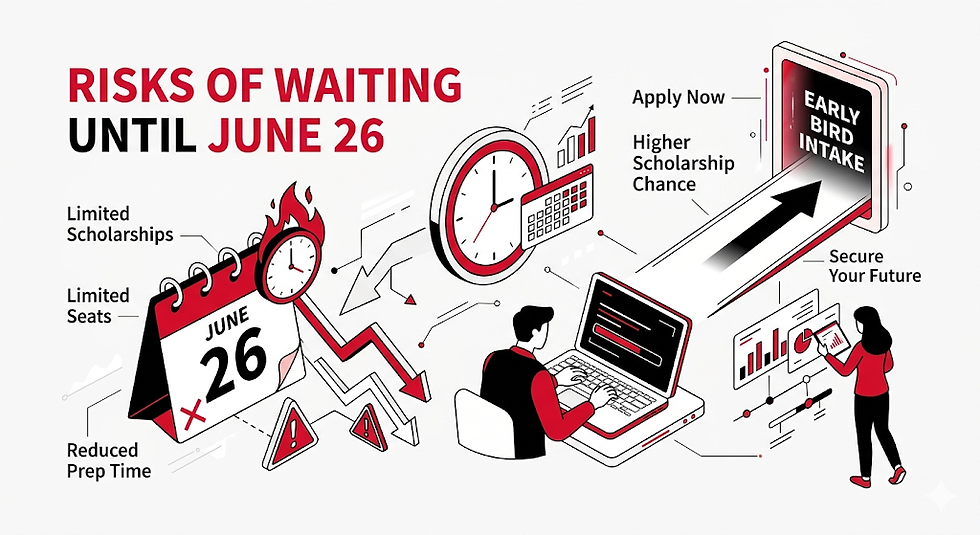
The application window for this intake closes on June 26, 2026. Taking immediate action ensures you don't lose precious career momentum.
Frequently Asked Questions (FAQs)
Q1: When evaluating Scaler School of Technology vs Taking a Gap Year, which option offers better long-term industry readiness?
A: When comparing Scaler School of Technology vs Taking a Gap Year, Scaler School of Technology provides significantly higher industry readiness. Instead of spending a year out of the tech ecosystem studying for competitive entrance exams, students immediately begin an intensive computer science curriculum. Combined with a mandatory 1-year industry immersion working with top tech firms, students graduate with actual professional experience rather than just theoretical knowledge.
Q2: Does Scaler School of Technology provide a recognized undergraduate degree?
A: Yes. Scaler School of Technology has an integrated educational structure where students complete their rigorous 4-year computer science and AI specialization alongside a fully recognized parallel degree program from BITS Pilani.
Q3: What happens if I miss the upcoming June 26 application deadline?
A: The June-2 intake deadline is strictly set for June 26, 2026, at 11:59 PM. Missing this deadline means losing the opportunity to sit for the June 28 NSET exam, which could delay your entry into the August 2026 foundational batch or limit your available scholarship opportunities.
Q4: Can I skip the Scaler NSET exam if I have strong national test percentiles?
A: Yes. Students who have achieved a 92 percentile or higher overall in JEE Main (or 95 percentile or higher specifically in Mathematics/Physics), or a SAT score of 1430 and above, can bypass the NSET exam and advance directly to the interview selection rounds.
Call to Action (CTA) & Important Links
Ready to take the next step and skip the drop year? Secure your spot in the upcoming batch before the deadline closes.
Apply Online: Click the Official Scaler School of Technology Portal to begin your application. Use the exclusive Coupon Code CS500 during registration to claim your fee waiver.
Join the Community: Have questions about the NSET exam pattern, interview rounds, or student life? Connect directly with peers, mentors, and admission experts by joining the Scaler SST Admissions WhatsApp Group.


Comments