Scaler SST Deadline: What Every Tech Aspirant Must Do Before June 26
- 6 hours ago
- 10 min read

Choosing an undergraduate path in today's rapid technological landscape is arguably the most critical decision a young tech builder will make. With traditional engineering institutions relying on decades-old, theory-heavy syllabi, modern high school graduates are seeking alternatives that mirror the actual tech ecosystem. In 2026, the elite choice for high-potential software engineers and AI developers is the Scaler School of Technology (SST).
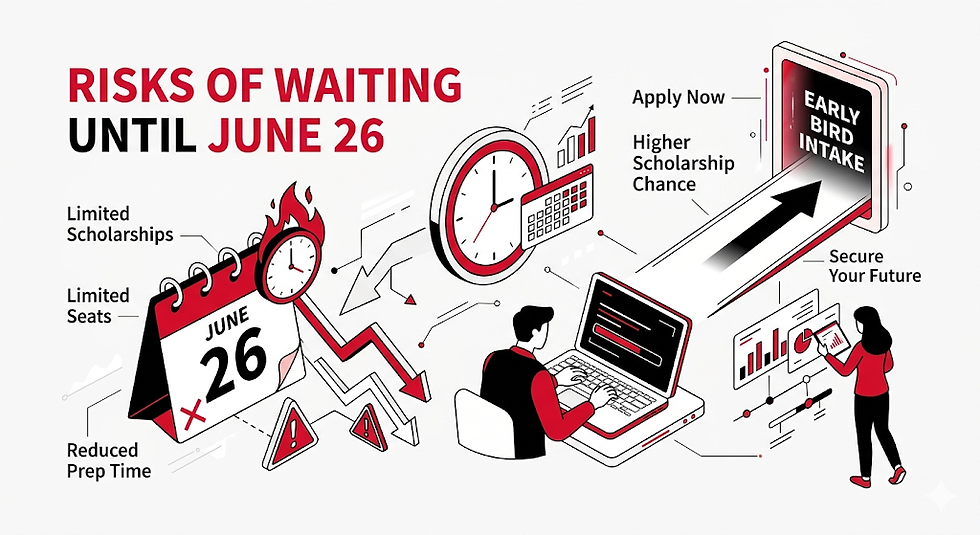
However, time is running out for the high-demand Jun-2 Intake batch. The critical Scaler SST deadline of June 26, 2026, at 11:59 PM is fast approaching.
If you are a student intending to break away from traditional rote-learning frameworks and instead build scalable products, master Data Structures & Algorithms (DSA), and learn directly from active technology leaders, this specific timeline window is your definitive moment. Missing this final intake cutoff could delay your path into the tech industry by a full calendar year.
This comprehensive checklist and strategic blueprint outlines exactly what you need to prepare, review, and execute to secure your admission before the clock runs out.
Why the June 26 Scaler SST Deadline Changes Everything
The standard engineering admissions process across India is notorious for ranking applicants based on memory-based testing patterns rather than hands-on building capacity. Scaler School of Technology operates on a completely reimagined paradigm. Located in Bengaluru—the true engine room of Indian technology—SST filters for raw programmatic aptitude, spatial-logical reasoning, and authentic passion for computing.
+--------------------------------------------------------+
|              CRITICAL ADMISSION LIFELINE               |
|                                                        |
|  [June 26th, 11:59 PM] ---> Scaler SST Deadline        |
|  [June 28th]           ---> Scaler NSET Exam Date      |
|  [June 30th Onwards]   ---> NSET Results Declared      |
|  [July 1st Onwards]    ---> Interview Panels Begin     |
|  [August 2026]         ---> 4-Year Batch Commences     |
+--------------------------------------------------------+
As a fully residential program that confers a 4-year undergraduate ecosystem integrating specialized industry immersion, the upcoming cutoff represents the ultimate standard portal for the upcoming batch. Approaching the Scaler SST deadline without a systematic roadmap leaves you vulnerable to simple mistakes on your application, unoptimized scholarship possibilities, or poor preparation for the incoming entrance exams.
If you are ready to take action immediately, you can fast-track your form submission by accessing the Official Scaler Application Portal. Make sure to apply the exclusive institutional application fee waiver code CS500 at checkout to save instantly on your registration fees.
The Master Timeline for the Jun-2 Intake 2026
To avoid system failure or unexpected documentation bottlenecks on the night of June 26, you must align your daily schedule with the official university dates. The admission process moves at an elite velocity; there is no lag period between the closing of applications and the testing process.
The critical milestones for the current June admissions sequence are structured systematically below:
Admission Event Milestones | Crucial Date & Deadlines | Specific Window Specifics |
Online Application Form Submission | June 26, 2026 | Closes strictly at 11:59 PM IST |
Scaler National Scholarship Entrance Test (NSET) | June 28, 2026 | Online, remotely proctored 2-hour portal |
NSET Metric & Score Results | June 30, 2026 onwards | Disseminated via registered applicant dashboards |
Personal Interview Panels (Human & AI Assessment) | July 1, 2026 onwards | 2-stage verification focusing on logic and intent |
Final Institutional Offer Letters Distributed | July 9, 2026 onwards | Rollout based on cumulative profile merit evaluation |
Full Residential Campus Onboarding & Commencement | August 2026 | Bengaluru campus physical cohort integration |
As shown in this breakdown, you have exactly 48 hours between completing the registration form and sitting for the intensive entrance test. Attempting to review your math foundations or logical syllogisms after submitting the form is a high-risk approach. True execution begins well before the application is completed.
Step-by-Step Action Plan: What to Do Right Now
To transform your application from a standard profile entry into a compelling tech candidate dossier, execute these core preparation tracks sequentially.
1. Verify Your Fundamental Academic and Age Eligibility
Before investing your energy into optimization strategies, confirm that you clear the absolute academic baselines set by the admissions board. The mandatory prerequisites include:
Age Limitation: The applicant must be 20 years of age or younger as of July 1, 2026.
Academic Streams: Open to all academic domains (Science, Commerce, or Arts) provided you possess a valid background in Mathematics.
Minimum Performance Metrics: You must have secured or be appearing for a minimum aggregate score of 60% or above in Class XII Mathematics from a recognized national or international educational board (CBSE, ISC, State Boards, IB, or IGCSE).
2. Prepare Your Extracurricular Portfolio and Achievement Credentials
The admissions committee looks beyond raw percentages. Scaler uses a comprehensive profile-vetting methodology. If you have exceptional competitive exam rankings, you can use them to bypass certain application phases. Gather and scan digital copies of your credentials if you possess:
A JEE Main overall percentile score of 92%+ (or a mathematics-specific percentile of 95%+).
An overall SAT benchmark score of 1430 or higher.
State-level or national achievements in Olympiads (IMO, IOI), robotics tournaments, or recognized hackathons.
Concrete proofs of early software products built, active GitHub repositories, or innovative startup projects launched during high school.
3. Initiate the Application Form Early to Avoid Peak Traffic
Do not wait until the final evening of June 26 to input your personal information. High traffic on global registration portals can lead to localized gateway timeouts or transaction failures.
Navigate straight to the Scaler School of Tech Portal, complete your primary structural verification with your mobile number and one-time password (OTP), and begin filling out your personal history. When arriving at the final structural fee component page, apply the exclusive coupon code CS500 to lower the processing barriers immediately.
Demystifying the Scaler NSET Exam Pattern
Once you register before the Scaler SST deadline, your immediate existential focus turns to the Scaler National Scholarship and Entrance Test (NSET) scheduled for June 28. This is not your standard engineering examination. It features zero questions relying on pure chemistry definitions or complex physics rotational dynamics derivations. The entire testing framework evaluates how effectively your mind processes abstract logic.
Deep-Dive Structure of the Entrance Test
Duration Strategy: 120 minutes (2 Hours).
Delivery Mechanism: Completely online, securely proctored environment. You require a functional laptop/desktop containing a web camera and uninterrupted high-speed internet access.
Core Question Format: Manual Numeric Input / Subjective Logic Fields. Unlike multiple-choice questions (MCQs), Scaler forces applicants to compute the precise outcome value manually. This structure eliminates guessing and filters for true problem solvers.
+-------------------------------------------------------------+
|               SCALER NSET CORE SYLLABUS TRACKS              |
+-------------------------------------------------------------+
|  1. MATHEMATICAL REASONING                                  |
|     --> Matrices, Determinants, Combinatorics, Probability   |
|     --> Calculus Foundations, Sequence Series, Set Theory   |
|                                                             |
|  2. LOGICAL & SPATIAL PUZZLES                               |
|     --> Algorithmic Sequences, Pattern Recognition          |
|     --> Cryptarithms, Advanced Analytical Deduction         |
+-------------------------------------------------------------+
Strategic Preparation Tactics for the NSET Exam
To maximize your chances of clearing the cutoffs on June 28, split your review plan into two operational divisions:
The Math Core: Focus heavily on high-yield discrete mathematics topics. Master combinations, permutations, conditional probabilities, and structural matrices. The test emphasizes computing combinations accurately under tight time limits rather than memorizing long formulas.
The Analytical Logic Layer: Practice solving non-verbal logic problems, network path puzzles, and multi-variable logical constraints. The exam requires you to map out connections systematically, similar to designing a software data model.
Mastering the 2-Round Personal Interview Phase
Passing the NSET screen moves your profile to the definitive evaluation stage: the online personal interview panels starting on July 1. Scaler's interview rounds are structured to separate traditional memorizers from genuine product builders and analytical thinkers.
The selection track consists of two distinct interactions:
Round 1: The Analytical & Core Aptitude Assessment
This round frequently uses advanced AI-assisted interactive interview interfaces to measure your dynamic real-time processing capabilities. You will be asked to think out loud while solving unexpected logic puzzles, variable-based sequence arrays, and structural tracking matrices. The evaluators are less concerned with a perfectly polished initial answer and more focused on your step-by-step problem-solving methodology.
Round 2: The Holistic Profile & Tech Intent Interview
Conducted directly by senior technology leaders, engineering managers, and program directors from elite technology firms, this round assesses your long-term tech potential.
Be prepared to discuss your past projects in detail. If you listed a website, mobile application, or automation script in your application dossier, you must be ready to explain your engineering choices clearly. They will evaluate your core drive, your capacity to absorb constructive criticism, and your readiness to manage the intense pace of a professional engineering ecosystem.
Advanced Analysis: SST Curriculum vs. Traditional B.Tech
To appreciate why thousands of high-potential students are completing their applications before the imminent cutoff, look at how the educational journey matches up against standard collegiate models.
TRADITIONAL B.TECH:
[Yr 1: General Science] -> [Yr 2: Theory-Heavy CS] -> [Yr 3: Rote Learning] -> [Yr 4: Final Project]

SCALER SST BLUEPRINT:
[Yr 1-2: Core DSA & Full-Stack] -> [Yr 3: Industry Track & HFT] -> [Yr 4: Paid Corporate Tech Immersion]
The difference between standard universities and the industry-integrated undergraduate environment of Scaler School of Technology becomes clear when tracking their real-world outcomes:
Core Educational Parameter | Scaler School of Technology (SST) | Traditional University Engineering Options |
Core Curriculum Architecture | Built dynamically from day one with data structures, scalable development, system design, and AI models. | Heavily focused on general chemistry, generic mechanical engineering shop concepts, and old programming paradigms. |
Active Faculty Profiles | Active software architects, tech directors, and developers from top-tier companies. | Purely academic professors with minimal real-world enterprise software experience. |
Industry Integration & Internships | Built-in, mandatory 1-year corporate immersion in Year 4 with tech leaders. | Short 2-month summer block internships with minimal exposure to live operational systems. |
Ecosystem & Environment | Fully residential elite tech campus inside India's primary technology capital (Bengaluru). | Scattered locations requiring additional external bootcamps to reach job-readiness. |
Parallel Academic Validation | Verified degrees via partners like BITS Pilani (BSc Hons Computer Science) or IIT Madras. | Standard regional university degrees that don't guarantee modern workplace skills. |
Maximizing Your Merit and Need-Based Scholarships
A major benefit of completing your registration before the Scaler SST deadline is the higher likelihood of securing institutional financial aid. Scaler maintains a dedicated scholarship fund to ensure that financial constraints don't keep top-tier tech talent from joining the program.
These financial awards scale all the way up to 100% total tuition fee waivers for exceptional profiles.
+-------------------------------------------------------------------+
|               SCALER SST TUITION AID ALLOCATION MATRIX             |
+-------------------------------------------------------------------+
|  [NSET Top Percentiles]  ---> Automated Merit-Based Fee Waivers    |
|  [Tech Portfolio Review] ---> Project & Product Builder Stipends   |
|  [Olympiad / JEE Rank]   ---> Elite National Achievement Awards    |
|  [Verified Need Profiles]---> Socio-Economic Financial Assistance  |
+-------------------------------------------------------------------+
Because scholarships are drawn from a fixed institutional budget allocation for the year, early applicants have a distinct statistical advantage. As remaining seats are filled toward the closing stages of the intake cycles, the available financial aid packages shrink significantly.
Submitting your verified documentation right now ensures that your profile is evaluated while the financial aid reservoirs are completely full.
Final Checklist Before You Submit
Before you hit the final submit button on the registration system, run through this operational checklist to ensure zero errors on your profile:
Data Consistency: Confirm that your full legal name, date of birth, and familial details exactly match your official Class X and Class XII educational identity certificates.
Core Academic Inputs: Double-check that your Class XII aggregate percentage or your specific scores in Mathematics are typed in correctly.
Credential Links: Test every portfolio link you provide. Ensure your GitHub profiles, hosted web applications, or digital project directories are set to public view so the admissions review panel can access them.
Discount Verification: Confirm that the application coupon code CS500 has been successfully applied to the fee page before making your final payment.
Hardware Readiness Check: Confirm that your laptop camera, microphone system, and internet settings are prepared for the online proctored entrance exam on June 28.
Frequently Asked Questions (FAQs)
What happens if I miss the Scaler SST deadline on June 26?
If you miss the official Scaler SST deadline on June 26, 2026, at 11:59 PM, your application for the Jun-2 Intake batch will be automatically locked out. This means you will lose the opportunity to sit for the entrance test on June 28. While later testing cycles may occasionally open if seat availability allows, applying late significantly reduces your chances of securing institutional scholarships and premium residential housing options.
Can I change my NSET exam center or date after registering?
No, the entrance exam is conducted completely online in a remotely proctored digital format on June 28, 2026. Because you take the test from your home or a private space with a stable internet connection, there are no physical test centers to select or modify.
How many times can a student retake the NSET entrance test?
Applicants can attempt the NSET entrance test up to 3 times within a single academic year cycle. However, given the fast-approaching August 2026 batch commencement date, completing your entry during the current intake gives you the cleanest runway to secure your spot without complications.
How is the BITS Pilani or IIT Madras parallel degree structure managed alongside SST?
Students at Scaler School of Technology take part in a highly integrated hybrid learning structure. While your primary focus is on hands-on software construction, system design, and AI models on the physical Bengaluru campus, you simultaneously fulfill the academic requirements for your parallel degree program through structured online platforms and formal examinations.
Is the application processing fee fully refundable if my profile is not selected?
No, the standard application fee is strictly non-refundable. To help manage this upfront cost, make sure to apply the verified promo code CS500 during your application checkout to secure your processing discount immediately.
Your Launchpad Into Elite Tech Starts Here
The choice is simple: you can spend the next four years studying outdated theoretical textbooks at a traditional engineering college, or you can build production-ready software systems alongside leading tech engineers in the heart of Bengaluru. The journey to becoming an elite software developer requires taking proactive action before windows of opportunity close.
====================================================================
                        IMMEDIATE ACTION PROTOCOL
====================================================================
1. Go to: https://scalerschooloftech.com/4ruflJ5
2. Insert Code: CS500 for application optimization fee support
3. Finalize profile submission before June 26th, 11:59 PM
4. Join the official interactive prep circle on WhatsApp
====================================================================
Do not let procrastination push you past the final registration deadline. Complete your official submission at the Scaler School of Technology Portal right now, use the code CS500 to optimize your application process, and set up your preparation track for the upcoming entrance exam on June 28.
Essential Calls to Action (CTA) Links
Begin Your Online Registration: Jump straight to the secure processing framework by visiting the Scaler School of Tech Application Link and use code CS500 to activate your processing discount.
Join the Scaler Applicant Community: Connect with fellow applicants, coordinate study sessions, and get immediate answers to your admissions questions by joining the Official Scaler Applicant WhatsApp Group.


Comments