The Ripple Effect: How Global Crude Oil Prices Affect Indian Fuel Rates
For the average Indian commuter, pulling up to a petrol pump often comes with a sudden dose of anxiety. One week, prices are stable; the next, they creep upward, triggering a domino effect on the cost of groceries, ride-sharing fares, and daily essentials.
If you have ever wondered why your local fuel stall feels tethered to events unfolding thousands of miles away, you are looking at a classic economic web. India relies heavily on external energy sources, meaning that local prices are deeply intertwined with international oil markets.
This comprehensive guide breaks down the complex mechanics of how global crude oil prices affect Indian fuel rates in 2026. We will look at everything from maritime chokepoints and currency valuation to domestic tax frameworks and the fiscal strategies shielding consumers today.
The Core Mechanism: India’s Deep Import Dependency
To understand why international price shifts hit home so quickly, look at the sheer scale of India’s oil consumption. India stands as the world’s third-largest consumer of crude oil (Reddy, 2026). However, there is a stark mismatch between what the nation consumes and what it pumps out of its own soil.
Because India imports roughly 85% to 87% of its total crude oil requirements, the domestic economy functions as a price taker rather than a price maker. The foundational component of local petrol and diesel pricing is the Indian Basket of Crude Oil, which reflects a weighted average of sour and sweet crude grades typically bought by domestic refiners. When global benchmarks like Brent Crude or West Texas Intermediate (WTI) move, the Indian Basket shifts in lockstep, instantly altering the landing cost for Indian oil marketing companies (OMCs).
4 Crucial Pillars Connecting Global Oil Fields to Indian Petrol Pumps
The journey from an offshore drilling rig in West Asia to a fuel station in New Delhi involves several distinct economic layers.
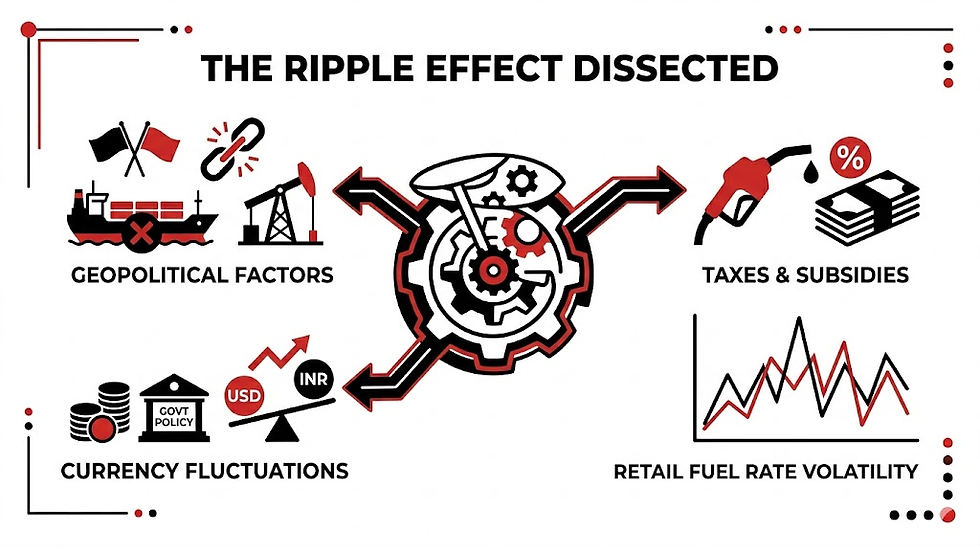
1. Geopolitical Crises and Maritime Chokepoints
Geopolitics remains one of the most volatile drivers of fuel pricing. The vulnerability of supply lines was vividly highlighted by the 2026 Strait of Hormuz crisis, during which escalated international conflicts caused ship transits through the strait to plummet from 120 down to just 4 daily transits over a one-month span (De, 2026).
The Strait of Hormuz handles roughly half of India's crude oil shipments (De, 2026). When shipping lanes encounter bottlenecks or closures, the immediate fallout includes:
Longer Transit Routes: Ships are forced to bypass chokepoints, drastically increasing the "ton-miles" traveled (De, 2026).
Surging Insurance and Freight: War-risk premiums and freight rates spike, adding hidden premiums to every barrel.
Global Benchmark Spikes: Supply panic can easily drive Brent crude toward $110–$112 per barrel (De, 2026).
2. The Currency Factor: USD vs. INR Exchange Rates
Crude oil is uniformly traded in United States Dollars ($USD$). Therefore, the financial health of the Indian Rupee ($INR$) acts as a secondary modifier. Even if global oil prices stay perfectly flat, a depreciation of the Rupee against the Dollar makes importing oil more expensive.
For instance, during geopolitical strains, capital flight to safe-haven assets frequently weakens the Rupee. This currency depreciation inflates India's import bill and expands the Current Account Deficit (CAD), forcing domestic oil companies to spend more Rupees to acquire the same volume of fuel (De, 2026).
3. Domestic Refining and Logistics Costs
Once crude oil safely reaches Indian ports, it is transferred to state-owned or private refineries (such as those run by IOCL, BPCL, HPCL, or Reliance). Here, crude is processed into petrol, diesel, jet fuel, and petrochemicals. The OMCs calculate a Trade Parity Price (TPP), which is a mix of Import Parity Price and Export Parity Price, to determine the baseline value of the refined product before adding domestic marketing margins, internal freight, and dealer commissions.
4. The Massive Heavyweight: Central and State Tax Structures
If international oil prices drop to historic lows, why don't retail pump prices plummet to the same degree? The answer lies in India's unique tax landscape. Fuel in India does not fall under the Goods and Services Tax (GST) regime. Instead, it is subjected to two distinct layers of taxation:
Central Excise Duty: A fixed tax per liter levied by the Central Government.
Value Added Tax (VAT) or Sales Tax: A percentage-based or flat tax levied by individual state governments.
Taxes often account for 35% to 50% of the final retail price paid by consumers. When global crude prices decline, the government frequently increases excise duties to shore up revenue for infrastructure and welfare programs. Conversely, when global prices skyrocket, the government may choose to slice excise duties to protect citizens from runaway inflation.
Macroeconomic Fallout: Beyond the Petrol Pump
The consequences of fluctuating crude prices extend far beyond your personal vehicle's fuel tank. Because petroleum products power logistics, agriculture, and manufacturing, changes in crude prices send shockwaves across the entire Indian financial landscape.
Wholesale and Retail Inflation
Diesel is the lifeblood of India's commercial transport network. When diesel prices climb, freight operators face higher overhead costs. To preserve their margins, they raise transport fees for agricultural produce, manufactured goods, and consumer deliverables. This creates cost-push inflation, driving up the Consumer Price Index (CPI) and reducing the purchasing power of households.
Fiscal Deficit and Economic Growth Constraints
Sustained oil spikes above $100 per barrel place considerable strain on state budgets. According to policy research, shielding consumers from sharp global price spikes through excise tax relief and capped pricing creates an incremental fiscal cost of about 0.6% of GDP annually for petrol and diesel alone (Gupta, 2026).
When billions of dollars are diverted to absorb energy shocks, it limits the capital available for public infrastructure, education, and healthcare development. Furthermore, prolonged energy crises can slow down real GDP growth while putting pressure on domestic interest rates (Nitsure, 2026).
The Strategic Path Forward: Building Long-Term Insulation
Relying entirely on short-term tax adjustments to blunt the impact of global crude oil shifts is financially draining and unsustainable over long horizons (Gupta, 2026). To truly protect the economy, India has actively pursued structural energy diversification:
Expanding Strategic Petroleum Reserves (SPRs): Building underground rock caverns capable of storing millions of barrels of crude oil to provide an emergency safety cushion during sudden maritime embargoes or supply disruptions.
Accelerating the EV Transition: Massively scaling up public charging infrastructure and offering manufacturing incentives (like the FAME schemes) to transition urban mobility away from fossil-fuel dependence.
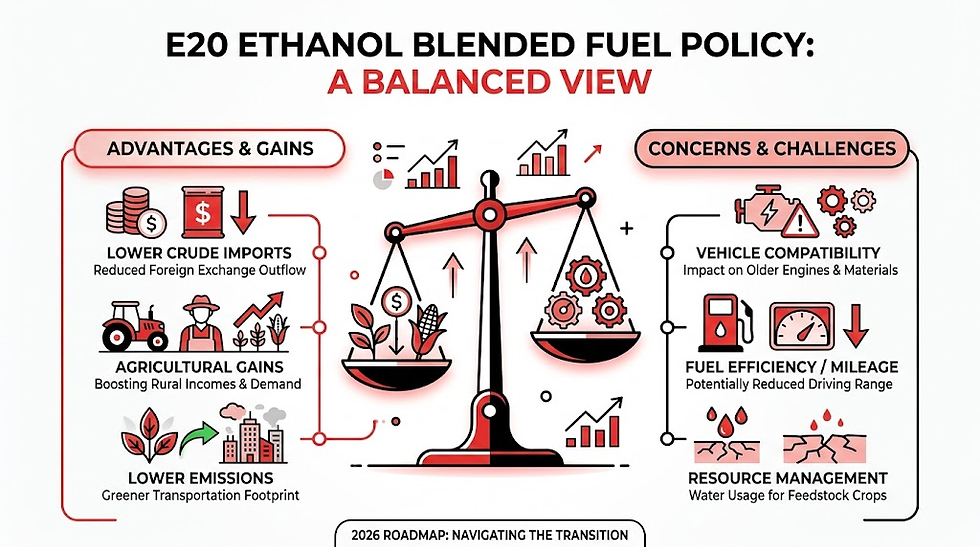
Biofuel Blending: Aggressively pursuing ethanol-blending targets in petrol to reduce the net volume of crude oil that must be purchased from foreign suppliers.
Green Hydrogen and Renewable Infrastructure: Investing heavily in solar, wind, and green hydrogen technology to gradually transition industrial energy demand cleanly off the global carbon grid.
Frequently Asked Questions (FAQs)
Q1: How do global crude oil prices affect Indian fuel rates directly?
A: Since India imports more than 85% of its crude oil, the baseline cost of production for domestic oil marketing companies is tied directly to global prices (Reddy, 2026). When international benchmarks rise due to supply constraints or geopolitical tensions, the cost of the Indian Basket of crude increases. This higher cost is then passed down to consumers at retail pumps, unless offset by government tax cuts (Gupta, 2026).
Q2: Why don't Indian fuel prices drop immediately when global oil prices crash?
A: When global crude prices slide, central and state governments often look to stabilize their fiscal revenues by increasing fixed Excise Duties or local VAT. This mechanism allows the government to build financial buffers and fund public welfare programs, though it means retail pump prices may stay steady even during global market downturns.
Q3: What role does the US Dollar play in determining Indian fuel costs?
A: International crude oil is priced and settled in US Dollars. Because of this, the USD-INR exchange rate acts as a direct multiplier. If the Indian Rupee weakens against the Dollar, it requires more Rupees to purchase each barrel of oil, raising import costs and pushing local pump prices higher even if global crude oil rates remain unchanged (De, 2026).
Q4: Why is fuel not included under the uniform GST system in India?
A: Taxes on petroleum products represent a critical, highly dependable source of direct revenue for both the Central and State governments. Keeping fuel outside the GST framework allows authorities to quickly adjust excise duties and VAT rates in response to shifting economic conditions, budget priorities, and global market shocks.
Stay Ahead of the Market and Optimise Your Energy Management
Fluctuations in global energy markets can hit your household budget or business operational costs unexpectedly. Proactive planning is key to successfully navigating these shifting price trends.
Are you looking to optimize your logistics operations, upgrade to energy-efficient commercial fleets, or explore alternative fuel options for your business? Connect with industry experts today to secure your operations against unpredictable fuel hikes.
Get Personalized Fleet Optimization Advice: Visit the Bureau of Energy Efficiency (BEE) India to discover government-backed strategies for commercial energy management.
Monitor Real-Time Energy Market Data: Keep tabs on daily domestic oil price trends and regulatory updates directly via the Ministry of Petroleum and Natural Gas (MoPNG).


Comments