The Ultimate GST Compliance Checklist for Small Businesses in 2026
- Jul 1
- 6 min read
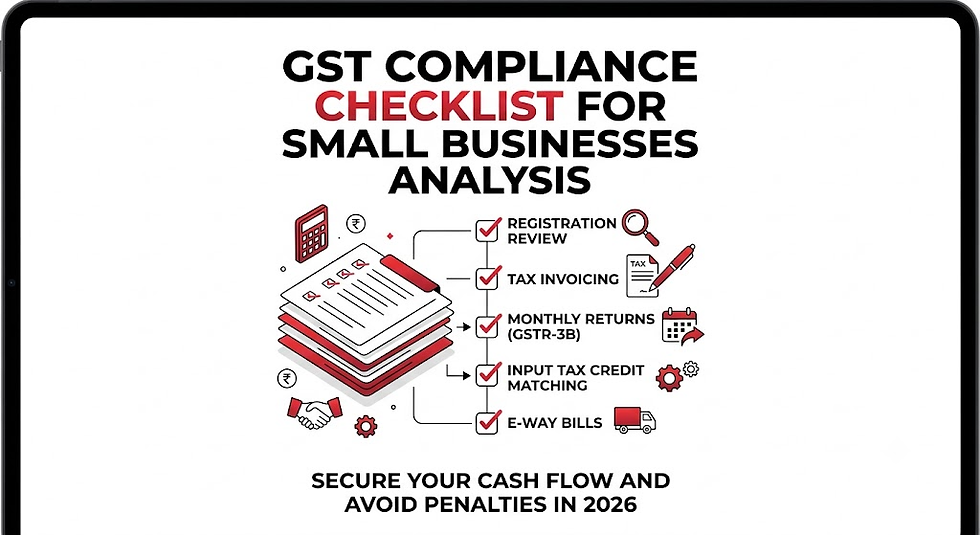
Navigating the landscape of indirect taxation can feel like a moving target for micro, small, and medium enterprises (MSMEs). As digital automation, real-time tracking, and data reconciliation become tighter within the Goods and Services Tax Network (GSTN), staying compliant is no longer just a legal obligation—it is a core component of cash flow preservation.
With stricter e-invoicing laws and multi-layered automation completely active this year, manual accounting errors are becoming an open invitation for automated tax notices. To protect your enterprise from operational blocks, late fees, and lost tax benefits, we have broken down the ultimate GST Compliance Checklist for Small Businesses to keep your accounting bulletproof.
What is the Focus Keyword for Small Business GST Compliance?
To structure your accounting, optimization, and internal workflows effectively, your primary focus keyword for managing tax tasks efficiently is "GST compliance for small businesses".
Maintaining an updated tracking routine based on this keyword ensures you target the exact operational vulnerabilities that the tax department scans for during routine assessments.
1. Monitor Thresholds and Maintain Correct Registration Details
Your compliance obligations begin with knowing exactly where your annual business volume stands. Under the updated frameworks, registration liabilities primarily depend on your aggregate annual turnover (AATO), calculated on an all-India basis under a single PAN.
Current GST Registration Thresholds
The entry barrier for entering the tax network is determined by the nature of your transactions and your primary geographic operations:
Suppliers Exclusively in Goods:
Normal Category States: ₹40 Lakhs
Special Category States (e.g., Manipur, Mizoram, Nagaland, Tripura): ₹20 Lakhs
Service Providers & Mixed Supplies:
Normal Category States: ₹20 Lakhs
Special Category States: ₹10 Lakhs
Crucial Warning for Aggregate Turnover: Aggregate turnover is not just your taxable sales. It strictly includes your domestic taxable sales, zero-rated export revenues, and exempt supplies altogether. Ignoring export values or exempt categories when calculating your threshold can lead to severe penalties for delayed or missed registrations.
Mandatory Registration Triggers
Regardless of your annual turnover, registration remains legally required from your very first rupee of sales if you engage in:
Inter-state taxable supplies of goods.
E-commerce selling (e.g., selling via Amazon, Flipkart, or your own digital platform).
Operations as a casual taxable person or non-resident taxable individual.
If your core profile changes—such as updating your primary business address, adding a warehouse, linking new bank accounts, or changing corporate directors—ensure these amendments are updated instantly on the GST portal to prevent mismatched documentation.
2. Implement the Mandatory E-Invoicing and HSN Frameworks
Digital invoicing is no longer reserved for large corporations. The expansion of the Invoice Registration Portal (IRP) has firmly brought small businesses into the real-time digital reporting net.
The ₹5 Crore E-Invoicing Mandate
If your aggregate annual turnover has crossed ₹5 Crores in any single financial year from 2017–18 onwards, e-invoicing is completely mandatory for all Business-to-Business (B2B) transactions and export invoices.
Once your business crosses this benchmark, it remains permanently flagged for e-invoicing, even if your turnover drops below ₹5 Crores in subsequent financial terms. Eligible transactions must be uploaded directly to the IRP to generate a unique Invoice Reference Number (IRN) and a digitally signed QR code before goods move or invoices are shared with clients.
Standard Tax Invoicing Requirements
For businesses operating below the e-invoicing threshold, issuing structurally sound manual or digital tax invoices remains vital. Every legal tax invoice must prominently display:
Your legal business name and unique 15-digit GSTIN.
A consecutive, unique serial number series distinct for the current financial year.
The exact HSN (Harmonized System of Nomenclature) code for goods or the SAC (Services Accounting Code) for services (6-digit HSN reporting is required for businesses exceeding ₹5 Crores turnover).
Clear breakdowns of CGST, SGST, or IGST rates based on the correct place of supply.
3. Mastering the Monthly and Quarterly Return Filing Schedules
Filing deadlines are rigid, and missing them causes an automated accumulation of late fees and interest liabilities that hit your bottom line.
Return Type | Who Needs to File? | Core Focus | Due Date Structure |
GSTR-1 | Monthly Filers | Outward Supplies (Sales) | By the 11th of the following month |
GSTR-3B | Monthly Filers | Summary Return & Net Tax Payment | By the 20th of the following month |
QRMP GSTR-1 | Quarterly Filers (Turnover under ₹5 Cr) | Outward Supplies | By the 13th of the month following the quarter |
QRMP GSTR-3B | Quarterly Filers (Turnover under ₹5 Cr) | Final Tax Summary & Payment | By the 22nd or 24th of the following month (State-wise) |
GSTR-9 & 9C | Eligible Regular Taxpayers | Annual Consolidated Returns | By December 31st following the end of the financial year |
The QRMP Alternative for Micro-Enterprises
Small enterprises with an annual turnover up to ₹5 Crores can opt into the Quarterly Return Filing and Monthly Payment (QRMP) Scheme. This allows you to file your structural GSTR-1 and GSTR-3B returns quarterly while utilizing the Invoice Furnishing Facility (IFF) to pass on Input Tax Credit (ITC) to your B2B buyers on a monthly basis. Tax payments under QRMP are still deposited monthly using simple payment challans.
4. Operational Guardrails for GST Compliance for Small Businesses
Achieving flawless GST compliance for small businesses requires focusing heavily on two critical areas: matching Input Tax Credit and managing hidden liabilities.
Tight Input Tax Credit (ITC) Control
The GST network operates on an automated matching mechanism. You cannot legally claim ITC based solely on the purchase invoices stored in your physical drawers.
GSTR-2B Reconciliation: Your purchase register must be matched directly against your auto-populated GSTR-2B statement every single month before you file GSTR-3B. If your vendor forgets or delays uploading their sales data, the transaction will not appear in your GSTR-2B, and you cannot claim that credit.
The 180-Day Rule: If you fail to pay a supplier within 180 days from the invoice issuance date, you must reverse any ITC claimed on that transaction along with an interest liability of 180 days calculated at 18% per annum. The credit can only be reclaimed once the vendor payment is fully settled.
Identify Blocked Expenses: Avoid claiming ITC on blocked expenses under Section 17(5) of the CGST Act. This includes GST paid on corporate food and beverages, employee health club memberships, personal travel, and business gifts.
Reverse Charge Mechanism (RCM) Vigilance
Many small businesses miss their RCM liabilities entirely. If you procure specific goods or services from unregistered vendors, specialized Goods Transport Agencies (GTAs), or direct legal professionals, the tax liability flips. You—the buyer—must calculate the tax, pay it out-of-pocket via your electronic cash ledger, and then claim it back as ITC if eligible.
5. Clean Accounting Practices to Avoid Common Audit Risks
Tax authorities use advanced data analytics to spot structural discrepancies instantly. To keep your company clear of automated scrutiny, ensure your accounting workflows follow these three core practices:
Keep Corporate and Personal Expenses Separate: Mixing personal fuel expenses, asset purchases, or dining bills with your business accounts skews your input balances and triggers audit flags during assessments.
Reconcile E-Way Bills with Sales Books: Ensure that every e-way bill generated for moving goods matches the corresponding value, quantity, and date on the invoice recorded in your sales register.
Know Your P&L Allocations: Any GST expense that cannot be recovered as ITC—such as late fees, penalties, or blocked credits—should not sit inside asset accounts. It must be written off directly as business expenses in your profit and loss statement.
Frequently Asked Questions
Q1. Why is regular data reconciliation so vital for GST compliance for small businesses?
Regular data reconciliation prevents expensive tax mismatches. Under the automated GST matching system, the department cross-checks your sales records in GSTR-1 against your tax summaries in GSTR-3B, while verifying your purchase ledger against your vendor's filings in GSTR-2B. Monthly reconciliation ensures you find discrepancies early, catch missing vendor invoices, reverse ineligible credits, and resolve errors before they result in automated tax demand notices.
Q2. What are the immediate penalties for missing a GST return deadline?
Filing your GSTR-1 or GSTR-3B past the official due date results in a statutory daily late fee ranging from ₹20 to ₹50 per day, depending on whether it is a nil return or a taxable return. Additionally, any delayed tax payments draw a mandatory interest liability of 18% per annum on the net tax liability, which escalates to 24% for wrong or excessive ITC claims.
Q3. Can a small business opt out of regular monthly filings completely?
Yes. Small business owners with an aggregate annual turnover below ₹1.5 Crores can opt out of regular monthly filings by choosing the GST Composition Scheme. This simplified alternative allows traders and manufacturers to pay a fixed, lower tax rate (usually 1% to 2% of total turnover) and file a simplified quarterly statement (CMP-08) alongside one annual return (GSTR-4). However, composition dealers cannot issue standard tax invoices, collect GST from customers, or claim any Input Tax Credit.
Streamline Your Business Taxes Today
Do not let tax compliance slow down your daily operations. Establishing clear, weekly tracking routines, setting up automated return alerts, and utilizing modern ERP accounting platforms can turn your annual compliance into an efficient, predictable routine.
If your corporate volume is scaling up or you need strategic advice to handle complex reconciliation issues, look to verified national filing platforms and official government utilities to keep your operations accurate:
Official E-Invoicing Access: Set up your digital invoicing integrations securely through the Government Invoice Registration Portal.
Corporate Tax Filings: Track your returns, check your GSTR-2B updates, and manage your electronic cash balances at the Official GST Common Portal.
Startup Compliance Support: For end-to-end guidance tailored specifically to scale-ups and MSMEs, check out the resources available on Startup India Legal Services.


Comments