Tukaram Mundhe IAS Analysis: Modern Governance, Administrative Ethics, and Public Accountability
- 2 hours ago
- 5 min read
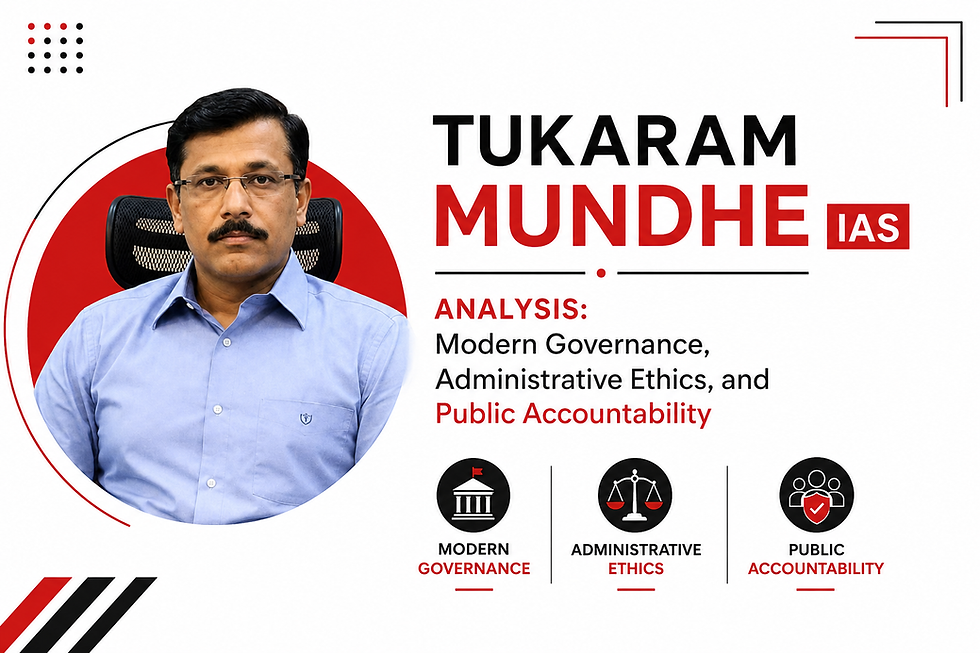
In the complex landscape of Indian public administration, few bureaucrats command the public imagination quite like Tukaram Mundhe. Known throughout Maharashtra as an unflinching, rule-bound administrative reformer, the 2005-batch Indian Administrative Service (IAS) officer has spent over two decades demonstrating what transparent governance looks like under intense pressure. Across 25 transfers in 21 years of service, his administrative career offers an invaluable case study in public policy execution, institutional reform, and bureaucratic integrity.
In 2026, as the Commissioner of Maharashtra’s Food and Drug Administration (FDA), Mundhe continues to drive statewide regulatory reforms, tackling food adulteration, misbranded cosmetics, and supply chain corruption. This in-depth analytical breakdown explores his administrative methodology, leadership style, key policy initiatives, and the broader institutional lessons his career holds for modern civil service.
Administrative Profile & Core Milestones
To understand the governance philosophy of Tukaram Mundhe, one must analyze the key phases of his career across various municipal, state, and regulatory postings.
                THE DEFENSIBLE REFORM WORKFLOW

  ┌─────────────────┐    ┌─────────────────┐    ┌─────────────────┐
  │  Phase 1:       │    │  Phase 2:       │    │  Phase 3:       │
  │  Strict Audit & │───►│  Digital & Rule │───►│  Public Reach & │
  │  Enforcement    │    │  Systematization│    │  Accountability │
  └─────────────────┘    └─────────────────┘    └─────────────────┘
Born in Tadsona village in Beed district, Maharashtra, Mundhe’s journey from a rural Zilla Parishad school to achieving All India Rank (AIR) 20 in the Civil Services Examination 2004 reflects a foundational commitment to public welfare.
Governance Parameter | Career Specification & Achievements |
IAS Batch & Cadre | 2005 Batch, Maharashtra Cadre |
UPSC Civil Services Rank | All India Rank 20 (CSE 2004) |
Current Posting (2026) | Commissioner, Food and Drug Administration (FDA), Maharashtra |
Key Past Administrative Roles | District Collector (Solapur), Municipal Commissioner (Navi Mumbai, Nashik, Nagpur), CMD (PMPML), Secretary (Divyang Kalyan) |
Major Regulatory Milestones | Statewide FDA Food & Drug Safety Crackdown (2026), Jalyukt Shivar Water Conservation (Solapur), ₹900 Cr Tax Audit (Navi Mumbai) |
5 Core Pillars of the Tukaram Mundhe Governance Model
Every administrative posting helmed by Mundhe demonstrates a consistent structural framework focused on removing system inefficiencies, enforcing compliance, and restoring citizen trust.
               THE 5 PILLARS OF ADMINISTRATIVE REFORM

     ┌─────────────────────────────────────────────────────────┐
     │ 1. Zero Tolerance for Non-Compliance & Adulteration     │
     ├─────────────────────────────────────────────────────────┤
     │ 2. Data-Driven Auditing & Revenue Recovery              │
     ├─────────────────────────────────────────────────────────┤
     │ 3. Direct Citizen Engagement & Feedback Mechanisms      │
     ├─────────────────────────────────────────────────────────┤
     │ 4. Digital Transparency & System Integration            │
     ├─────────────────────────────────────────────────────────┤
     │ 5. Institutional Independence & Equal Enforcement       │
     └─────────────────────────────────────────────────────────┘
1. Zero Tolerance for Non-Compliance & Adulteration
Whether regulating municipal encroachments or enforcing food safety standards, Mundhe's approach applies statutory laws without exception. In his role as Maharashtra FDA Chief, he has spearheaded over 1,100 targeted inspections, issuing immediate suspensions to non-compliant commercial establishments, government canteens, and high-profile eateries to safeguard public health.
2. Data-Driven Auditing & Revenue Recovery
Financial discipline forms the backbone of his municipal leadership. During his tenure as Navi Mumbai Municipal Commissioner (NMMC), he initiated a comprehensive property tax audit that uncovered over ₹900 Crore in uncollected revenues and illegal assessments, proving that public institutions can achieve fiscal sustainability through proper oversight.
3. Direct Citizen Engagement & Feedback Mechanisms
A hallmark initiative during his municipal terms was the launch of direct public interaction models, such as "Walk with Commissioner" in Navi Mumbai. By meeting citizens in public parks every week without intermediaries, he bypassed bureaucratic delays and established rapid grievance-redressal mechanisms.
4. Digital Transparency & System Integration
Mundhe systematically replaces manual, opaque workflows with digital platforms. During his tenure at the Divyang Kalyan Department, he prioritized digital service delivery for citizens with disabilities. Similarly, at the FDA, he integrated online license tracking and transparent grievance filing on official portals to eliminate middleman extortion.
5. Institutional Independence & Equal Enforcement
Mundhe’s enforcement policy operates under the principle that the law applies equally to all entities regardless of political influence, commercial size, or institutional prestige. From high-court canteens to multinational retail outlets, regulatory standards are applied uniformly.
Comparative Analysis: Traditional Bureaucracy vs. Reform-Oriented Administration
Understanding the operational contrast between traditional administrative practices and Mundhe's reform-oriented execution reveals why his postings frequently spark institutional structural shifts:
Administrative Feature | Traditional Bureaucratic Approach | Reform-Oriented Execution Model |
Enforcement Protocol | Selective, delayed, and process-heavy compliance | Rapid, rule-bound, and non-negotiable statutory enforcement |
Financial Oversight | Passive budget utilization and legacy tax collection | Aggressive revenue audits, loss reduction, and anti-leakage controls |
Public Accessibility | Multi-layered file routing behind closed office doors | Direct grievance forums, open site visits, and public accountability |
Response to Friction | Diplomatic compromise and delayed policy implementation | Strict adherence to legal mandates regardless of administrative transfers |
Technology Integration | Optional digitization used primarily for record-keeping | Core digital architecture for real-time tracking, licensing, and audits |
The 2026 Statewide Regulatory Crackdown: Maharashtra FDA Case Study
Mundhe’s assignment as Maharashtra’s Food and Drug Administration Commissioner highlights how his administrative methods scale up to state-level regulation.
                 2026 FDA ENFORCEMENT METRICS & ACTIONS

   ┌─────────────────────────────────────────────────────────────────┐
   │ Inspections Conducted: 1,131+ Statewide Raids                   │
   │ Restaurant Licences Suspended: 56 Major Establishments          │
   │ Seizures & Stock Impoundment: ~₹50 Crore Unsafe Food & Drugs    │
   │ Special Drives: Counterfeit Cosmetics & Illegal Milk Rackets    │
   └─────────────────────────────────────────────────────────────────┘
Statewide Food Safety Raids: The FDA launched systematic inspections of restaurants, cloud kitchens, and warehouses across Mumbai, Pune, Thane, and tier-2 cities, enforcing strict hygienic and labelling compliance.
Combating Counterfeit Cosmetics: Beyond food safety, the FDA tackled counterfeit cosmetics markets. Following surveys indicating that 40% of consumers encountered fake beauty products causing adverse health reactions, high-value seizures were executed across major commercial hubs like Crawford Market.
Dismantling Adulteration Networks: High-risk supply chains—including synthetic milk processing units and illegal gutkha distribution lines—were systematically dismantled through surprise raids and criminal FIR filings.
The Public Integrity Rule: Effective administration requires that public safety, statutory rules, and regulatory oversight take precedent over administrative convenience or vested commercial interests.
Frequently Asked Questions
What is the primary governance model demonstrated in a Tukaram Mundhe analysis?
A Tukaram Mundhe analysis highlights a governance model built on non-negotiable legal compliance, transparent public audits, zero tolerance for corruption, and direct citizen accountability across civil service postings.
What is the current posting of IAS officer Tukaram Mundhe in 2026?
As of 2026, IAS officer Tukaram Mundhe serves as the Commissioner of the Food and Drug Administration (FDA), Maharashtra, leading major statewide enforcement drives against food adulteration and illegal drug distribution.
How does strict rule enforcement impact local administrative revenue and service delivery?
Strict rule enforcement eliminates revenue leakages, identifies uncollected property taxes, and establishes standardized digital workflows, directly improving municipal services and public trust.
Why are frequent administrative transfers common for reform-oriented bureaucrats?
Reform-oriented officers frequently challenge entrenched interest groups, audit non-compliant establishments, and refuse political compromises, which often results in frequent transfers across departments.
Administrative Resources & Official Portals
Stay informed about Maharashtra's administrative reforms, public safety notices, and official government portals:
Maharashtra Food and Drug Administration: Access official safety circulars and online licensing services on the official Maharashtra FDA Portal.
Government of Maharashtra Official Services: Explore state administrative initiatives, grievance portals, and public schemes via Aaple Sarkar Maharashtra.
Union Public Service Commission: Review civil services examination frameworks and administrative guidelines on the official UPSC Portal.



Comments