West Bengal Elections 2026 - High Voter Turnout in Phase 1: Will It Impact Phase 2 Results?
- Apr 24
- 4 min read
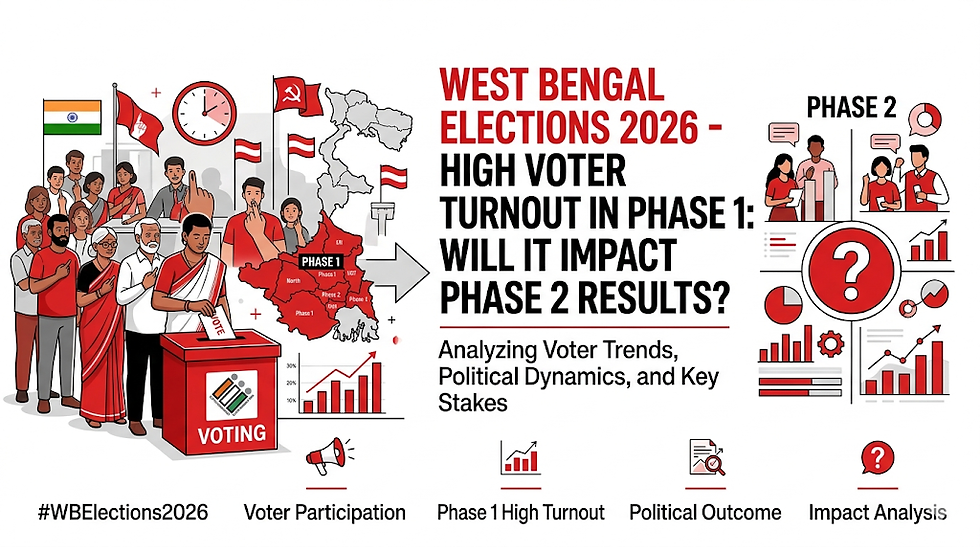
The 2026 West Bengal Legislative Assembly elections have already made headlines with a record-breaking voter turnout in Phase 1 (April 23, 2026). With polling percentages crossing 90% and in some estimates even above 92% this phase has witnessed one of the highest levels of electoral participation in the state’s history.
Such massive turnout is not just a statistic it is a powerful indicator of voter sentiment, political engagement, and possible shifts in electoral dynamics. As the state prepares for Phase 2 on April 29, 2026, a key question dominates political discussions:
Will this unusually high turnout influence the results of Phase 2 and ultimately the final outcome?
This blog explores the data, trends, political interpretations, and ground realities to understand how Phase 1 turnout could shape what comes next.
Phase 1 Voter Turnout – Key Highlights
Category | Details |
Polling Date | April 23, 2026 |
Seats Covered | 152 constituencies |
Total Voter Turnout | 91% – 92.8% (approx.) |
Highest Ever? | Yes, among highest in state history |
Comparison (2011) | ~85.5% turnout |
Comparison (2024 Lok Sabha) | ~79–80% turnout |
Voter Participation Trend | Significantly increased |
Nature of Voting | High participation across rural & semi-urban areas |
Phase 1 recorded turnout figures ranging from 91.5% to over 92.8%, making it the highest-ever participation since independence, according to election authorities.
West Bengal Elections 2026 : Understanding the High Turnout: What Does It Mean?
High voter turnout in elections can signal multiple underlying factors. In West Bengal’s case, analysts point to a mix of political, social, and situational reasons.
1. Strong Political Mobilization
Both major parties the Trinamool Congress (TMC) and Bharatiya Janata Party
(BJP) ran aggressive campaigns, ensuring maximum voter outreach.
Door-to-door campaigns
Booth-level mobilization
High-profile rallies
This directly contributed to large-scale participation.
2. High-Stakes Election Battle
West Bengal remains one of the most politically contested states in India.
Direct TMC vs BJP contest
Close margins expected in many seats
Strong ideological divide
This naturally increases voter enthusiasm and turnout.
3. Anti-Incumbency vs Pro-Incumbency Sentiment
High turnout is often interpreted in two ways:
Anti-incumbency wave: Voters coming out to demand change
Pro-incumbency consolidation: Supporters mobilizing to retain power
Interestingly, leaders from both sides have claimed the turnout supports their narrative.
4. Increased Voter Awareness
Compared to previous elections, voter awareness has improved due to:
Social media influence
Youth participation
Election Commission campaigns
5. Security Measures & Confidence
Heavy deployment of central forces and strict monitoring increased voter confidence, encouraging participation even in sensitive areas.
Phase 1 Ground Reality: Not Just Numbers
While turnout was high, Phase 1 was not entirely without issues:
Reports of sporadic violence and clashes in some constituencies
EVM glitches at select polling booths
Political allegations of voter intimidation
At the same time, record turnout reflected strong democratic participation
Despite challenges, the scale of voting suggests voters were determined to participate actively in the democratic process.
Will High Turnout Impact Phase 2?
Now comes the key question how does Phase 1 influence Phase 2 (April 29)?
1. Momentum Effect
High turnout often creates psychological momentum:
Parties gaining confidence after Phase 1
Increased voter enthusiasm in remaining constituencies
Media narratives influencing undecided voters
If one party is perceived to benefit from Phase 1 turnout, it may gain an edge in Phase 2.
2. Voter Behavior Spillover
Voting patterns in Phase 1 can influence Phase 2 in terms of:
Community voting trends
Regional political alignment
Tactical voting decisions
For example:
If rural voters show strong participation, similar turnout may repeat in Phase 2 regions.
3. Strategic Campaign Adjustments
After Phase 1, parties often recalibrate strategies:
Candidate focus shifts
Messaging changes
Targeting swing voters
High turnout data gives parties insight into:
Which areas performed well
Where voter mobilization needs improvement
4. Impact on Swing Constituencies
Phase 2 includes several urban and mixed constituencies, where voter turnout patterns differ.
Urban areas traditionally see lower turnout
If Phase 1 enthusiasm carries forward, Phase 2 turnout may rise
This could alter expected results in closely contested seats.
5. Narrative War
Political narratives play a crucial role:
BJP leaders claim high turnout reflects “desire for change”
TMC claims it reflects “support for governance”
Such narratives can influence undecided voters in Phase 2.
Historical Perspective: Does High Turnout Change Outcomes?
Looking at past elections:
High turnout does not always guarantee regime change
It often indicates greater voter engagement rather than a clear political shift
However:
In closely contested elections, even small swings can change results
High turnout increases unpredictability
Phase 2 Expectations Based on Phase 1 Trends
Based on current trends, Phase 2 could see:
1. Strong Voter Participation
Even if slightly lower than Phase 1, turnout is expected to remain high.
2. Increased Security
Given Phase 1 incidents, stricter monitoring is expected.
3. More Intense Campaigning
Parties are likely to:
Increase rallies
Target undecided voters
Focus on key constituencies
4. Closer Contests
Phase 2 includes:
Urban belts
Politically sensitive districts
High-profile candidates
This makes outcomes more competitive.
Key Factors That Will Decide Phase 2 Results
1. Turnout Consistency
Will Phase 2 match Phase 1 turnout levels?
2. Urban Voting Patterns
Urban turnout could significantly influence results.
3. Swing Voters
Undecided voters may play a decisive role.
4. Campaign Effectiveness
Post-Phase 1 adjustments could impact results.
Frequently Asked Questions ( FAQs )
1. What was the voter turnout in Phase 1 of West Bengal Elections 2026?
Phase 1 recorded over 91–92% turnout, one of the highest ever.
2. Why was the turnout so high?
Reasons include:
Strong political competition
High voter awareness
Aggressive campaigning
Improved security measures
3. Does high turnout favor any particular party?
Not necessarily. Both ruling and opposition parties interpret high turnout differently.
4. Will Phase 2 turnout be similar?
It may be slightly lower due to urban areas but is expected to remain strong.
5. Can Phase 1 turnout predict final results?
No direct prediction, but it provides insights into voter sentiment and engagement.
Final Takeaway
The record-breaking voter turnout in Phase 1 of the West Bengal Elections 2026 is a strong indicator of high political engagement, competitive intensity, and voter awareness.
However, high turnout alone does not determine winners. Its real impact lies in how:
Political parties interpret the data
Campaign strategies evolve for Phase 2
Voters in remaining constituencies respond
As Phase 2 approaches on April 29, the election remains wide open and highly unpredictable.
If Phase 1 was about participation, Phase 2 will be about conversion—turning voter enthusiasm into electoral victory.


Comments