CBSE Verification vs Revaluation vs Photocopy — What’s the Difference?
- May 19
- 7 min read
The declaration of the Central Board of Secondary Education (CBSE) Class 10 and Class 12 results brings a wave of intense emotions. For many students, the final percentages align perfectly with their expectations. However, each year, a substantial number of students find themselves staring at a scorecard that does not mirror the effort they put in or the answers they wrote.
If you are a student or a parent convinced that an error occurred during the assessment process, CBSE provides a structured, legally sound safety net. The board allows students to challenge their scores through three sequential post-result processes: Verification of Marks, Obtaining a Photocopy of the Evaluated Answer Book, and Revaluation of Answers.
Many students rush into this territory without understanding the foundational rules. They treat these options as interchangeable, but they are strictly progressive steps. You cannot jump directly to a revaluation without going through verification first. This comprehensive guide breaks down the precise differences between CBSE Verification vs Revaluation vs Photocopy, outlining the rules, fees, timelines, and strategic approaches for the 2026 academic cycle.
The Golden Rule: The Mandatory Three-Tier Sequence
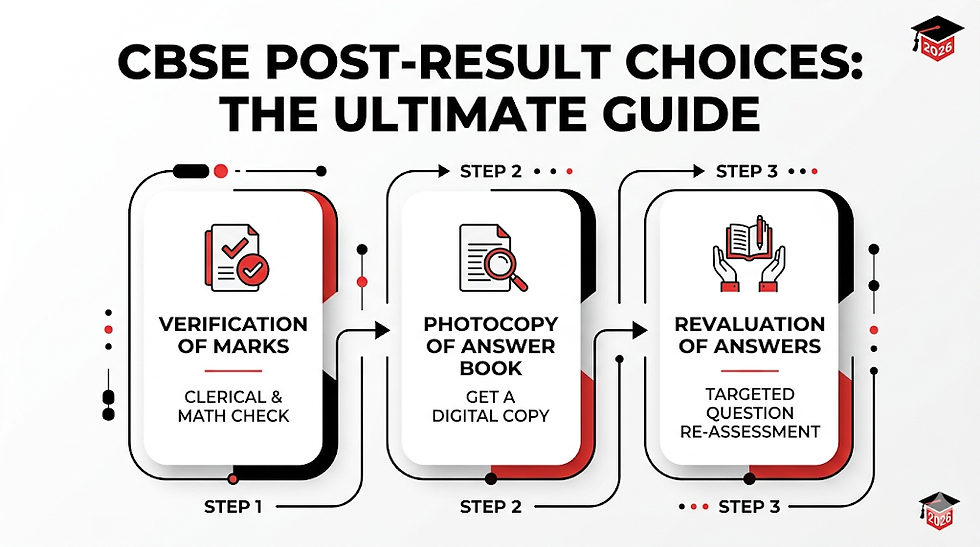
Before analyzing each step individually, it is vital to understand the structural workflow mandated by the CBSE. The board does not allow candidates to pick and choose a process at random. The entire mechanism functions as a strict, linear pipeline:
Step 1: Verification of Marks (Mandatory first step)
Step 2: Obtaining a Photocopy (Only available to those who applied for Step 1)
Step 3: Revaluation (Only available to those who applied for Step 1 and Step 2)
If you miss the deadline for Step 1, you automatically forfeit your right to proceed to Steps 2 and 3. Every stage operates on tight, non-negotiable windows—often lasting only 2 to 5 days immediately following the declaration of results.
1. Verification of Marks: The First Line of Defense
The first stage of the post-result process is the Verification of Marks. This is essentially a clerical and mathematical check of your answer booklet.
What Happens During Verification?
When you apply for verification, a CBSE evaluator pulls your original answer script and checks for the following administrative errors:
Totalling Errors: They verify whether the marks awarded for each individual answer add up correctly to the final score printed on your report card.
Unevaluated Answers: They ensure that the examiner did not accidentally skip grading an entire answer or sub-question.
Data Entry Slips: They check if the marks written on the inside pages of the answer book were accurately transferred to the cover page and subsequently uploaded to the CBSE database.
Crucial Note: During verification, the evaluator will not re-read your answers or judge the quality of your writing. If an examiner gave you 2 out of 5 marks for an answer, the verification process will not challenge that judgment. It only ensures that those 2 marks were added to your total.
Key Details for 2026:
Timeline: Typically opens within 4–6 days after the declaration of Class 10 and 12 results. The application window is open for roughly 5 days.
Application Mode: Online only, via the official CBSE Portal.
Expected Fee: ₹500 per subject.
Outcome: The board releases a status letter online. If a mistake is found, your marks are updated (which can go up or down), and you must surrender your old marksheet to receive a revised one.
2. Obtaining a Photocopy of the Evaluated Answer Book: Visual Transparency
If your verification status comes back as "No Change," or if your marks were updated but you still believe you deserve more, the next logical step is to see exactly how your paper was checked. This is where Obtaining a Photocopy comes into play.
What Happens When You Get a Photocopy?
CBSE uploads a scanned, digital copy of your evaluated answer booklet in PDF format to your candidate login portal.
When you download this document, you will see:
Your actual handwritten answers.
The marks scribbled by the examiner next to each question.
White-out or masking over the identity elements (like your roll number) to maintain examiner confidentiality.
The official CBSE marking scheme used by the evaluator to grade your paper.
Reviewing this document allows you to act like an auditor. You can sit down with your school subject teachers, compare your answers directly against the official CBSE marking scheme, and pinpoint exactly where the examiner was overly harsh or completely missed a point.
Key Details for 2026:
Eligibility: Only students who applied for the Verification of Marks for that specific subject can apply.
Timeline: The window opens a few days after the verification results are announced, remaining open for just 2-3 days.
Expected Fee: ₹700 per answer book for Class 12; ₹500 per answer book for Class 10.
Outcome: You receive the PDF copy. No marks are changed at this stage; it is purely an information-gathering step to prepare you for the final phase.
3. Revaluation: The Ultimate Challenge to the Evaluator's Judgment
Once you have your photocopy in hand and your school teachers have validated that you have genuine grounds for a challenge, you enter the final and most critical phase: Revaluation.
What Happens During Revaluation?
Unlike verification, revaluation is a structural re-assessment of specific answers. However, you cannot ask CBSE to "re-check the whole paper." Instead, you must specify the exact question numbers you wish to challenge based on the photocopy you received.
You must upload a formal justification for each challenged question, citing how your answer aligns with the official CBSE marking scheme.
A specialized subject-matter expert or a revaluation committee will independently read your specific answers and evaluate them fresh.
If they find that the original examiner departed drastically from the marking scheme, they will revise your score.
Key Details for 2026:
Eligibility: Only students who applied for and received the photocopy of their answer booklet can apply for revaluation.
Limitations: You can only challenge a maximum of 10 targeted questions per subject.
Timeline: This window is incredibly brief, usually opening for a 48-to-72-hour period after photocopy links are distributed.
Expected Fee: ₹100 per challenged question.
Outcome: The decision of the revaluation committee is final. No further appeals are entertained by the board.
Comprehensive Comparison: CBSE Verification vs Revaluation vs Photocopy
To help you visually process these differences at a glance, here is a detailed breakdown of how the three options compare across essential parameters:
Feature/Parameter | Verification of Marks | Obtaining a Photocopy | Revaluation |
Primary Purpose | To check for totaling errors, omitted questions, and data entry slips. | To get a digital PDF copy of the evaluated script for personal review. | To challenge the grading quality of specific, individual answers. |
Prerequisite | None (Any student who appeared for the board exams can apply). | Must have applied for the Verification of Marks stage first. | Must have applied for both the Verification and Photocopy stages. |
What is Reviewed? | Only the calculations, margins, and cover sheets. | No review occurs; a copy is simply scanned and sent to you. | Only the specific question numbers you explicitly challenge. |
Fee Structure (Approx.) | ₹500 per subject. | Class 12: ₹700 per book Class 10: ₹500 per book. | ₹100 per individual question challenged. |
Scope of Challenge | Entire subject paper (clerical check only). | Entire subject paper (visual copy only). | Maximum of 10 individual questions per subject. |
Risk of Score Decrease | Yes (Marks can decrease if a calculation error inflated your initial score). | No (This stage is purely informational). | Yes (The revaluation expert's assessment could result in a lower score). |
The Risk Factor: Can Your Marks Actually Decrease?
One of the most vital realities students must accept before hitting the "Submit" button on the CBSE portal is the double-edged nature of this system.
Important Warning: When you apply for Verification or Revaluation, you sign an acknowledgment accepting that the final outcome could result in an increase, no change, or a decrease in your marks.
If a clerical error is discovered during verification where an examiner accidentally added 5 extra marks to your total, the board will correct that math, causing your final percentage to drop. Similarly, during revaluation, a strict expert might find your answer less convincing than the original examiner did.
If your marks decrease by even one point, your original scorecard is nullified. You are legally required to mail or hand over your physical passing certificate to your CBSE regional office to receive an updated, lower-scoring certificate. Therefore, you should only pursue these steps if you or an experienced educator are completely certain an error was made.
Frequently Asked Questions (FAQs)
Q1: Can I skip the verification phase and apply directly for a photocopy or revaluation?
No. CBSE strictly enforces a linear, three-step hierarchy. To get a photocopy, you must have applied for verification. To apply for revaluation, you must have successfully completed both the verification and photocopy phases. There are absolutely no exceptions to this rule.
Q2: Is the fee refundable if my marks increase after the CBSE verification or revaluation process?
No. The fees charged by CBSE for verification, photocopies, and revaluation are processing fees to cover administrative costs and evaluator compensations. They are completely non-refundable, regardless of whether your marks change drastically or stay exactly the same.
Q3: How long does it take for CBSE to declare the updated results?
The results for the verification phase are updated progressively online within a few days to two weeks from the closing of the application window. Revaluation outcomes take a bit longer because subject matter experts must manually evaluate targeted questions. All updated marks are generally finalized well before the commencement of university admissions and compartment exams.
Q4: If my marks change, will I get a new physical marksheet?
Yes. If your marks change (either increase or decrease), your old marksheet becomes invalid in the CBSE database. You will receive an official notification directing you to return your original physical marksheet to your school or the designated CBSE Regional Office. Once received, the board will issue a brand-new physical marksheet reflecting your updated scores.
Next Steps: Moving Forward Productively
Navigating post-result anxiety is tough, but acting impulsively will only waste time and money. If your scorecard doesn't look right, don't panic. Keep a close eye on the official board announcements immediately following the results declaration. Talk openly with your school teachers, look objectively at your preparation, and use this three-tier system methodically to get the clarity and fairness you deserve.
To stay updated on official schedules, track your results, or access the application forms directly, visit the official CBSE Results Portal.
For official regulatory notifications, circulars, and the main dashboard, check out the primary Central Board of Secondary Education Website.


Comments